


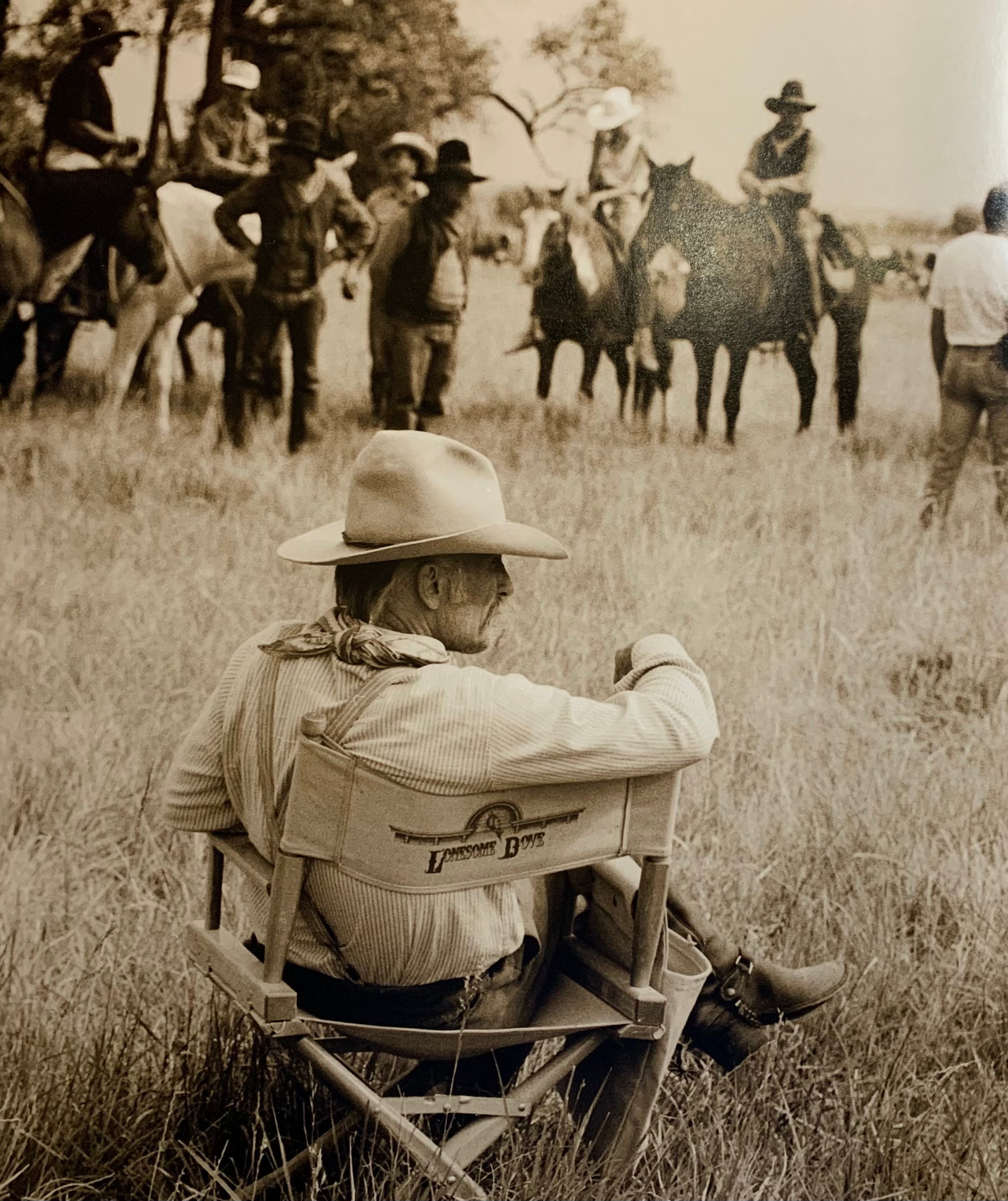
Playing Augustus McCrae was kind of like my Hamlet. It may be my favorite role.
Robert Duvall
Robert Duvall, actor and honorary Texas Ranger, is dead. He passed away on Sunday, February 15, 2026, at the age of ninety-five. His film career spanned sixty years, beginning with his film debut as Arthur “Boo” Radley in To Kill a Mockingbird (1962). He made a brief but memorable appearance as “Lucky” Ned Pepper in True Grit, starring John Wayne (1969). Many forget he was Frank Burns in the movie M*A*S*H (1970). But none can forget his performance as Tom Hagen in The Godfather (1972) and The Godfather II (1974), or his portrayal of the surfing obsessed Lt. Col. Kilgore who loved the “smell of napalm in morning” in Apocalypse Now (1979), or of the hard-bitten Marine Lt. Col. “Bull” Meechum in The Great Santini (1979). However, it was his performance as country and western singer Mac Sledge in Tender Mercies (1983) that not only won him a Best Actor Oscar, it also endeared him to audiences.
Many other roles were to follow—wonderful roles: Max Mercy in The Natural (1984), Euliss “Sonny” Dewey in The Apostle (1997), which Duvall wrote and directed, Mr. Hillyer in Rambling Rose (1991), Frank Childers in Sling Blade (1996), Robert E. Lee in Gods and Generals (2003), Hub McCann in Secondhand Lions (2003), Bluebonnet “Boss” Spearman in Open Range (2003), Prentice “Prent” Ritter in Broken Trail (2006), Red Bovie in A Night in Old Mexico (2013), and Jean Pepe in The Pale Blue Eye (2022), his last film—he was ninety-one.
And yet, none of these roles marked him as did his personification of Augustus “Gus” McCrae in the television miniseries Lonesome Dove (1989)—the eccentric former Texas Ranger who befriends pigs but doesn’t rent pigs, and who has a fondness for Latin he can’t understand. In an interview about filming Lonesome Dove, Duvall told Bob Welch, “When we finished shooting, I said, ‘I can retire now. I’ve done something I can be proud of.’ Playing Augustus McCrae was kind of like my Hamlet. It may be my favorite role.” When asked why Lonesome Dove has held up so long, Duvall said, “The English have Shakespeare, the French have Molière, the Russians have Chekhov, the Argentines have Borges, but the Western is ours—from Canada to the Mexican border..”
On playing the part of Gus, Duvall said, “The writing was so good that I innately responded to the part.” He did more than respond, he personified the part. Everyone who has seen the miniseries and loved it—especially the character of Gus—knows no other actor but Robert Duvall could (and can) embody the person of Augustus McCrae. In honor of his portrayal, which continues to bring joy to so many, I offer a baker’s dozen of Gus’s greatest moments and lines. Though Bobby didn’t write the words, he made them breath and gave them life.
During the opening when the Hat Creek crew are having supper, Gus tells Bolivar, the cook, “I want you to quit whacking that dinner bell for supper. You can whack it at noon if you want to, but let off doing it in the evening. A man with any sense at all can tell when it’s sundown without you whacking that bell.”
After supper, Gus, Newt, and Bolivar are sitting on the porch. Bolivar is sharpening his knife and compares it to a wife. Gus says, “If that’s the case your wife over there in Mexico’s getting pretty rusty by now. She don’t get sharpened more’n twice a year, does she, Bol?” Bol says, “She is old. Like you.” Gus responds, “The older the violin, the sweeter the music.”
Before the Hat Creek outfit heads out with a herd of cattle for Montana, Gus visits Lorena (Lorie) in the Dry Bean saloon. He says to her, “I’ll give you fifty dollars for a poke.” She’s astonished and informs Gus that she’s with Jake Spoon. “Tell you what,” Gus says, “let’s cut cards. If you’re high, you win the fifty dollars and you can forget the poke. If I’m high I’ll still give you the fifty dollars but I get the poke.” When they cut cards Gus draws the Queen of Hearts. Lorie accuses him of cheating, to which he says, “Well, I wouldn’t say I did and I wouldn’t say I didn’t. But I will say this—a man who wouldn’t cheat for a poke don’t want one bad enough. Let’s go, darling.”
After crossing the Nueces River with the herd and burying Sean O’Brien, the Hat Creek crew, hats in hand, stand around the freshly dug grave. Gus breaks the silence. “I’ll say a word. This was a good, brave boy here. He had a fine tenor voice and we’ll all miss that. There’s accidents in life and he met with a bad one. We may all do the same if we ain’t careful. Dust to dust. Let’s the rest of us go onto Montana.”
Gus and Call ride into San Antonio to find a new cook after Bolivar refused to cross the Nueces River. They visit the Buckhorn saloon where they and Jake used to frequent in their rangering days. The bartender is insolent. He says to them, “You dern cowboys oughta broom yourselves off before you walk in here. We get all the sand we need without the customers bringing it in.” When Gus pays for their drinks and the bartender reaches for the money, Gus grabs the man’s hair and slams his nose into the bar, breaking it. Gus then pulls his gun and turns the bartender’s face with it toward a faded picture behind the bar and says, “Besides the whiskey, I think we’ll require a little respect. I’m Captain Augustus McCrae and this is Captain Woodrow F. Call. Now, if you care to turn around you can see how we looked when we was younger and the people ’round here wanted to make us senators. The thing we didn’t put up with then was dawdling service, and, as you can see, we still don’t put up with it.” The bartender curses Gus and Gus hits him with the barrel of his pistol, knocking him out. Gus pours himself another drink and raises his glass: “Well, here’s to the sunny slopes of long ago.” When Call tells Gus he’s lucky he wasn’t thrown in jail, Gus responds: “Whacking a surly bartender ain’t much of a crime.”
Gus and Call ride back to the Hat Creek outfit with their new cook, Po Campo, but Gus peals off to visit Lorie who is sitting along a creek. She wants to go to San Francisco but knows Jake won’t take her. And when she can’t convince Gus to take her, she becomes gloomy. Gus says to her, “Listen, Lorie. Life in San Francisco’s still just life. If you want only one thing too much it’s likely to turn out a disappointment. The healthy way to live is to learn to like all the little everyday things. . . . Like a sip of good whiskey of an evening, or a soft bed, or a glass of buttermilk, or, say, a feisty gentleman like myself.”
While Gus and Lorie are visiting, Blue Duck rides in to water his horse. After Gus and Blue Duck exchange insults, the halfbreed rides on. Fearing Blue Duck might try to steal the Hat Creek horses, Gus tries to persuade Lorie to accompany him to the outfit. She refuses and Gus leaves her. When he returns to the Hat Creek crew he sends Newt to Lorie’s camp and Deets to track Blue Duck. Gus and Call get into an argument. Call says Jake should have left Lorie in Lonesome Dove, to which Gus responses (with a bit of humor if you think about Call being a young girl): “If you was a young girl with your whole life before you, would you wanna stay in Lonesome Dove? Maggie done it and look how long she lasted.” Irritated Gus would bring up Maggie, a prostitute whom he had shamefully visited for a while, Call says, “She might a’died anywhere. It just happened she died in Lonesome Dove, that’s all.” In frustration Gus responds, “I God, Woodrow, you just don’t never get the pint, do you? It ain’t dying I’m talking about, it’s living.”
After Blue Duck kidnaps Lorie and Gus rescues her, they ride back to where sheriff July Johnson left his inept deputy Roscoe Brown with the boy Joe and the girl Janey—all three have been butchered by Blue Duck during the night. July is digging shallow graves and says to Gus, “It’s all my fault. You told me to stay.” He tells Gus he wants to join him if he’s going after Blue Duck. Gus says, “Yesterday’s gone and we can’t get it back. . . . These lives here are lost for good, son, and giving pain for pain ain’t gonna bring ’em back. If I ever run across Blue Duck again I’ll kill him for you . . . and for her, too.”
On the Kanas plains, after learning of the murder of some cowboys by Dan Suggs and his brothers, who also stole the cowboys’ horses, Call, Gus, Deets, Pea Eye, and Newt go after them. Deets informs the others that Jake is riding with the outlaw crew. When the Hat Creek boys ride into the Suggs camp Jack tries to talk himself out of a hanging. Gus is unmoved. “You know how it works, Jake. Ride with an outlaw, die with an outlaw. I’m sorry you crossed the line.”
On the outskirts of Ogllala, Nebraska, Lorie is afraid Gus is going to leave her for a woman he used to love a long time ago in Texas: Clara Allen. Gus tells Lorie not to worry. He plans to take her when he visits Clara. Lorie says, “She’ll know what I am.” “Yes,” Gus replies, “she’ll recognize right off you’re a fine human being. You don’t duck your head to nobody, Lorie. Not to me. Not to Clara. Not to nobody.” Lorie asks, “I bet she was always a lady, wasn’t she?” Gus lets her know, “A lady can slice your jugular as quick as a Comanche. Clara’s got a sharp tongue. She’s tomahawked me many a time in the past. You’ll like her.”
Just before the Hat Creek crew is turned loose on the town, Gus greets them, “Hello, girls. I hear you’re planning an orgy when we get to Ogallala.” Jasper Fant is none too happy with Gus’s joke: “It’s fine for you to laugh. You got Lorie.” Gus, always a quick wit, says, “Yes, but what’s good for me ain’t necessarily good for the weak-minded.”
At the Allen horse ranch, after their picnic, Clara convinces Lorie to stay with her and her two daughters. Lorie asks, “Would you come back, Gus?” Looking over the faces of all the ladies, young and old, Gus says, “Sure I’ll come back. A ladies man like me can’t be expected to resist such a passel of beauties.” When Cara and the girls leave to prepared Lorie’s room, Lorie asks, “You will come back, won’t you?” Gus says, “Yes, but you probably won’t want me.” “Why wouldn’t I?” Gus says to her, “Because by then you’ll have discovered there’s more in this old world than just me. You’ll find there’s others that treat you decent.”
After Gus and Pea Eye are attacked by Indians in Montana, Pea leaves Gus in a shallow cave along a creek bed gravely wound. With the help of an old trapper, Old Hugh, Gus makes his way to Miles City. In a doctor’s office, with one leg amputated, Call finally catches up with Gus. Call insists the doctor take off Gus’s other leg, which is infected with gangrene. Gus pulls his pistol and points it at Call and reminds him that he the one man Call can’t boss. Call says to him, “You don’t like to do nothing but sit on the porch and drink whiskey,” and Gus didn’t need legs for that. Gus responds, “I like to kick a pig ever’ once in a while. How would I do that?” As the night passes, Gus says to Call, “I’ve walked the earth in my pride all these years. If that’s lost, then let the rest be lost with it. There’s certain things my vanity won’t abide.” Gus then asks Call to bury in Texas, to buy his share of the cattle and give the money to Lorie, and to find him a couple pieces of paper and a pencil so he can write a letter to Clara and Lorie. After writing his letters, Gus closes his eyes and lays still. Call whispers, “Augustus.” Gus open his eyes and looks into Call’s and says, “I God, Woodrow, it’s been quite a party, ain’t it,” and breathes his last.
I have read and watched that death scene more times than I can count. And yet, I am struck—and surprised—every time I read or watch it by how it fills me with profound sadness. But now, with the passing of Robert Duvall, the poignancy is palpable, as if the fictional character of Augustus McCrae, enfleshed by one of the greatest actors of our time, has really and finally died.
And so I say with Gus at the death of Jake and with Horatio at the death of Hamlet, “Yes, he died fine, didn’t he?” “Now cracks a noble heart. Goodnight, sweet prince, and flights of angels sing thee to they rest!”
Vaya con Dios, mi amigo—the one of a kind Augustus McCrae: Robert Selden Duvall.
Bob Welch, “At Home With Robert Duvall,” American Cowboy, June 6, 2014.
Bill Wittliff, Lonesome Dove, teleplay, “Part 1: Leaving,” scenes 3, 5, 38; “Part 2: On the Trail,” scenes 67, 81, 85, 90; “Part 3, The Plains,” scenes 128, 159, 160, 181, “Part 4, Return,” scenes 199, 239, 239.
William Shakespeare, “Hamlet,” 5.2.306–307, in The RSC William Shakespeare Complete Works (The Modern Library, 2022), 1976.
Y’allogy is an 1836 percent purebred, open-range guide to the people, places, and past of the great Lone Star. We speak Texan here. Y’allogy is created by a living, breathing Texan—for Texans and lovers of Texas—and is free of charge. I’d be grateful, however, if you’d consider riding for the brand as a paid subscriber, it helps offset research and writing expenses—and ensures that Y’allogy remains cost free.
You can also show your support by purchasing my novel.
Be brave, live free, y’all.
A life well lived. I’ve read and reread the book and watched the miniseries multiple times. Robert Duvall didn’t just play the part. He embodied the character created by Larry McMurtry. The physical description as written by the author didn’t match, but in all other aspects Duvall was Augustus McCrae. Your eulogy mirrors the pain that so many of us feel regarding the actor’s passing. It wasn’t just this one role that made him so beloved, but I know that I’ll return to the book and the TV adaptation again and again.
Beautifully written, deeply felt. Told my wife yesterday, “I feel like my best friend died.” That was Gus - he felt like a best friend or a really, really great uncle. Thanks, Derrick.