


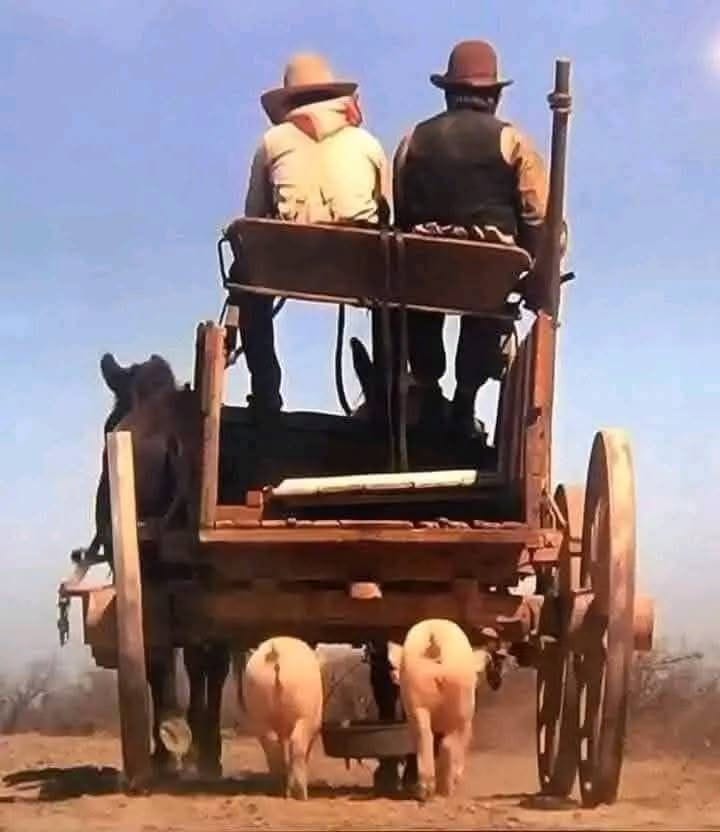
Dogs look up to you, cats look down on you. Give me a pig! He looks you in the eye and treats you as an equal.
Winston S. Churchill
I don’t know whether Larry McMurtry liked pigs as much as Winston Churchill did, whom his wife Clementine affectionately called “Pig” and who famously compared pigs to cats and dogs:“Dogs look up to you,” Churchill said, “cats look down on you. Give me a pig! He looks you in the eye and treats you as an equal.” I do know, however, McMurtry’s logo for his bookshop, Booked Up, was a sketch of a pig standing on an open book. I also know it was drawn by Marcia Carter, a Washingtonian socialite who collected pigs and with whom McMurtry had had an affair. I know as well that the name of the shop was in tribute to the fact that she was always booked up.
Whether McMurtry like pigs or not, I couldn’t say, but he did include almost one hundred and twenty-five references to pigs in Lonesome Dove. That’s a lot of oink if he didn’t like bacon.
Whatever McMurtry’s personal affinity for pigs, his literary hero Augustus McCrae had an abiding fondness for them—a fondness the reader shares from the very first sentence of the novel:
When Augustus came out on the porch the blue pigs were eating a rattlesnake—not a very big one. . . . “You pigs git,” Augustus said, kicking the shoat. “Head on down to the creek if you want to eat that snake.” It was the porch he begrudged them, not the snake. Pigs on the porch just made things hotter, and things were already hot enough.
The pigs become McMurtry’s literary foils: as comic relief, to illustrate Augustus’s eccentric nature, and to illustrate the contrast between Gus and Call and their outlooks on life.
The pigs are symbolic of Gus’s ability to find and celebrate life in small, everyday experiences. They’re hardy and able animals who endure hardships and accomplish impossible challenges without complaint. They take life as it comes and enjoy it, whether it’s eating a rattlesnake or resting in a springhouse mud hole.
They’re treated as part of the Hat Creek “family,” at least by Gus and Newt—as faithful as any dog. On the night Dish Boggett rides into Lonesome Dove to visit Lorena, Gus walks from the Dry Bean, the town’s saloon, to the ranch house and discovers the pigs sleeping on the porch snoring. McMurtry writes,
The pigs were stretched out on the porch, lying practically snout to snout. Augustus was about to kick them off to make room for the guest he more or less expected, but they looked so peaceful he relented and went around to the back door. If Dish Boggett, with his prairie dog of a mustache, considered himself too refined to throw his bedroll beside two fine pigs, then he could rout them out himself.
Over the course of the cattle drive, the heart of the narrative, the pigs become the mascots for the Hat Creek outfit.
Gus sees great intelligence in the pigs. “The pigs spent half their time rooting around the springhouse,” McMurtry writes, “hoping to get into the mud, but so far none of the holes in the adobe was big enough to admit a pig.” Later, McMurtry writes,
The two pigs had quietly disregarded Augustus’s orders to go to the creek, and were under one of the wagons, eating the snake. That made good sense, for the creek was just as dry as the wagon yard, and farther off. Fifty weeks out of the year Hat Creek was nothing but a sandy ditch, and the fact that the two pigs didn’t regard it as a fit wallow was a credit to their intelligence. Augustus often praised the pigs’ intelligence in a running argument he had been having with Call for the last few years. Augustus maintained that pigs were smarter than all horses and most people, a claim that galled Call severely.
“No slop-eating pig is a smart as a horse,” Call said, before going on to say worse things.
Gus talks to the pigs as if they were children. The morning after Dish comes to Lonesome Dove, Gus is cooking his biscuits in the dutch oven, reading his Bible when the pigs approach. Here’s how McMurtry put it:
When he was enjoying a verse or two of Amos the pigs walked around the corner of the house, and Call, at almost the same moment, stepped out the back door, pulling on his shirt. The pigs walked over and stood directly in front of Augustus. The dew had wet their blue coats.
“They know I’ve got a soft heart,” he said to Call. “They’re hoping I’ll feed them this Bible.
“I hope you pigs didn’t wake up Dish,” he added, for he had checked and seen that Dish was there, sleeping comfortably with his head on his saddle and his hat over his eyes, only his big mustache showing.
Later, to the annoyance of Jake Spoon, who had ridden into Lonesome Dove with Deets, when the pigs “stopped and looked at Augustus a minute,” hoping for something to eat, Gus said to them, “‘Get on down to the saloon. Maybe you’ll find Lippy’s hat.’” To which Jake said, “‘Folks that keep pigs ain’t no better than farmers.’”
When Gus teases Jake for not owning a railroad or at least a whorehouse, Jakes says in a testy and high mannered tone: “‘I may not have no fortune, but I’ve never said a word to a pig, either.’”
Even Call found Gus’s attachment to the pigs and his practice of talking to them peculiar. When Call rides to the Rainey family’s hovel looking for hands to make a crew for the cattle drive, Maude Rainey, who sold the two pigs to Gus, asks Call, “‘Have you et that shoat yet?’” “‘No, we ain’t,’ Call said. ‘I guess Gus is saving him for Christmas, or else he just likes to talk to him.’”
Gus keeps the pigs around for amusement. When the Hat Creek crew was eating their breakfast, “The blue shoat came to the door and looked in at the people, to Augustus’s amusement. ‘Look at that,’ he said. ‘A pig watching a bunch of human pigs.’”
And when Augustus painted his sign outlining what the Hat Creek outfit sold and rented, he included a line about the pigs: “We Don’t Rent Pigs.” This caused Call no small amount of consternation: “‘Why, they’ll think we’re crazy here when they see that. Nobody in their right mind would want to rent a pig. What would you do with a pig once you rented it?’” Gus had a ready answer: “‘Why, there’s plenty of useful tasks pigs can do. They could clean the snakes out of a cellar, if a man had a cellar. Or they could soak up mud puddles. Stick a few pigs in a mud puddle and pretty soon the puddle’s gone.’”
If that weren’t reason enough, Gus argued the line about renting pigs, if not good marketing, at least was philosophical: “‘It ought to make a man stop and consider just what it is he wants out of life in the next few days.’” To which, the ever practical Call responded: “‘If he thinks he wants to rent a pig he’s not a man I’d want for a customer.’” Clearly, Call would think such a man a few pickles short of a barrel.
Gus treats the pigs as independent critters. Just before the Hat Creek outfit is about to leave Lonesome Dove, heading north on the drive, Call asks Gus, “‘I guess you’re planning to take [the pigs] too?’”
“‘It’s still a free country,’ Augustus said. ‘They can come if they want the inconvenience.’”
And when Soup Jones joins the crew, Gus jokes that he wasn’t the only new hire, “‘we got two fine pigs that just joined us last night,’” he said.
Gus admires the pigs’ courage and accomplishments. Everyone in the Hat Creek outfit was afraid of the Texas bull. But not the pigs. The bull was curious about them, but when he approached they “[rooted] around a chaparral bush” and “ignored him.”
When the Hat Creek outfit reached the San Antonio River, the pigs dove right in. “‘Look at them,’ Augustus said happily. ‘Ain’t they swimmers?’”
And When the drive finally arrived in Montana, Gus, afraid the pigs might get lost in the tall grass, said to Call, “‘We ought to let them ride in the wagon.’
“‘I don’t see why.’
“‘Well, they’ve made history. . . . They’re the first pigs to walk all the way from Texas to Montana. That’s quite a feat for a pig.’
“What will it get them?’ Call inquired. ‘Eaten by a bear if they ain’t careful, or eaten by us if they are. They’ve had a long walk for nothing.’
“‘Yes, and the same’s likely true for us,’ Augustus said, irritated that his friend wasn’t more appreciative of pigs.”
Gus becomes annoyed at the loss of the pigs affection. Over the course of the drive, the pigs transfer their affection from Gus to Po Campo, the Hat Creek cook. “He had long since won the affection of Gus’s pigs,” McMurtry writes. “The shoat followed him around everywhere. It had grown tall and skinny. It annoyed Augustus that the pigs had shown so little fidelity; when he came to the camp and noticed the shoat sleeping right beside Po Campo’s workplace, he was apt to make tart remarks.”
Call eventually came to (begrudgingly) admire the pigs. After scouting out water in the dry country of Wyoming, Call “unsaddled the mare [the Hell Bitch], one of Augustus’s pigs grunted at him. Both of them were lying under the wagon, sharing the shade with Lippy, who was sound asleep. The shoat was a large pig now, but travel had kept him thin. Call felt it was slightly absurd having pigs along on a cattle drive, but they had proven good foragers as well as good swimmers. They got across the rivers without any help.”
Toward the end of the novel we’ve been confronted with the tragic deaths of young Sean O’Brien, Jake Spoon, Joshua Deets, and Gus. One of Gus’s last thoughts is about the pigs. After the Miles City doctor amputated Gus’s rotten leg, but refused the doctor to remove the other, Call said, “‘You don’t like to do nothing but sit on the porch and drink whiskey anyway. It don’t take legs to do that.” Gus answered: “No, I also like to walk around the springhouse once in a while, to see if my jug’s cooled proper. . . . Or I might want to kick a pig if one aggravates me.’”
By this time, you’d think McMurtry could have spared us any more death, but he wasn’t through. “At Christmas, hungering for pork, [the Hat Creek boys] killed Gus’s pigs.”
Winston S. Churchill, 1952 ca. Sir Anthony Montague Browne to The Editor, in Churchill By Himself: The Definitive Collection of Quotations, ed. Richard Langworth (New York: Public Affairs, 2008), 535.
Larry McMurtry, Lonesome Dove (New York: Simon & Schuster, 1985), 3–6, 41–43, 46, 65–66, 77, 154, 193, 253, 293, 487, 684, 723, 760, 792.
Y’allogy is an 1836 percent purebred, open-range guide to the people, places, and past of the great Lone Star. We speak Texan here. Y’allogy is created by a living, breathing Texan—for Texans and lovers of Texas—and is free of charge. I’d be grateful, however, if you’d consider riding for the brand as a paid subscriber, it helps offset research and writing expenses—and ensures that Y’allogy remains cost free.
You can also show your support by purchasing my novel.
Be brave, live free, y’all.
"A man that would rent a pig would be a hard man to stop."
It’s been a while since I read LD. Forgot how well McMurtry put those pigs to use. Might have to get me some for my current work-in-progress novel! Thanks for the fun piece!