

The Legend & Legacy of "The Line"

It is a Grand Canyon cut into the bedrock of human emotions and heroical impulses. It may be expurgated from histories, but it can [not] be expunged from popular imagination. . . . Nobody forgets the line. It is drawn too deep and straight.
J. Frank Dobie
Young men are apt to be reckless. Old men are apt to be retiring. Perhaps that explains his “cowardice” on the night of March 5, 1836, given that his warrior years were twenty-five and more years earlier. Whatever the reason, to many he was a coward—the coward of the Alamo.
A more charitable assessment of the man’s actions might lead us to conclude that what he did we might have done in a similar situation. Who knows? But one thing is certain: if he hadn’t done what he did we might not know of one of the most intriguing and intimate tales of what took place inside the Alamo before the twilight attack of Mexican soldados on March 6, 1836—that is, if the tale he told wasn’t a tall one and is to be believed.
Before we get into his story, however, we should get inside the Alamo, to get our bearings of what it might have been like behind the walls on the night of March 5.
Inside the Alamo: March 5, 1836
March 5, 1836, marked the twelfth day of the Mexican siege of the Alamo. From the first day of the siege, February 23, the Texians endured a continual cannonade from Mexican artillery. President-General Antonio López de Santa Anna had extended to the Alamo’s commander, twenty-six-year-old William Barret Travis, surrender at discretion. Travis rejected that offer with a cannon shot. Santa Anna, in turn, ordered the blood-red flag of no quarter raised over San Fernando Church and the song of the cut-throat—the Degüello—played. And the cannons roared.
On March 4 Mexican batteries advanced down the acequia—a water ditch running just on the other side of the the western wall and the northwest corner of the Alamo—to within two hundred yards of the northern wall, a vulnerable point in the garrison’s defenses, and pounded it with such devastating effect cannonballs passed through the wall.1 Every man inside the Alamo knew an attack was imminent. Not only was the northern artillery and its relentless shelling weakening an already weak wall, Mexican forces doubled on March 3 when reinforcements marched into San Antonio de Béxar and took up positions around the adobe-stone fort and began constructing scaling ladders within sight of the garrison.2 The only question was when would the attack come.
Then on Saturday afternoon, March 5, the cannonade ceased and silence descended over the beleaguered mission-fort.
Conditions inside the walls were dreadful. Rations of beef were nearly vanquished. Medical necessities for Doctor Amos Pollard were in short supply. Sanitation was virtually nonexistent. Outdoor latrines, cattle and horse pens filled with manure, and few facilities for washing, cleaning, and cooking created a toxic—and smelly—stew.
Outside the walls, on the day before, March 4, Santa Anna held a council of war to discuss plans for an attack. Sometime that evening a Béxareña—a Tejano woman from the town of Béxar—fled from the fort and passed through the Mexican lines. Despite Travis’s February 24 “Victory or Death” letter and his bold claim to “never surrender or retreat,” she told Santa Anna morale inside the garrison was low and that the defenses were crumbling.3 Lieutenant Colonel Enrique José de la Peña, in his generally reliable firsthand account of the siege and battle, recounted:
Travis’s resistance was on the verge of being overcome; for several days his followers had been urging him to surrender, giving the lack of food and the scarcity of munitions as reasons, but he had quieted their restlessness with the hope of quick relief, something not difficult for them to believe since they had seen some reinforcements arrive [on March 1 when thirty-two men from Gonzales—the “Immortal 32”—marched into the Alamo]. Nevertheless, they had pressed him so hard that on the 5th he promised them that if no help arrived on that day they would surrender the next day or would try to escape under cover of darkness; these facts were given to us by a lady form Béjar, a Negro who was the only male who escaped [presumably James Bowie’s servant Joe], and several women who were found inside and were rescued by Colonels Morales and Miñón [after the fall of the Alamo].4
Santa Anna’s second in command, General Vicente Filisola also recalled that Travis had considered surrender:
On that same evening [March 5] about nightfall it was reported that Travis Barnet [William Barret Travis], commander of the enemy garrison, through the intermediary of a woman, proposed to the general in chief that they would surrender arms and fort with everybody in it with the only condition of saving his life and that of all his comrades in arms. However, the answer had come back that they should surrender unconditionally, without guarantees, not even for life itself, since there should be no guarantees for traitors. With this reply it is clear that all were determined to lose their existence, selling it as dearly as possible.5
The Mexican accounts paint a grim picture. Things were getting desperate. But whether Travis ever seriously considered surrendering or attempting to break through the Mexican lines, he abandoned those notions by the time he called the garrison together in the courtyard. Perhaps, as Filisola indicates, Travis had received word from Santa Anna that there would be no guarantees of life. Even if Travis hadn’t received a written message from Santa Anna, the message of the blood-red banner and the Degüello was unmistakably clear.
Travis gave the men a choice: fight or flee. A few hours before sunset, he called the company together and addressed them.
My brave companions—Stern necessity compels me to employ the few moments afforded by this probably brief cessation of conflict in making known to you the most interesting, yet the most solemn, melancholy, and unwelcome fact that perishing humanity can realize. . . . Our fate is sealed. Within a very few days—perhaps a very few hours—we must all be in eternity. This is our destiny, and we cannot avoid it. This is our certain doom. . . .
Our business is, not to make a fruitless effort to save our lives, but to choose the manner of our death. But three modes are presented to us. Let us choose that by which we may best serve our country. Shall we surrender, and be deliberately shot, without taking the life of a single enemy? Shall we try to cut our way out through the Mexican ranks, and be butchered before we can kill twenty of our adversaries? I am opposed to either method; for, in either case, we could but lose our lives, without benefiting our friends at home—our fathers and mothers, our brothers and sisters, our wives and little ones. . . . My choice, then, is to remain in this fort, to resist every assault, and to sell our lives as dearly as possible. . . .
But I leave every man to his own choice. Should any man prefer to surrender, and be tried and shot; or to attempt an escape through the Mexican ranks, and be killed before he can run a hundred yards, he is at liberty to do so.6
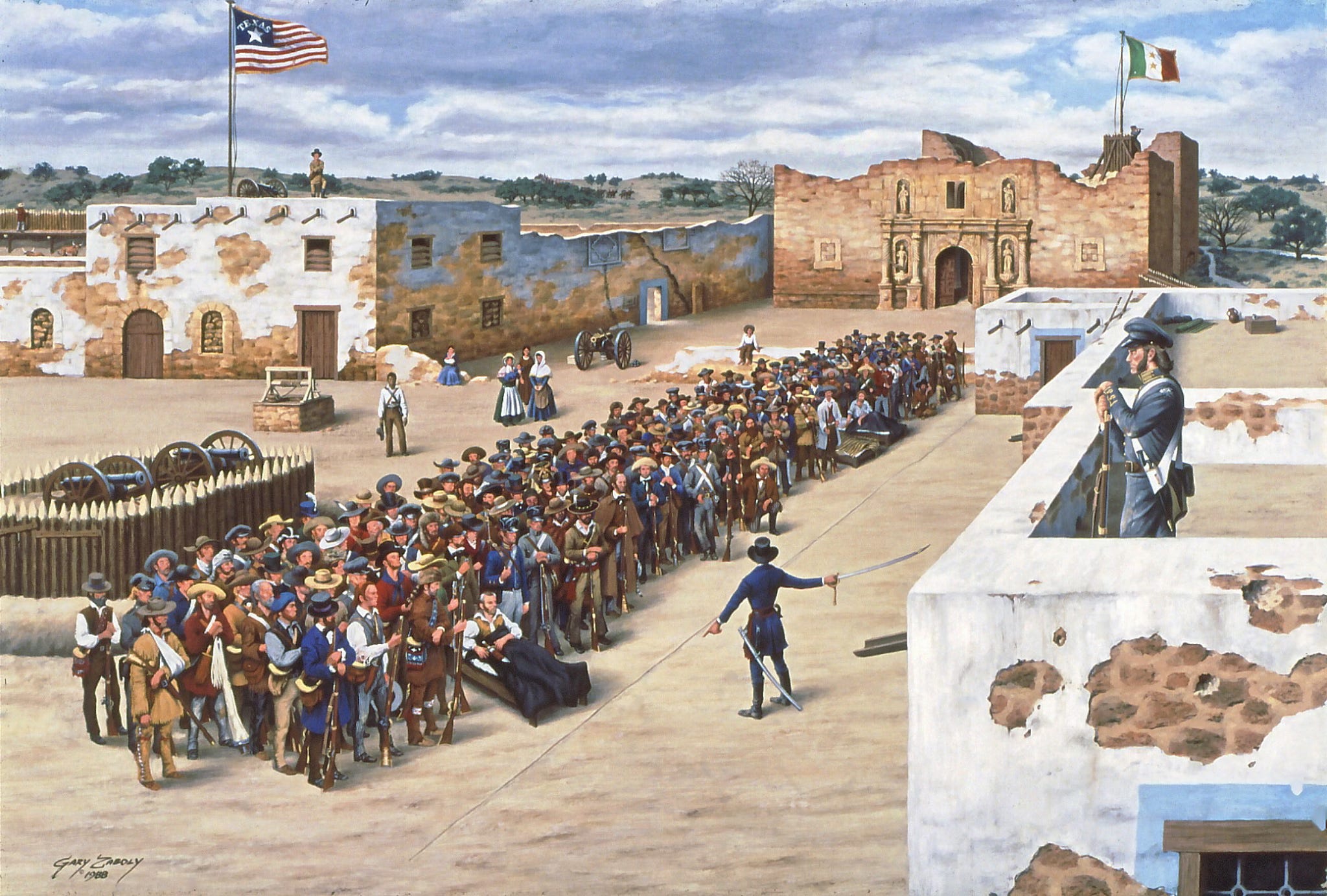
Travis then unsheathed his sword and with the point traced a line in the dirt. Sheathing his sword, he said, “I now want every man who is determined to stay here and die with me to come across this line. Who will be first? March!” The first man to cross was twenty-five-year-old Tapley Holland, one of Captain William Carey’s gunners, who exclaimed: “I am ready to die for my country!” Other men began to cross over, including the sick and wounded. The bedridden James Bowie said, “Boys, I am not able to come to you, but I wish some of you would be so kind as to remove my cot over there.” Four men picked up his cot and carried him over the line.7
Señora Candelaria—María Andrea Castañon Villanueva—who claimed to have tended the ailing Bowie said, “One evening Colonel Travis made a fine speech to his soldiers [and] he drew a line on the floor with the point of his sword and asked all who were willing to die for Texas to come over on his side.” She said all did but two: the bedridden Bowie, who asked to be carried across, where “Colonel Davy Crockett and several others instantly sprang towards the cot and carried the brave man across the line,” and an unnamed man who “sprang over the wall.”8
Though Susanna Dickinson, wife of artillery Captain Almeron Dickinson, makes no mention of Travis scratching a line in the sand, she remembered that Travis “On the evening previous to the massacre . . . asked the command that if any desired to escape, now was the time to let it be Known, & to step out of ranks. . . . One stepped out. His name to the best of my recollection was Ross. The next morning he was missing.”9
The Man Who Left the Alamo: Louis “Moses” Rose
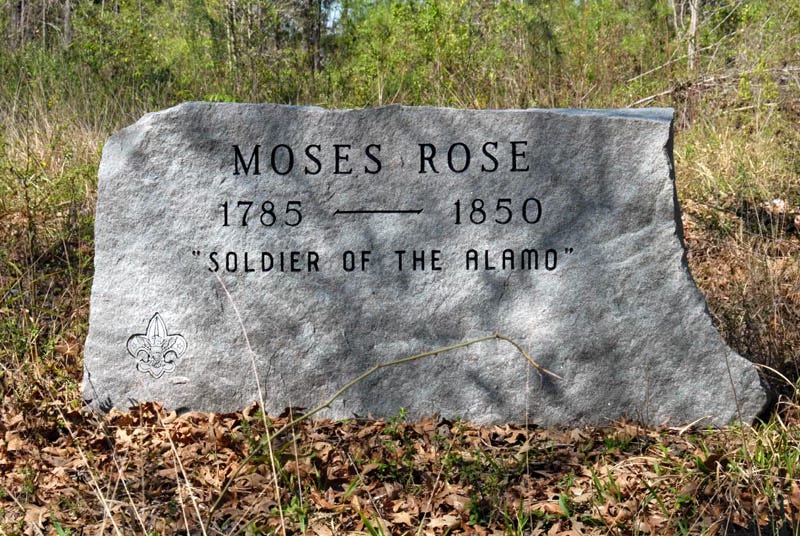
Susanna was wrong in her recollection. The man’s name was Rose—Louis Rose, sometimes called “Moses” because of his age: he was fifty-one at the time of the 1836 siege and battle.10
Rose, a Frenchman from Nacogdoches, undoubtedly was the most experienced military man inside the Alamo.11 Born on May 11, 1785, in Laferée, Ardennes, France, Rose joined Napoleon Bonaparte’s 101st Regiment in 1806, seeing combat in Naples, Portugal, Spain, and Russia, having survived the frozen retreat from Moscow during the brutal winter of 1812. Two years later, Rose was named to the French Legion of Honor—France’s highest and most prestigious order of merit—for his service as aide-de-camp to General Jacques de Montfort.
Rose emigrated to Texas sometime in 1826 and joined the Fredonian Rebellion and took part in the battle of Nacogdoches in 1832. Somewhere along the way, he met and befriended James Bowie. In the fall of 1835 Rose accompanied Bowie to Béxar and joined the Texian cause. He (most likely) fought at the battle of Concepción during the siege of the town and took part in the subsequent attack, driving General Martín Perfecto Cos and his Mexican troops from Béxar. When Bowie entered the Alamo on January 19, 1836, Rose rode in his company, along with a detachment of thirty men from Goliad. He was with Bowie every day up and until the evening before the decisive battle.
Given his swarthy complexion and his fluency with Spanish, Rose could pass for a Mexican, especially at night. So when Travis gave the garrison a choice to stay or leave, Rose chose to leave. The man who published Rose’s story wrote,
He directed a searching glance at the cot of Col. Bowie. There lay his gallant friend. Col. David Crockett was leaning over the cot, conversing with its occupant in an undertone. After a few seconds Bowie looked at Rose and said, “You seem not to be willing to die with us, Rose.” “No,” said Rose, “I am not prepared to die, and shall not do so if I can avoid it.” Then Crockett also looked at him, and said, “You may as well conclude to die with us, old man, for escape is impossible.”12
Rose said nothing more. He grabbed his satchel of belongings and scaled the four and half foot wall of the cattle pen and jumped into the near-full moon darkness. He slunk along the north wall to the acequia and followed it to the gently flowing San Antonio River, where he waded across the shallows and walked through the sleepy town of Béxar. To any passing soldados he would appear as an old, bedraggled Bexareño. He recrossed the river at the ford of the southern side of the loop, following it out of town southward for about three miles. He then struck an easterly course, cross-country toward the colonies.13
To avoid Mexican patrols, Rose traveled at night—a dangerous proposition itself, as he was soon to find out. One evening he hit a thick patch of prickly pear, impaling his legs with dozens of cactus thorns. More than a week and two hundred miles later he stumbled to the door of a friend who lived along Lake Creek, some sixty miles northwest of San Felipe—Abraham and Mary Ann Zuber. Rose could barely walk. The Zubers took him in and treated his badly infected wounds, using forceps to remove the embedded thorns and applying salve to his legs. He stayed with the Zubers for a couple of weeks. While recuperating, he recounted the gist of Travis’s speech and of how Travis drew the line with the tip of his sword and how he, Rose, made his escape from the Alamo. He told the story so many times the Zubers virtually committed it to memory—or so they professed.
When he recovered enough to travel, Rose left the Zubers for his home in Nacogdoches, where he operated a meat market for a while and lived as a hermit. In time, his story spread and whenever someone asked him why he fled the Alamo his unwavering response was, “By God, I wan’t ready to die.”
Rose didn’t stay long in Nacogdoches. He left sometime in the early 1840s, drifting further east. Eventually he hired onto the Logansport, Louisiana, plantation of Aaron Ferguson. A few years later, now bedridden from the cactus wounds which never healed properly, he lived in a small wooden shack. The Fergusons cared for him until his death, burying him in their family cemetery. More than a century later, an 1813 French coin stamped with Napoleon’s image was found nearby.14
The Man Who Published the Story: William P. Zuber
Abraham and Mary Ann Zuber’s son, William, wasn’t at their home when Louis Rose showed up with his thorn-infected legs. In 1836, William was a fifteen-year-old boy solider with Sam Houston’s army. When he returned home after the battle of San Jacinto, where he served in the rear guard, he learned from his parents the story of Travis’s line in the sand, his appeal to the Alamo defenders, and Rose’s escape.
Thirty-five years later, in 1871, William put the story to paper, aided by his aged mother’s (remarkable) memory. He submitted Rose’s account to the Texas Almanac, which published it in 1873 under the title, “An Escape from the Alamo.” Zuber’s article concludes with a signed statement from his mother endorsing it.
I have carefully examined the foregoing letter of my son, William P. Zuber, and feel that I can endorse it with the greatest propriety. The arrival of Moses Rose at our residence, his condition when he came, what transpired during his stay, and the tiding that we afterwards heard of him, are all correctly stated. The part which purports to be Rose’s statement of what he saw and heard in the Alamo, of his escape, and of what befell him afterwards is precisely the substance of what Rose stated to my husband and myself.15
Three years after it’s publication, Rufus Grimes, brother of Alamo defender Albert Grimes and a neighbor of the Zubers, wrote to Texas governor E. M. Pease expressing his belief in Rose’s story. “This account is entitled to full credit,” Grimes wrote. “This Wm. P. Zuber is a man of undoubted veracity and when Rose escaped from the Alamo he made his way to the house of Abram Zuber an old friend and acquaintance then living in Roans Prairie in this county (Grimes) where he staid until his feet got well enough to travel again (his feet & legs were full of the cactus thorns), traveling in the night—Zuber tells me of many other interesting statements made by Rose beside what is stated in the sketch.”16


Since then, Texas historians have debated the veracity of Rose’s story, or at least Zuber’s recounting of the story. William C. Davis, a well-respected scholar, in Three Roads to the Alamo, provides an extended note discounting Rose’s account. “Nothing in the story stands up to scrutiny, and none of the survivors made any mention of such an incident, except Mrs. Dickenson, and she only mentioned it after Zuber’s account appeared in print, and at a time when her own accounts were becoming increasingly imaginative, inaccurate, and derivative.” After listing a number of troubling facts about Rose’s story and Zuber’s romanticized retelling of it, Davis concludes: “The event simply did not happen, or if it did, then something much more reliable than an admittedly fictionalized secondhand account written thirty-five years after the fact is necessary to establish it beyond question.”17
Others, however, like James Donovan, an equally credible historian who dedicated the afterword in The Blood of Heroes to the question of whether Rose’s story is true or not, concludes:
An important point to bear in mind is this: there is not a single event associated with the siege and fall of the Alamo that has been related in so many independent versions by so many different individuals attesting to its fundamental truth. Furthermore, not a single one of these people had an ulterior motive, e.g., for money or for personal aggrandizement, in supporting Zuber and his 1873 account. There now exists enough reliable evidence to consider the existence of Moses Rose, his escape from the Alamo, and the line drawn by Travis to be acceptable, factual history.18
For myself, I tend to lean toward Donovan. But whether the Rose story is a tall tale or not, my heart is with J. Frank Dobie: “For Travis to have drawn the line would have been entirely natural, the more natural because of the fact that in both history and fiction Rubicon lines have repeatedly been drawn for fateful crossings. Because an act has precedent is no reason for denying it. History is sprinkled with momentous sentences spoken by military men at crucial hours. These men about to die in the Alamo must have been conscious of doing a fine and brave thing. Travis certainly thought that he was acting a part that the light of centuries to come would illumine.”19
Todd Hansen, who compiled the definitive writings about the Alamo in The Alamo Reader, agrees with Dobie.
In the end, perhaps Dobie was closest to the truth. We know that for the defenders, the line had to be there, and crossed, at least in a figurative sense, regardless of what literally happened. Thus we can also ask, does it really matter? What does matter is that we are left to wonder, as Zuber noted, whether we ourselves would have chosen Rose’s way out. Seldom does history—or life—offer such clear, decisive options. It is the choice that all but one of the defenders made that has led to the major fascination with the Alamo story.20
And no less a careful historian as Walter Lord, who wrote the first popular account of the siege and fall of the Alamo ends A Time to Stand with “a print the legend” type of conclusion: “If Zuber was hiding a gentle fabrication, he was also protecting a shining legend—and what harm is a legend that only serves to perpetuate the memory of valor and sacrifice? As matters stand, there’s still room to speculate, and every good Texan can follow the advice of J. K. Beretta in the Southwestern Historical Quarterly: ‘Is there any proof that Travis didn’t draw the line? If not, then let us believe it.’”21
The epigraph is from J. Frank Dobie, “The Line that Travis Drew,” in The Alamo Reader: A Study in History, ed. Todd Hansen (Stackpole Books, 2003), 286, 287.
1 The fragile condition of the north wall is discussed in James E. Ivey’s (unpublished manuscript) “Mission to Fortress: An Architectural History of the Alamo,” 7. John Sowers Brooks, who was stationed at Goliad, passing on information heard from a courier from the Alamo—likely James L. Allen—wrote to James Hagarty on March 9, 1836: “We have heard from Bexar. . . . [Santa Anna] has erected a battery within 400 yards of the Alamo, and every shot goes through it, as the walls are weak.” The following day, Brooks wrote his father, A. H. Brooks: “The enemy have erected a battery of nine pounders within 400 yards of the Fort, and every shot goes through the wall.” Hansen, 606, 607.
2 John Sutherland had been the garrison’s physician but was sent from the Alamo by Travis to bring help from Gonzales. He had returned after the battle to see the funeral pyres. He wrote in his draft account, “Santa Anna arrived with his division of the army . . . [and] directly commenced making Scaling ladders—which was Seen from the Alamo.” Hansen, 179.
3 On the Travis letter see the Texas State Library and Archives Commission, “William Barret Travis Letter from the Alamo, 1836.”
4 José Enrique de la Peña, With Santa Anna in Texas: A Personal Narrative of the Revolution, trans. Carmen Perry, expanded edition (Texas A&M University Press, 1997), 44. Historian Stephen L. Hardin writes, “The Negro mentioned by de la Peña was Travis’s body servant known to history only as ‘Joe.’ Although Joe was seemingly illiterate, he told his story to [Republic of Texas] President David G. Burnet’s cabinet on March 20, 1836. The slave’s accounts of the battle were recorded by William Fairfax Gray and George Childress, but in neither of their versions did Joe mention that his master was contemplating surrender. Perhaps Gray and Childress neglected to record that unpleasant detail.” Texian Iliad: A Military History of the Texas Revolution (University of Texas Press, 1994), 274 n. 37. I say “generally reliable account” because de la Peña’s account of David Crockett’s surrender and execution is fraught with difficulties, as I explain in “On the Death of David Crockett.”
5 Vicente Filisola, Memoir of the History of the War in Texas, vol. 2, trans. Wallace Woolsey (1849; reprint, Eakin Press, 1987), 176–77. Susanna (Dickinson) Hannig, who was in the Alamo during the siege and battle, testified that “A Mexican woman deserted us one night, and going over to the enemy informed them of our very inferior numbers, which Col. Travis said made them confident of success and emboldened them to make the final assault, which they did at early dawn on the morning of the 6th of March.” Hansen, 46. This would mean Travis had to have been in communication with Mexican officers.
6 William Barret Travis, as recounted by Louis Moses to Ann Zuber, retold to William P. Zuber, “An Escape from the Alamo,” reprinted in Hansen, 245–46, 247. Zuber confessed Travis’s speech was his own creation, but continued to argue that it captured the essence and spirit of what Travis said on March 5, 1836. See Hansen, 250, 253–54.
7 Hansen, 247, 248.
8 Madam Candelaria, in the St. Louis Republic before her death in 1899, reprinted in Timothy M. Matovina, The Alamo Remembered: Tejano Accounts and Perspectives (University of Texas Press, 1995), 59–60. Hansen asserts that Madam Candelaria “definitely was not in the Alamo,” 731. Enrique Esparza, an eyewitness and survivor of the battle of the Alamo, was a boy of either eight or twelve years of age (his birth year is disputed: either 1824 or 1828), in an interview with Charles Merritt Barnes of the San Antonio Daily Express (May 19, 1907) also claimed Travis drew a line in the dirt with his sword, reprinted in Matovina, 82.
9 Susanna (Dickinson) Hannig, in Hansen, 48. She reported: “Col. [Juan Nepomuceno] Almonte (Mexican) told me that the man who had deserted the evening before had also been Killed & that if I wished to satisfy myself of the fact that I could see the body, still lying there, which I declined.”
10 Some have doubted Louis Rose’s existence. James Donovan addresses the proof for Rose’s existence in The Blood of Heroes: The 13-Day Struggle for the Alamo—and the Sacrifice That Forged a Nation (Little, Brown and Company, 2012), 361–62, 465n; see Hansen, 273–74, 278.
Concerning Rose’s presence at the Alamo, Donovan writes, “His name was not on either of the two lists of the Alamo garrison—the January 15, 1836, muster roll or the February 1, 1836, election certificate—although other men known to have died in the Alamo were also not listed. (The garrison roster was somewhat fluid in the months between the battle of Béxar and the arrival of the Mexican army on February 23, with volunteers coming and going rather freely. But on March 24, 1836, Telegraph and Texas Register had run a list of the fallen derived from couriers John W. Smith and Gerald Navan that included the entry ‘Rose, of Nacogdoches,” 356.
The Daughters of the Republic of Texas, in 1986, compiled muster rolls for all who fought in the Texas Revolution. Using the Telegraph and Texas Register they list as having been at the Alamo a “Rose” (first name unknown) from Nacogdoches, where Louis Rose lived before the revolution began, see “Muster Rolls of the Texas Revolution,” Texas History Trust, pdf, 26.
Esparza later identified Rose as the man who escaped in the May 19, 1907, San Antonio Daily Express, reprinted in Matovina, 82. The official Alamo website lists James M Rose from Ohio, the nephew of President James Madison, on their “defenders” list, which includes only those who fought and died during the final battle.
11 The biographical sketch of Rose is compiled from William P. Zuber, “The Escape of Rose from the Alamo,” reprinted in Hansen, 245–50, Robert B. Blake, “Rose and His Escape from the Alamo,” part of which is reprinted in Hansen, 274–82, and Natalie Ornish, “The Life of Louis (Moses) Rose: Alamo Survivor and Soldier of Fortune,” Texas State Historical Association.
12 Zuber, in Hansen, 428. Crockett use of the phrase “old man” seems odd since Crockett himself was forty-nine at the time.
13 Rose claimed he departed the Alamo on March 3, 1836, a date Zuber continued to repeat in subsequent writings. Both Rose and Zuber are mistaken. There was no reason for Travis to call the men together and offer them a desperate choice on March 3. On that afternoon James Butler Bonham, one of the Alamo’s couriers, rode into the fort with news that James W. Fannin and several hundred men were on their way from Goliad to reinforce the besieged garrison. Zuber also writes that when Rose stood on the wall “he was amazed at the scene of death that met his gaze. From the wall to a considerable distance beyond the ground was literally covered with slaughtered Mexicans and pools of blood.” Rose asserted that when he jumped from the wall he landed “sprawling on his stomach in a puddle of blood” and that his satchel of clothing came loose, depositing his clothes in blood. This is certainly not the case since there had been no general engagement against Mexican forces before March 6. Hansen, 248.
14 See Donovan, 347–48, 463–64n; Hansen, 274–82.
15 Mary Ann Zuber, Prairie Plains, Grimes County, Texas, May 9, 1871, reprinted in Hansen, 250.
16 Rufus Grimes, in Donovan, 354–55, see also 464n.
17 William C. Davis, Three Roads to the Alamo: The Lives and Fortunes of David Crockett, James Bowie, and William Barret Travis (HarperCollins, 1998), 731–32, n. 99.
18 Donovan, 374.
19 J. Frank Dobie, “”The Line that Travis Drew,” reprinted in Hansen, 286.
20 Hansen, 293.
21 Walter Lord, A Time to Stand (University of Nebraska, 1961), 204. Of course, additional evidence about Rose and his story has come to light since Lord wrote in 1961, as this article attests.
Y’allogy is an 1836 percent purebred, open-range guide to the people, places, and past of the great Lone Star. We speak Texan here. Y’allogy is created by a living, breathing Texan—for Texans and lovers of Texas—and is free of charge. I’d be grateful, however, if you’d consider riding for the brand as a paid subscriber, it helps offset research and writing expenses—and ensures that Y’allogy remains cost free.
You can also show your support by purchasing my novel.
Be brave, live free, y’all.