

The Contradictory Mr. McMurtry

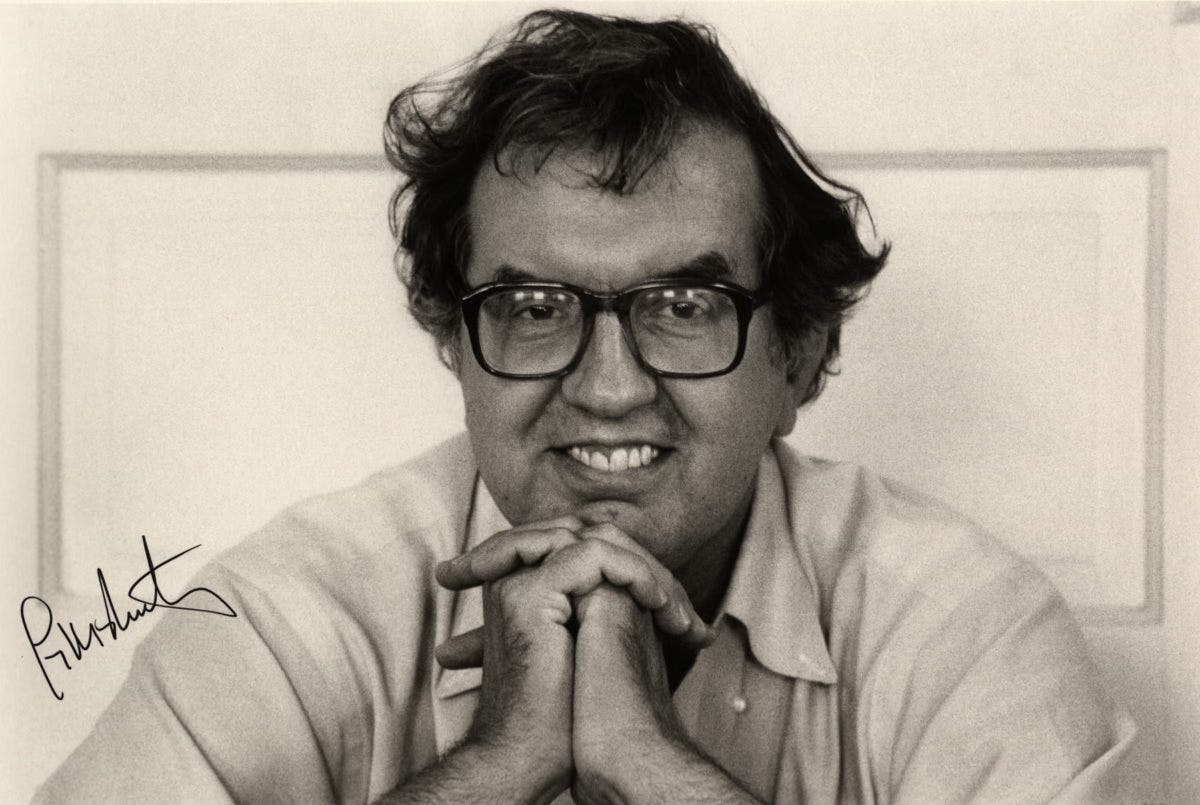
I have this compulsion to fictionalize. . . . By necessity, I invent.
Larry McMurtry
One of the wonderful serendipities of writing a newsletter is that on occasion a reader will reach out who knows much more about a subject and engages me in a deeper conversation. That happened in November 2025 when David Streitfeld sent me a nice note about “Yes, a Hell of a Vision.” Uttered by old-time Texas rancher Charles Goodnight, Larry McMurtry placed it in the mouth of Woodrow F. Call in Lonesome Dove. David spoke with erudition about the use of that quote, and could do so not only because he’s a student of the novel but as it turns out he was in the process of editing his biography about Larry when he reached out to me. I had preordered his biography, which was released in March 2026, but he graciously provided an advanced reading copy.
Here’s my review.
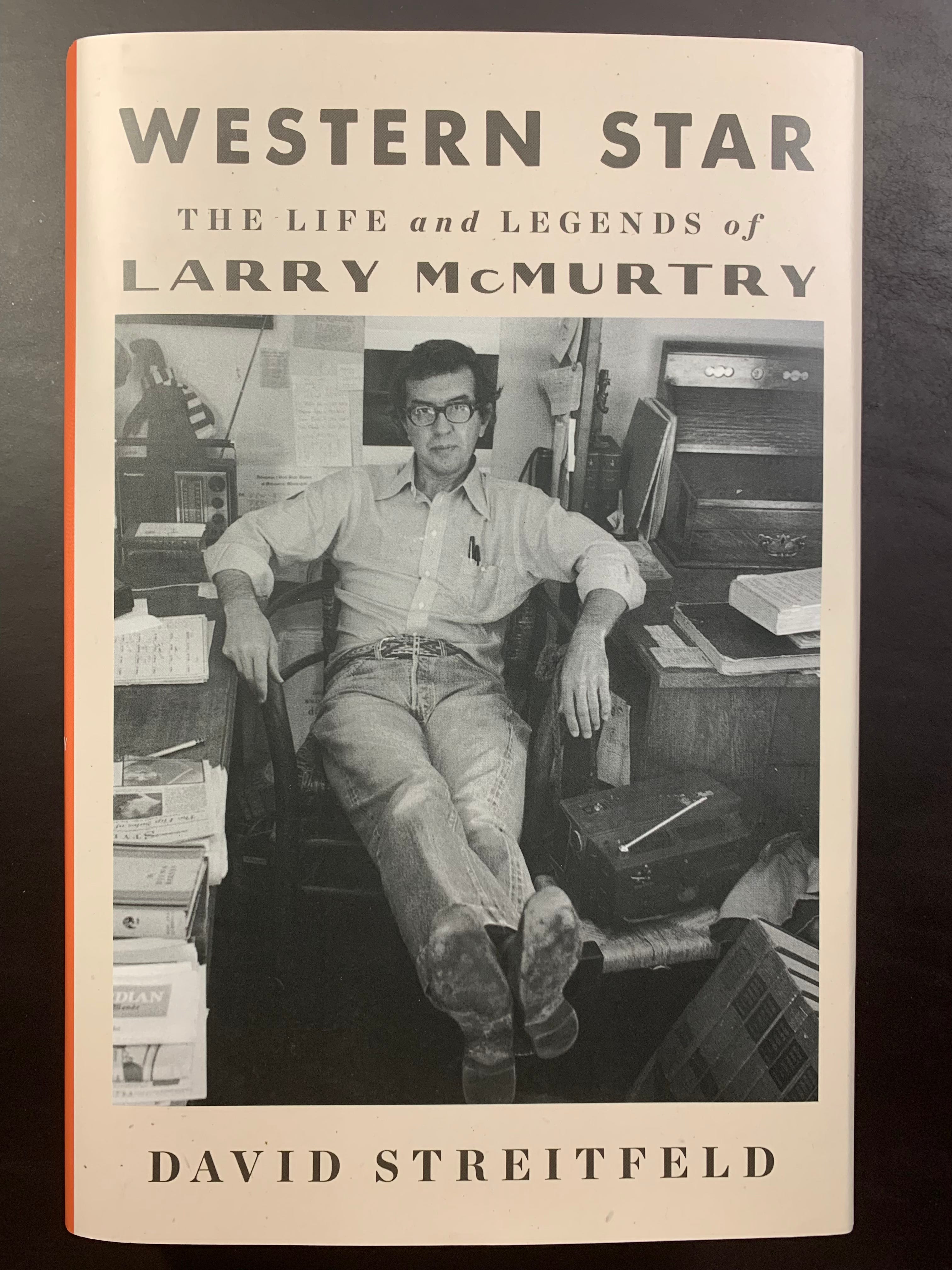
This bit of wisdom from Solomon, Israel’s ancient king, seems to be at the heart of David Streitfeld’s biography of Texas’ most famous novelist: “Faithful are the wounds of a friend” (Proverbs 27:6).
Whether Streitfeld intended Solomon’s sentiment to pulse like a heartbeat within his book or not, the New York Times Pulitzer Prize-winning journalist is the one biographer who could unravel and tell the truth about the many contradictions that made up Larry McMurtry’s life because he was McMurtry’s friend. From the very start of Western Star: The Life and Legends of Larry McMurtry (2026) Streitfeld tell us:
I became a regular in Archer City [McMurtry’s hometown] and in [McMurtry’s] complicated life from the late 1990s until he died. I was a crony and confidant despite being male (he didn’t trust men), a newspaper reporter (he found them ridiculous), and a potential biographer (like reporters, but malevolent).
Just because Streitfeld was a “crony and confidant” didn’t mean McMurtry warmed to the idea of having Streitfeld write a biography of his life. In fact, in an email exchange with Streifteld where I mentioned curating a collection of essays on McMurtry and Lonesome Dove he encouraged me: “A collection of essays—always a good idea. Larry as a topic is kind of undernourished, because he didn’t allow anyone to write anything in the last twenty years of his life, including me.” In Western Star, Streitfeld mentioned the challenges of penning a biography:
Although I never pushed the idea, Larry told friends he expected me to overcome at last his deep aversion to biographers and write a book about him.
In 2009, when he was well into his eighties and time was drawing short, I went to Archer City. I asked him to endorse the idea of my writing a book about him. He said he’d have to think about it. He wrote on a blank sheet of paper, “David has to charm these people,” and listed a few names. All had been sworn to silence years before. It was like being given an impossible task in a fairy tale: Bring me the witch’s broom.
Having met David in person at the release of Western Star, I can tell you he is charming. And if he hadn’t charmed Larry and the people on Larry’s list then Western Star would be a wholly different book. As it is, David secured the witch’s broom and gives us an intimate look into McMurtry’s family lore, his personal and professional life, as well as the legends he created (knowing and unknowing) about himself.
Western Star, like every well-written biography (or poorly written biography for that matter), gives us a womb to tomb account of one of the most significant literary figures in the twentieth century. But it was the contradictions—the legends in McMurtry’s life—and the hutzpah to tell the truth about those contradictions that attracted my attention. A lesser biography, and perhaps one written without the intimate relationship between biographer and subject, would have never uncovered those conflicting truths—conflicts that didn’t much concern McMurtry. He confessed, “I have this compulsion to fictionalize. . . . I just can’t stick to the facts. By necessity, I invent.” Streitfeld doubts McMurtry was even aware of his contradictory nature. Streitfeld writes, “Larry’s life often imitated his fiction and his fiction was inspired by his life, but he was an instinctive writer who forgot each page as soon as it came out of the typewriter so he never realized any of this.”
Aware or not, McMurtry was full of incongruity. Here are some of my favorites from Western Star.
✭
McMurtry famously professed in his memoir Books (2008) that he grew up in a bookless town, in a bookless home, and that his father, Jeff, never read to him. In fact, as McMurtry told the story it wasn’t until his cousin Robert Hilburn, on his way to enlist in the U.S. Marine Corps, dropped off a box of nineteen volumes in 1942 that a book entered McMurtry’s world. As Streitfeld writes, “It is a powerful story: the world-class storyteller who began with literally nothing.” But it was just that, a story. McMurtry’s father, whom the local paper called a “lifelong bookworm,” disputed Larry’s claim that their home was bookless and that he never read to Larry as a child. Texas folklorist J. Frank Dobie was a favorite of Jeff’s and upon his death his collection of Dobie volumes was inherited by Larry’s sister Judy.
Another McMurtry tall-tale concerns the name of the family ranch in Archer County: Idiot Ridge. The name first appeared in print in McMurtry’s first novel, Horseman, Pass By (1961), and reappeared in Leaving Cheyenne (1963) and All My Friends Are Going To Be Strangers (1972), where Danny Deck says Idiot Ridge “was just a little bluff, with lots of mesquite trees and rattlesnakes, but in a way it was the place most truly mine.” Based on these references and in interviews with McMurtry’s sister Sue and brother Charles, George Getschow, the director of the Mayborn Graduate School of Journalism at the University of North Texas, asserted in “The Rancher & Writer,” published in the university’s Spurs of Inspiration (2006), that the name of the McMurtry family ranch was Idiot Ridge. Getschow sent McMurtry a complimentary copy of Spurs of Inspiration and McMurtry took umbrage with the claim. McMurtry sent a note to the editorial team pointing out that the name of the ranch was not Idiot Ridge. It was a local name he liked and used in his fiction. And yet, as Streitfeld makes clear, Getschow and others could (and should) be forgiven for the confusion—one of McMurtry’s own making. Streitfeld writes,
If Idiot Ridge was Larry’s Yoknapatawpha County or his West Egg—an imaginary place superimposed on a reality it closely resembled—he forgot himself more than once. There’s an ambiguous reference in Narrow Grave [McMurtry’s collection of Texas essays], and he referred in a 1981 essay to “the ranch house on Idiot Ridge where I spent my boyhood.” At a minimum, he created ample opportunity for confusion. . . .
Larry’s attempt to correct the record went nowhere, even with himself. In 2017, I asked him about the name. “There was an idiot living down the road when I was a child,” he said without hesitation. “We would give him a ride when we saw him walking. There’s no one left alive to ask about him.” Larry could no longer write novels but he could still spin stories.
Perhaps my favorite legend is the one concerning McMurtry’s hypercritical essay of Texas novelists and the writing of Lonesome Dove. In 1981, he wrote “Ever the Bridegroom: Reflections on the Failure of Texas Literature,” published in The Texas Observer. According to Don Graham, “[Larry] went back and machine-gunned everybody he hadn’t taken out in Narrow Grave. It was like the Germans in World War II retracing the field for anyone still living.” In that piece, McMurtry complained that even the good Texas writers weren’t very good, and that too many Texas novelists were stuck on the frontier. Ironically, that’s exactly where McMurtry was struck. He wrote the essay while stalled on Lonesome Dove—the quintessential range novel, and the one he’s most famous for penning. As Streitfeld put it (deadpan), “He did not mention he was writing a 800-page cowboy novel, the sort of thing he was criticizing.” When asked about this contradiction after Lonesome Dove was published, McMurtry brushed the matter aside, like brushing away an irritating gnat, with a wave of the hand. “I never said the past wasn’t worth writing about,” he said. “What I said is that it’s not worth writing badly about. The past is always relevant.”
✭
For all his contradictions, Larry McMurtry is simply the most talented storyteller Texas has thus far produced. And David Streitfeld’s Western Star captures the contradictory Mr. McMurtry in all his glories and follies. It’s a biography lovingly written by a friend about a friend, but one that doesn’t paper over his friend’s peccadilloes, leaving us with a real man and not just the genius behind Lonesome Dove and his many other works.
✭
I want to tell one more contradictory story from McMurtry’s life. Quoting Streitfeld at length, with commentary from me:
All good Texans should die in Texas or, failing that, return to Texas after their death [as did Gus in Lonesome Dove]. . . .
Larry wanted his remains to spend eternity in the one place in Texas he loved without qualification: his bookstore [Booked Up, but his ashes were buried in the cemetery in Archer City next to his father]. . . . He was a bookseller and a Texan to the end, despite the inconvenience of dying far from his books in the Tucson townhouse he shared with Faye [his wife]. “Even if I die in Tucson, let’s just say I died in Texas,” he told his writing partner, Diana Ossana. It was one final fiction from a writer who reworked reality until he lost the ability to say what was true, a common fate for novelists.
In Lonesome Dove, Gus says, “I doubt it matters where you die, but it matters where you live.” Larry felt differently. If you’re the greatest writer in Texas, there’s no romance in dying in Arizona.
There is nothing contradictory about that. It’s the God’s honest truth.
✭
Following my initial email exchange with David, he sent my article on the death of Robert Duvall, “On the Death of ‘Augustus McCrae,’” to his brother Andy, who owns and operates AMS Pictures. Andy, who is producing a documentary on Larry, reached out and asked if I’d take part in the production by doing an on-camera interview to talk about Lonesome Dove. I would and I did. I’ll post a notice when the documentary is released.
✭
David Streitfeld, Western Star: The Life and Legends of Larry McMurtry (Mariner Books, 2026), 447 pages.
Y’allogy is an 1836 percent purebred, open-range guide to the people, places, and past of the great Lone Star. We speak Texan here. Y’allogy is created by a living, breathing Texan—for Texans and lovers of Texas—and is free of charge. I’d be grateful, however, if you’d consider riding for the brand as a paid subscriber, it helps offset research and writing expenses—and ensures that Y’allogy remains cost free.
You can also show your support by purchasing my novel.
Be brave, live free, y’all.
McMurtry influenced my writing. I've read all of his books except the one you feature here, and even visited Archer City to see the bookstore, which was closed. I read that a couple of house-fixers in Waco purchased it, but I can't confirm that. I do like J. Frank Dobie, too, but he left us with not enough. I wonder if he died with his boots on? He was that type of Texan, as I also am.
By the time I was in my fifties I had read many of McMurtry's classics. In high school I read The Last Picture Show before there was even talk of a movie. Many more followed. Not sure any American novel tops Lonesome Dove. By the time my wife and I visited Archer City on in the nineties it had become quite the tourist attraction. Half the buildings on square were filled with books. In one his son James sat with some of his friends playing a guitar. A bus load of folks debarked and started wandering around. Only one building had a cash register. You took whatever book you'd picked out over at the old hardware store or wherever to that one on the corner. The one where classics were sold. Lots of people in there. Larry McMurtry was behing the register, ringing everyone up. Looked like he was in hog heaven. What a memory.