

The Battle of Plum Creek

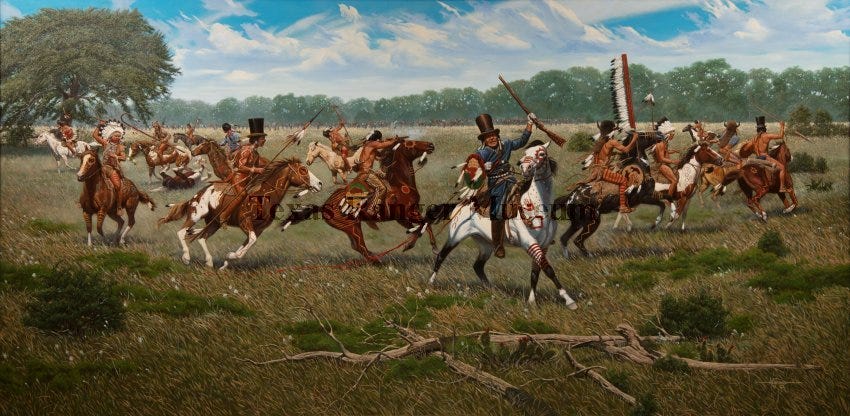
It was a spectacle never to be forgotten, the wild, fantastic band as they stood in battle array.
John Holland Jenkins
In the aftermath of the violence that broke out at the March 19, 1840, San Antonio Council House negotiations between Texans and Penatekas Comanches over the fate of white captives, Penataka chief Buffalo Hump—Po-chee-naw-quo-he-ep (“Long Time Hard Penis”)—organized the largest Comanche war party ever seen in the history of the Southwest. In early August, Buffalo Hump gathered some four to five hundred warriors, along with five to six hundred women and children, and decamped from the llano estacado in the Panhandle on a raid of revenge—to kill settlers and steal livestock and merchandise.
Reaching the Hill Country, the band rode past the limestone cliffs of the Balconies Escarpment then shadowed their movements by following the course of the treelined Blanco River. At the confluence of the Blanco and the San Marcos, they turned southward until they arrived at the junction of the Guadalupe, near Gonzales. From there, they swept down the river valley heading for the Gulf coast.
Near the town of Hallettsburg, between Gonzales and Victoria, the Comanches came across two men on horseback—Joel Ponton and Tucker Foley. Ponton and Foley set their horses in a run. The Penatakas giving chase. Ponton was struck by an arrow and unhorsed, but not badly wounded. Foley dismounted and ran for a nearby creek, seeking a hiding place. Unfortunately, the Comanche found him and threw a rope over him and drug him from the creek bottom. Instead of killing him, the warriors made sport of him. Secured behind a mounted Comanche, they flayed the soles of Foley’s feet and, in the words of one historian, forced him to run on his “exquisitely tender stumps” for several miles. When the Comanches tired of their game, they filled Foley with arrows and took his scalp as a trophy. Ponton retained his.
Arriving at Victoria on August 6, the band attacked and killed some fifteen folks on the outskirts and as they stampeded through the streets, releasing feathered missiles into anyone they saw. Though the Penataka tried to sack and burn the town, it was too large and well defended. Abandoning Victoria, they continued their southern raid, driving some 1,500 to 2,000 stolen horses before them—a boon for a horse people.
At a farmhouse south of Victoria, the Comanches captured Nancy Crosby, said to be the granddaughter of Daniel Boone, and her children (though accounts vary on the number). When one of the infants cried, the Comanches snatched him from her arms and smashed his head against a tree, killing him instantly. When her other son cried, a warrior drove a lance through his chest.
Two days later, the Comanches rode into the sea port of Linnville. Townsfolk fled in terror to Lavaca Bay, clambered into boats, and rowed from shore. Bobbing in the bay’s waters, the they watched as the Penataka torched buildings and looted stores, homes, and storehouses which were filled with recently arrived merchandise. The Comanches killed three who were unable to reach the boats, including H. O. Watts the customs inspector. Warriors spared the life of his wife Juliet, who, according those who knew her, was a “a remarkably fine looking woman.” As was their want, the Comanche men stripped and attempted to rape Mrs. Watts but were thwarted by her whalebone corset—a contraption they had never encountered before.
From their pitching perch in Lavaca Bay, the citizens of Linnville watched as their town burned. Judge John Hays was so incensed he jumped from one of the boats and waded ashore with a shotgun. The surprised Comanches encircled him but did not harm him, either admiring his courage or thinking him crazy. Later, Hays realized how lucky he had been. His shotgun wasn’t even loaded.
With more than 3,000 horses and at least a dozen mules laden in excess of a quarter of a million dollars in loot, much of it from John J. Linn’s warehouse, including “several cases of hats and umbrellas belonging to Mr. James Robinson, a merchant of San Antonio,” the Comanches rode away from Linnville.
✭
Before the first shots were fired at Victoria a couple of days before, a mail carrier stumbled upon the raiding party’s trail. He rode into Gonzales to sound the alarm. Ben McCulloch, who had commanded the two artillery pieces (the “Twin Sisters”) at San Jacinto, rallied 125 volunteers made up of men from Gonzales, Lavaca, Victoria, and Cuero, as well as members of the Texas Rangers under Captains John Tumlinson, Matthew “Old Paint” Caldwell, Adam Zumwalt, and Edward Burleson, who brought with him Chief Placido and twelve Tonkawas.
The Texans located the slow moving Comanches on August 9 and engaged them in a running battle. Shielded by their warriors, Penatakas women and children made their escape. When they had withdrawn a sufficient distance, the Comanche warriors broke off and spurred away on fresh horses from their stolen herd. The horses of the Texans became winded, preventing them from closing ranks. In time, however, the large caballado (horse herd) become unwieldy, requiring many warriors to corral it. And the weight of the mule-borne booty slowed the raiding party to a crawl. Then Buffalo Hump made a strategic mistake. Instead of cutting south of San Antonio, which would have dropped him into cover of the Hill Country, he chose to ride across the open prairie to the northwest, adjacent to the Colorado River.
Seeing the direction the Comanches took, McCulloch rode around the raiding party to the town of Lockhart to raise more men. He hastily assembled some two hundred, including Texas Rangers under Captains James Bird and John Moore. On August 11, General Felix Houston of the Republic of Texas army arrived in Lockhart and took command. The Texans would lay a trap at Big Prairie, near Plum Creek, a branch of the San Marcos.
The following day, August 12, Tonakawa scouts reported the Comanches were slowly moving north, raising a great dust cloud and would soon reach Big Prairie. Houston divided his dismounted men into three elements, with a fourth in reserve. He dispatched them among the brush that screened the creek. The Comanches rode into Big Prairie laughing and celebrating. They ceased their frivolity when Houston, Caldwell, and Burleson rode from the brush.
Feigning an attack, the Comanches put on a display of expert horsemanship and marksmanship. John Holland Jenkins, a volunteer from Bastrop, later reported the Penatakas were “arrayed in all the splendor of savage warriors, and finely mounted, [they] bounded over the space between the two hostile lines, exhibiting feats of horsemanship and daring none but a Comanche . . . could perform.” Their horsemanship and daring according to James Wilson Nichols, was “Lying flat on the side of their horses with nothing to be seen but a foot or a hand [and shooting] their arrows under the horses’s neck.”
Jenkins also admired the Comanches’ dress:
It was a spectacle never to be forgotten, the wild, fantastic band as they stood in battle array. . . . Both horses and riders were decorated most profusely, with all the beauty and horror of their wild taste combined. Red ribbons streamed out from their horses’s tales as they swept around us, riding fast. . . . There was a huge warrior, who wore a stovepipe hat, and another who wore a fine pigeon-tailed cloth coat, buttoned up behind. . . . Some wore on their heads immense buck and buffalo horns. One headdress struck me particularly. It consisted of a large white crane with red eyes.
Nichols also described this “huge warrior”: “He was riding an American horse . . . with a red ribbon eight or ten feet long tied to the tail of the horse. He was dressed in elegant style . . . with a high silk top hat, fine pair of boots and leather gloves, an elegant broadcloth coat, hind part before, with brass buttons shining up and down his back. When he first made his appearance he was carrying a large umbrella stretched.”
The showmanship allowed the Comanche women and children to push the horse heard and the loot-laden mules from the field. Experienced Indian fighters like Caldwell, Burleson, and McCulloch pressed Houston to attack as the caballado passed by, but he hesitated. Then a magnificent Comanche in a feathered headdress began to caper in front of the Texas lines, challenging their chiefs to individual combat. One of the Texans in the brush shot him from his horse and Caldwell yelled to Houston, “Now, General! Charge ’em!”
Houston gave the order and the Texan cavalry spurred into the Comanche flank, screaming and shooting. Captive horses stampeded and slammed into the pack animals. Comanches scattered. Caldwell’s men rode around the left flank, methodically killing every Penataka they rode across. The clash turned into a running fight covering fifteen miles. Combat was close and cruel. By the time the fighting played out, some eighty to one hundred Comanche warriors were strewn over the ground (exact figures are unknown). Only one Texan was killed and a handful wounded.
Comanche captives did not fare as well. Several were tied to trees and shot through with arrows. Mrs. Watts was also tied and shot with an arrow, but the corset that had saved her virtue now saved her life. She was found with a blunt arrow protruding from the breast of the corset.
Several Comanche women and children were captured in the melee. They were marched to San Antonio and parceled out to families to serve as slaves before making their escape. The Texans recovered a great amount of silver, cloth, whisky, and tobacco, as well as horses. These liberated goods were divided among the volunteers. The Tonkawas, who had run thirty miles on foot with Burleson to the battle now had mounts.
When the moon came up along Plum Creek the Tonkawas held a ceremonially victory dance and feast, having roasted several Comanche warriors. Robert Hall, a twenty-six-year-old Tennesseean whose family had built the first house in Memphis, was wounded. Recovering in camp, he witnessed the Tonkawas’ cannibalism.
The Tonkawas brought in the dead body of a Comanche warrior and they built a big fire not far from where I was laying. My wound had begun to pain me considerably, and I didn’t pay much attention to them for some time. After a while they began to sing and dance, and I thought that I detected the odor of burning flesh. I raised up and looked around, and, sure enough, our allies were cooking the Comanche warrior. They cut him into slices and broiled him on sticks. Curiously enough the eating of the flesh acted upon them as liquor does upon other men. After a few mouthfuls they began to act as if they were very drunk, and I don’t think there was much pretense or shame about it. They danced, raved, howled, and sang, and invited me to get up and eat a slice of Comanche. They said it would make me brave. I was very hungry, but not sufficiently so to become a cannibal. The Tonkawas were wild over the victory and they did not cease their celebration until sunrise.
✭
Later that October, another Texas force, led by John H. Moore and aided by Lipan Apaches and Tonkawas, attacked a large Comanche village on the upper Colorado River, near present-day Ballinger in the Panhandle, killing 130 and recovering much of the loot taken in the initial raid.
✭
Though Comanches continued their practice of guerrilla warfare for the next thirty-five years, after the overwhelming defeat of Buffalo Hump, who had escaped into the vastness of the llano estacado, no Comanche band attacked a town or raided as far as the Gulf coast ever again.
✭
T. R. Fehrenbach, Lone Star: A History of Texas and the Texans (The Macmillan Co., 1968), 461–62.
James L. Haley, Passionate Nation: The Epic History of Texas (Free Press, 2006), 230–31.
Y’allogy is an 1836 percent purebred, open-range guide to the people, places, and past of the great Lone Star. We speak Texan here. Y’allogy is created by a living, breathing Texan—for Texans and lovers of Texas—and is free of charge. I’d be grateful, however, if you’d consider riding for the brand as a paid subscriber, it helps offset research and writing expenses—and ensures that Y’allogy remains cost free.
You can also show your support by purchasing my novel.
Be brave, live free, y’all.
And that is why Lockhart is famous for smoked meat and barbecue.
;-)