

Texas Tales: The Council House Fight

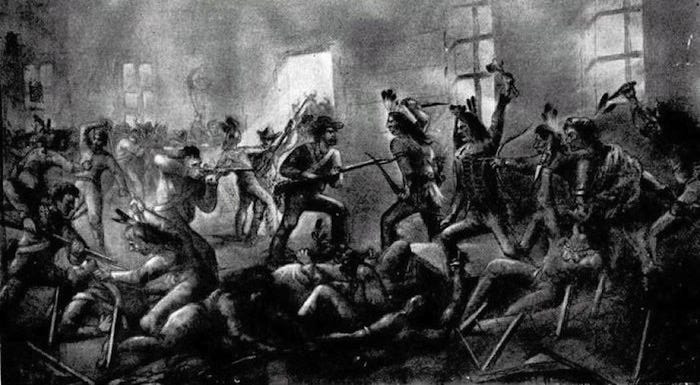
The Indians rushed on, attacked us desperately, and a general order to fire became necessary.
Hugh McLeod
No group of horsemen on the Texas frontier were as feared as the Comanches—not Mexican soldados or raiders, not gunman of any race, not even Apaches. Only the Kiowa could strike a similar fear into a Texan’s heart, and even that paled at the sight of horsed Comanches. In Goodbye to a River, John Graves hints at why the Comanches were such a fearsome race: “They were The People, only a few thousand strong in their most numerous times, but total possessors of an empire of grass and timber and wild meat, and constant raiders, for pleasure, far outside the limits of that empire.”
Sam Houston, the first president of the Republic of Texas, decided on a policy of conciliation with the Indians in Texas. His successor, Mirabeau Buonaparte Lamar, had a decidedly different policy—one of enmity. During his second annual message to the Texas Congress, Lamar said,
In my opinion, the proper policy to be pursued towards the barbarian race, is absolute expulsion from the country. Nothing short of this will bring us peace or safety. . . . [Our] only security against a savage foe, is to allow no security to him. The white man and the red man cannot dwell in harmony together. Nature forbids it. They are separated by the strongest possible antipathies, by colour, by habits, by modes of thinking, and indeed by all the causes which engender hatred and render strife the inevitable consequences of juxtaposition. Knowing these things, I experience no difficulty in deciding on the proper policy to be pursued towards them. It is to push a vigorous war against them; pursuing them to their hiding places without mitigation or compassion, until they shall be made to feel that flight from our borders without the hope of return, is preferable to the scourges of war.
Pursue them he did, especially the southern Comanches of the Edward Plateau in Central Texas known as the “Honey Eaters”—the Penatekas. Rangering companies, aided by Lipan Apaches and Towkawas, eternal enemies of the Comanches, hunted the Penatekas. No amount of harassment by the Texas Rangers, however, stopped the Comanches from raiding white settlements and capturing white women and children.
After Lamar’s inauguration, sixty-five-year-old John Webster and his thirty-one-year-old wife Dorthy (“Dolly”), and their two children (ten-year-old Booker and three-year-old Martha Virginia), along with a dozen men, were attacked by the Penatekas at the headwaters of Brushy Creek (in present-day Williamson County). The men were killed and scalped—Webster was spared because of his snow-white hair. Dolly and her children were carted off as captives. After eight days of hard riding, covering 250 miles, the raiding party reached the headwaters of the (Texas) Colorado River, in the Llano Estacado, where Comanche chief Maguara (Muk-wah-rah) was encamped. At his rancheriá—a large population center occupied by Indians and Mexican and American traders—Dolly discovered thirteen-year-old Matilda Lockhart and the four children of Mitchell Putnam, all of whom had been captured in the fall of 1838.
Separated from her children, Dolly was given to a Comanche warrior as a concubine. Her days were occupied with collecting firewood and skinning and tanning buffalo and deer hides. Her nights were filled with abuse by Comanche women and use by her Comanche master. Escape seemed hopeless. But one November afternoon Dolly and her children were gathering pecans and found themselves alone. Without hesitation she grabbed her little ones and ran, following the southern course of the Colorado River. They survived on nuts, berries, and prickly pears. More than a month after their escape, with the weather turning bitter, Dolly spotted a group of men wearing Western garb. She cried out. They were not Anglo settlers. They were a group of Vicente Córdova’s men, Mexicans and Cherokees who had taken part in his rebellion against the Republic of Texas and had been routed by Texans earlier in the year. They didn’t know what to do with Dolly and her children, and before they could decide a band of Comanches rode into their camp and bought the three captives for a mule and a horse.
Returned to Muguara’s rancheriá, Dolly learned a party had been dispatched to San Antonio with one of the Putnam boys, as a sign of good faith, to see if the Texans would agree to a boundary between white settlements and Comanche hunting grounds. The Ranger commander told the Penatekas the government was willing to negotiate but only under conditions: the Comanches must return all stolen property and bring in all “American” captives—the Indians could what they liked with Tejano (Hispano Texas) captives.
The delegation reported back to Muguara, who believed an agreement could be brokered. He questioned Dolly about the Texans and asked her to make a white banner out of silk, trimmed with white ribbons. She did. And the beatings continued.
Dolly was determined to attempt another escape. But Booker, who had almost died after eating yaupon berries on their first attempt, refused to leave. He believed he had a better chance of survival with the Penatekas now that he had been adopted into a family that had lost a son of the same age. He was convinced if he escaped and was captured he’d be killed. Sometime in March 1840, shortly after Muguara and a group of Penatekas departed for San Antonio, Dolly and Martha left Booker behind and disappeared into a rain drizzled night.
What happened next in San Antonio is recounted by Hugh McLeod, Lamar’s appointee to negotiate with the Comanches, in a letter to the president.
✭
To His Excellency, Mirabeau B. Lamar:
Sir.—On yesterday morning the 19th inst. two runners came into town and announced the arrival of the Comanches, who, about a month since, held a talk at this place, and promised to bring in the Texian prisoners in their camp. The party consisted of sixty-five—men, women, and children. The runners also informed us that they had with them but one prisoner (the daughter of Mr. Lockhart).
They came to town. The little girl was very intelligent, and told us that she had seen several of the other prisoners, at the principal camp a few days before she left; and that they brought her in to see if they could get a high price for her; and if so, would bring in the rest, one at a time.
Having ascertained this, it became necessary to execute your orders and take hostages for the safe return of our own people: and the order was accordingly given by Col. William G. Cooke, Acting Secretary of War.
Lieut.-Col. Fisher, first infantry, was ordered to march up two companies of his command, and post them in the immediate vicinity of the council-room. The Chiefs were then called together, and were asked: “Where are the prisoners you promised to bring in to this talk?” Muke-war-rah, the Chief who held the last talk with us, and made the promise, replied: “We have brought in the only one we had; the others are with other tribes.”A pause ensued, because, as this answer was a palpable lie, and a direct violation of their pledge, solemnly given scarcely a month since, we had the only alternative left us. He observed the pause, and asked quickly: “How do you like the answer?”
The order was now given to march one company into the council-room, and the other in the rear of the building, where the warriors were assembled. During the execution of this order, the talk was re-opened, and the terms of a treaty directed by your Excellency to be made with them, in the case the prisoners were restored, were discussed; and they were told the treaty would be made, when they brought in the prisoners. They acknowledged that they had violated all their previous treaties, and yet tauntingly demanded that new confidence should be reposed in another promise to bring in the prisoners.
The troops being now posted, the Chiefs and Captains were told that they were our prisoners, and would be kept as hostages for the safety of our people, then in their hands; and they might send the young men to the tribe, and as soon as our friends were restored they should be liberated.
Captain Howard, whose company was stationed in the council-house, posted sentinels at the doors, and drew up his men across the room. We told the Chiefs that the soldiers they saw were their guards, and descended from the platform. The Chiefs immediately followed. One sprang to the back door, and attempted to pass the sentinel, who presented his musket, when the Chief drew his knife and stabbed him. A rush was then made to the door. Captain Howard collared one of them and received a severe stab from him in the side. He ordered the sentinel to fire upon him, which he immediately did, and the Indian fell dead. They now all drew their knives and bows, and evidently resolved to fight to the last. Colonel Fisher ordered, “fire if they [resist].” The Indians rushed on, attacked us desperately, and a general order to fire became necessary. The Chiefs in the council-house, twelve in number, were immediately shot.
The council-house being cleared, Captain Howard was ordered to from in front, to receive any who might attempt to retreat in that direction. He was subsequently relieved of command, in consequence of the severity of his wound, by Captain Gillen, who commanded the company during the rest of the action.
Captain Redd, whose company was formed in rear of the council-house, was attacked by the warriors in the yard, who fought with desperation. They were repulsed and driven into the stone houses, from which they kept up a galling fire with their bows, and a few rifles. Their arrows, when they struck, were driven to the feather.
A small party succeeded in breaking through, and gained the opposite bank of the [San Antonio] river, but were pursued by Colonel Wells, with a party of mounted men, and all killed but one, (a renegade Mexican).
A single warrior, who threw himself into a very strong stone house, refused every offer of his life, sent to him through the squaws, and after killing and wounding several of our men, was forced out by fire late at night, and fell as he passed the door.
In a melée action, and so unexpected, it was impossible to discriminate between the sexes, so similar in dress; and several women were shot. But when discovered, all were spared, and twenty-nine women and children remain our prisoners.
Our loss was as follows:
Killed—Lieut. W. M. Dunnington, First Infancy; private Kaminské, of (A) company; private Whitney, of (E) company; Judge Thompson, of Houston; Judge Hood, of Bexar; Mr. Casey, of Matagorda county, and a Mexican, name unknown. Total killed, seven.
List of Wounded—Capt. George T. Howard, Capt. Matthew Caldwell, Lieut. Edward A. Thompson, First Infantry; private Kelly, company (I); Judge Robinson; Mr. Higginbotham; Mr. Morgan, and Mr. Carson. Total wounded, eight. Captain Howard, Lieut. Thompson and private Kelly very severely.
The loss of the enemy was total, with the exception of the renegade Mexican, above mentioned, thirty-five killed, including three women and two children, and twenty-seven women and children, and two old men captured. The Mexican was allowed to leave the quarters, and his departure was unobserved.
The regular troops did their duty, and the citizens rallied to our aid, as soon as the firing was heard.
Upwards of a hundred horses and a large quantity of buffalo robes and peltries were taken.
At the request of all the prisoners, a squaw has been liberated, and well mounted, to go to the main tribe and tell them we are willing to exchange prisoners. She promises to return in four days, with our captive friends; and Col. Cooke and myself will wait here until her return.
This communication is made at your request, to give you correct and early information, and is not designed to supersede the regular report of the commanding officer, Lieutenant-Colonel Fisher, to the War Department.
I have the honor to be, with high respect, your obedient servant,
H. MCLEOD, Adjutant and Inspector-General
✭
The daughter of Mr. Lockhart was (now) fifteen-year old Matilda. Mary Ann Maverick witnessed the Comanche entourage ride into San Antonio and in her memoir wrote of Matilda:
She was in a frightful condition, poor girl, when at last she returned to civilization. Her head, arms and face were full of bruises, and sores, and her nose actually burnt off to the bone—all the fleshy end gone, and a great scab formed on the end of the bone. Both nostrils were wide open and denuded of flesh. She told a piteous tale of how dreadful the Indians had beaten her, and how they would wake her from sleep by sticking a chunk of fire to her flesh, especially to her nose, and how they would shout and laugh like fiends when she cried. Her body had many scars from fire, many of which she showed us. Ah, it was sickening to behold, and made one’s blood boil for vengeance. . . . [Though] glad to be free from her detested tyrants, she was very sad and broken hearted. She said she felt utterly degraded, and could never hold her head up again.
According to Mrs. Maverick, Matilda lived only two or three years after her return.
Six days later, on March 26, 1840, a woman with an infant tied to her back stumbled into San Antonio. Her weather-beaten face was creased and caked with grime, her hair was matted and cropped Comanche style, her buckskinned clothing covered the bruises of her many beatings. She was mistaken for an Indian, her skin, according to Mrs. Maverick, “was sunburned and as dark as a Comanche.” Then she opened her mouth and “called out in good English [that] she had escaped from Indian captivity.” It was Dolly Webster and her (now) five-year-old daughter, Martha Virginia.
On April 4, 1840, Booker was exchanged for a blind Comanche man and a Comanche woman and child who had held captive after the Council House fight.
✭
“M. B. Lamar, Austin (Texas), Second Annual Message to Congress,” November 12, 1839, in The Paper of Mirabeau B. Lamar, vol. 3, ed. Charles Adams Gulick Jr. andKatherine Elliott (A. C. Baldwin & Sons, 1922), 166–67.
“Letter from Col. Hugh McLeod, communicating the defeat of the Comanches at San Antonio, March 20, 1840,” document F, in Appendix to the Journals of the House Representatives: Fifth Congress, 136–39.
Mary Ann Maverick, Memoirs of Mary A. Maverick (Alamo Printing Co., 1921), 44–45.
Y’allogy is an 1836 percent purebred, open-range guide to the people, places, and past of the great Lone Star. We speak Texan here. Y’allogy is created by a living, breathing Texan—for Texans and lovers of Texas—and is free of charge. I’d be grateful, however, if you’d consider riding for the brand as a paid subscriber, it helps offset research and writing expenses—and ensures that Y’allogy remains cost free.
You can also show your support by purchasing my novel.
Be brave, live free, y’all.