


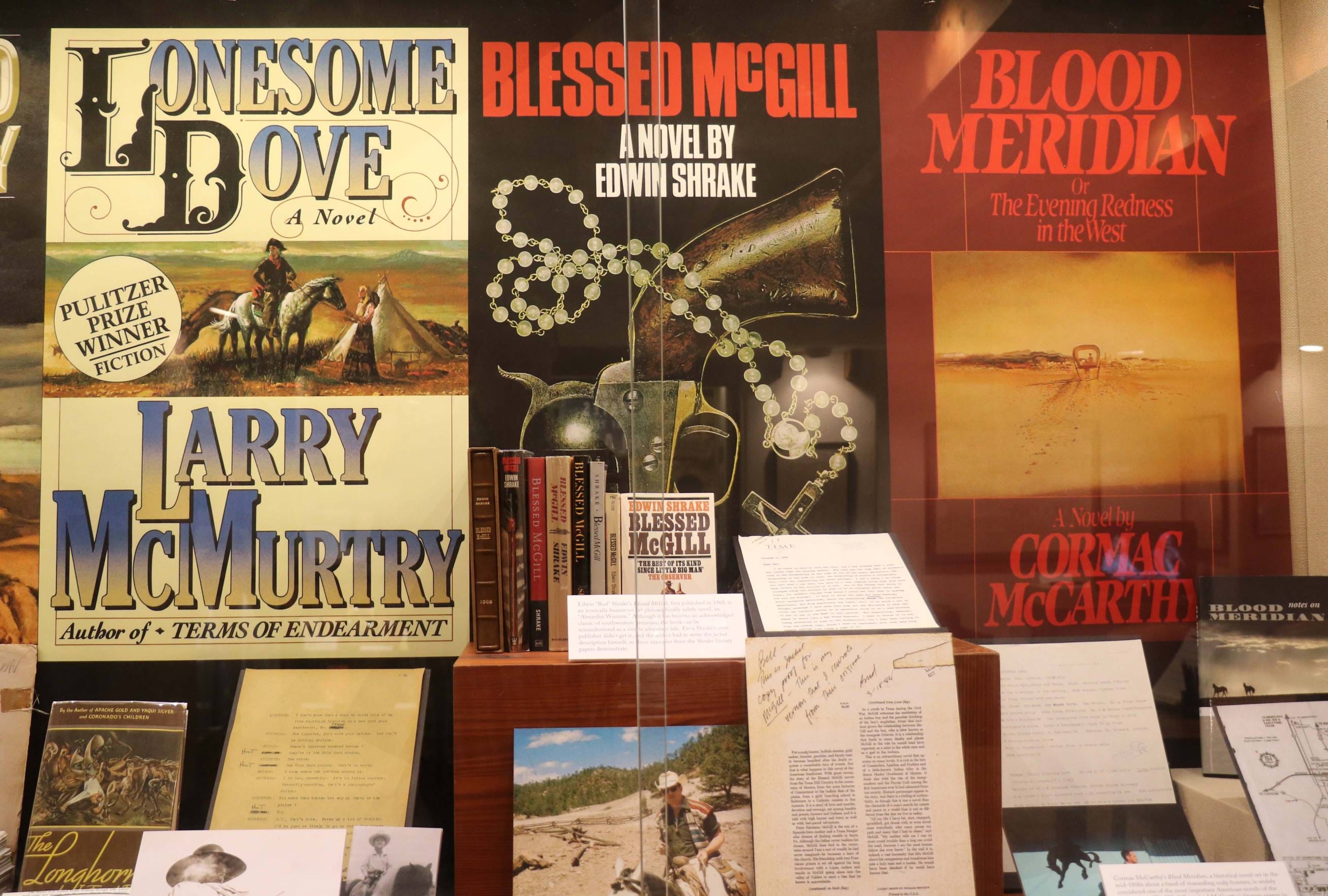
His great book, if he has a great book, is Blood Meridian, but I’m not sure it alone lifts him out of the category of being a minor regional writer.
Larry McMurtry
Larry McMurtry considered himself a “minor regional writer,” by which he meant he was not a major talent like Leo Tolstoy, Saul Bellow, or Flannery O’Conner, whom he called “a great writer.” In McMurtry’s estimation, these writers were untouchable—beyond reach. He wasn’t. Being a minor novelist didn’t worry McMurtry. “Literature is fed by minor talents,” he said in an interview. “It’s okay to be minor. In fact, if you can be minor you’ve made a considerable achievement, because more people don’t register in the scale of minor or major at all.”
When asked where Cormac McCarty stood in the pantheon of major and minor writers, McMurtry said he didn’t think much of McCarthy’s earlier works. McMurtry liked No Country for Old Men, but conceded that “[McCarthy’s] great book, if he has a great book, is Blood Meridian.” Though McMurtry admired the novel, he criticized it for being a “little windy” and losing focus at times. It’s “great passages,” however, “are really wonderful.” But McMurtry concluded, “I’m not sure it alone lifts [McCarthy] out of the category of being a minor regional writer.”
Of his own works, the ones that could possibly lift him out of the category of minor talent into the category of major talent, McMurtry listed one book of nonfiction and one book of fiction: Walter Benjamin at the Dairy Queen and Duane’s Depressed. Not Lonesome Dove—a novel he dubbed the “Gone With the Wind of the West.”
Why?
No doubt it had to do with the fact that Lonesome Dove was a failure in McMurtry’s eyes. It didn’t do what he set out for it to do: demythologize the West. Just as Gone With the Wind romanticized the antebellum South, so Lonesome Dove became “the chief source of western mythology,” he lamented.
That is true. But that doesn’t diminish the singular achievement that is Lonesome Dove. There’s hardly a novelist alive today, including this one, who wouldn’t consider Lonesome Dove as their greatest accomplishment if they had written it. The same is true for Blood Meridian, which McMurtry acknowledged as McCarthy’s magnum opus. McMurtry believed any given generation might only produce two or three major writers. Though he regarded himself and McCarthy as minor novelists, and Lonesome Dove as anything but a major work, the consensus of much of the reading population, as well as critical readers, disagrees with McMurtry’s assessment of his own talent and that of McCarthy, including their two magisterial works, Lonesome Dove and Blood Meridian.
Because this is true, I thought it would be interesting to compare these writers and their two major novels.
✭
Storytellers & Stylists: Both Larry McMurtry and Cormac McCarthy are two of the greatest storytellers and stylists in the late 20th century and the first quarter of the 21st century. When it comes to the language in Lonesome Dove and Blood Meridian both mastered the vernacular of the native Texan. This was easy for McMurtry. He grew up among cowboys in Archer County, Texas. It was perhaps more of a challenge for McCarthy, but his twenty-five or so years in El Paso shaved the Eastern Tennessee holler from his pen.
Publication: It was one of those delightful serendipities that both Lonesome Dove and Blood Meridian were published in the same year: 1985.
Genre & Setting: Both Lonesome Dove and Blood Meridian are cataloged as literary westerns. But they are more than westerns in the literary tradition, they are also journey epics. Lonesome Dove is set in the mid-1870s (post-1876) in South Texas and involves a cattle drive to Montana with a return to Texas. Blood Meridian is set between the years 1849 to 1878, beginning in Tennessee with a runaway who joins the Glanton scalp hunters in Texas, who ply their bloody trade throughout northern Mexico into New Mexico, Arizona, and California. The story eventually ends back in Texas.
Length: Though McMurtry called Blood Meridian a “little windy” in places, it’s not a terribly long novel (certainly not compared to Lonesome Dove), coming in at 116,404 words. At 365,712 words, Lonesome Dove weighs in at three times the length of Blood Meridian.
Violence: It shouldn’t come as a surprise, given the fact that both novels are westerns, that violence is a central theme in both works. McMurtry, in his effort to demythologize the West, believed his was writing a violent tale. And though there is violence aplenty, compared to what modern readers and viewers have experienced in this regard the violence in Lonesome Dove comes off as little more than a playground scuffle. This is certainly true compared to the violence found in McCarthy’s Blood Meridian, which is brutal in its descriptions and effects. I’ve written about this at greater length in “The Blood of Ambivalence” and “Beautiful Violence.”
Women: On June 5, 2007, Oprah Winfrey interviewed McCarthy and asked him about the lack of women in his work. He said, “I don’t pretend to understand women. I think men don’t know much about women; they find them mysterious.” So, he didn’t focus on them (until he wrote his last novel Stella Maris). Blood Meridian presents no notable women. Those who are there are little more than creatures of domestic service or objects of desire. Contrast this with McMurtry, one of the greatest creators of female characters in American letters, and Lonesome Dove, where Lorena, Clara, Elmira, and Janey are all fully developed characters with names, backstories, and narrative arches.
Critical Acclaim: Blood Meridian won no literary awards when it was published, and was met with lukewarm sales. However, it did receive (and continues to receive) critical acclaim in the academy, if not always by general readers. McCarthy and his work have been and continue to be subjects of academic study. McMurtry and his work, on the other hand, have not received the same academic scrutiny. “Larry as a topic is kind of undernourished,” McMurtry’s biographer David Streitfeld told me. Nevertheless, Lonesome Dove won the Pulitzer for fiction and is more popular and beloved among readers than McCarthy’s great work.
Film: Within four years of its publication, Lonesome Dove the miniseries, starring Robert Duvall and Tommy Lee Jones, aired on CBS to high praise. Blood Meridian, however, has continued to elude and frustrate filmmakers. Many believe the novel to be “unfilmable.” As of this writing, an adaption is in the works. But we’ll have to see whether the lyric beauty and brutality of McCarthy’s prose can be translated to the screen.
✭
Many readers, I believe, are drawn to Lonesome Dove—and come away loving it—because the language is approachable, the style is familiar, and the characters are relatable. Blood Meridian is a more challenging novel for the very reasons why Lonesome Dove isn’t—much of the language is exigent, the style has a hint of the archaic, and the characters are odious. But both are worthy of your time and attention. They are simply two of the greatest American novels written in the last half century.
Y’allogy is an 1836 percent purebred, open-range guide to the people, places, and past of the great Lone Star. We speak Texan here. Y’allogy is created by a living, breathing Texan—for Texans and lovers of Texas—and is free of charge. I’d be grateful, however, if you’d consider riding for the brand as a paid subscriber, it helps offset research and writing expenses—and ensures that Y’allogy remains cost free.
You can also show your support by purchasing my novel.
Be brave, live free, y’all.
Interesting that McMurtry thought Duane’s Depressed would be the fiction that would lift him to great. I’ve always thought that was the best book of the Duane Moore series. Wish we would’ve been able to Jeff Bridges continue that series on film what that adaptation.
Thanks for this treat today. Both books are in my Top 10 of all time, and it was a pleasure to read your thoughtful analysis of them. I have found that both authors gain esteem in my mind on the second or third readings. McMurtry’s short works about Texas are really under appreciated. As is McCarthy’s. BM is less known simply because it isn’t told in the traditional way, as Lonesome Dove is. BM is harder work but likely much more true to what you say was McMurtry’s goal: to demythologize the Western. To me, these two books form 2 of the 3 books of the Texas Trilogy. The third: Empire of the Summer Moon, by SC Gwynn.