

"A Day of Most Heartfelt Sorrow"

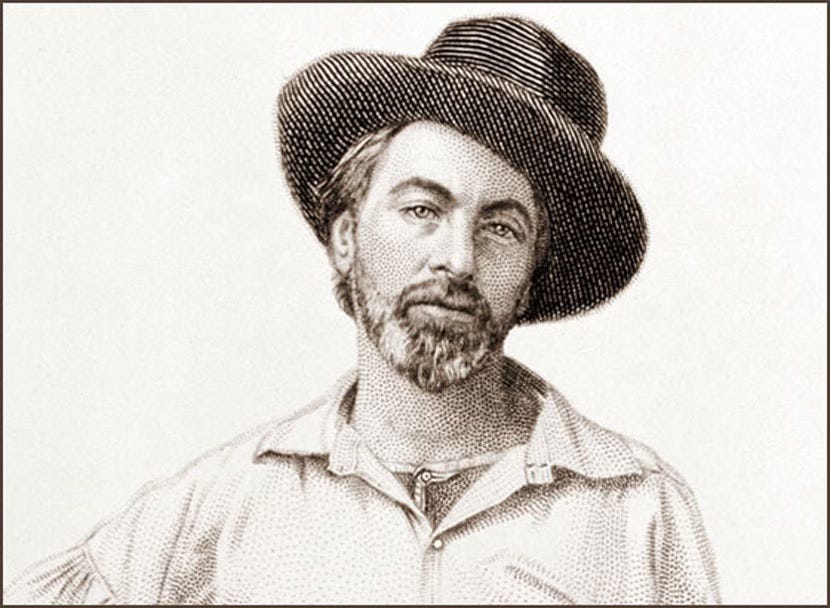
They were the glory of the race of rangers.
Walt Whitman
Walt Whitman was seventeen in the year 1836, living nearly 1,600 miles from the scene of the massacre. But in 1855, as a thirty-year-old man, he included what took place in a far-flung foreign country part of his magisterial poem “Song of Myself.” The country was the Mexican state of Tejas. The massacre was not the one you’re thinking of. “I tell not the fall of the Alamo,” Whitman wrote. Though unnamed, Whitman told of the capture of Colonel James W. Fannin and the 370 men under his command during the Texas Revolution at the battle of Coleto Creek and the massacre at nearby Goliad a week later.
It is a curious subject for a New York poet to put into verse. Why, of all the topics he could have written about, did he select an event that took place in a faraway country when he was boy? One Whitman scholar answers: “Is it not characteristic of Whitman’s poetical method, which always celebrates the leaves of grass in preference to the more showy flower, to pick out the less well-known event rather than the better known one?”
To Whitman, the dead of Goliad represented “the common people” and “their deathless attachment to freedom.” So he said in the preface of the 1855 edition of Leaves of Grass.
But how did Whitman learn about the Goliad massacre? Outside the Lone Star State, as one scholar put it, the Goliad massacre was “an obscure historical episode of the Texas fight for independence.” But was it really that obscure?
In the middle years of the 1840s the United States was embroiled in a war with Mexico. Texas was on the minds of many Americans, especially journalists, of which Whitman was one. As the editor of the Brooklyn Daily Eagle, on March 14, 1846, Whitman ran an extracts of an article originally published in Blackwood’s Edinburgh Magazine titled “Fanning’s Men, or The Massacre at Goliad.” The article was composed, for the most part, from an account of a survivor—Von H. Ehrenberg.
A few months later, on May 11, Goliad was very much on Whitman’s mind when he referenced the 1836 massacre within the context of another Anglo-Hispano conflict. In his article “Shall We Fight It Out?” Whitman wrote,“the sickening story of those brutal wholesale murders, so useless for any purpose except gratifying the cowardly appetite of a nation of bravos, willing to shoot down men by the hundred in cold blood.”
The article based upon Ehrenberg’s account wasn’t the only source of Whitman’s Goliad education—and it certainly wasn’t the inspiration for including the massacre in “Song of Myself.” That came from a letter by an unnamed Mexican officer who witnessed the massacre and wrote to his wife describing it. This letter first appeared in the 1837 edition of History of South America and Mexico and a Geographical and Historical View of Texas by John M. Niles and L. T. Pease, with Pease contributing the material on Texas. The letter was referenced often in the run-up to the Mexican War, most notably in a congressional speech by George A. Caldwell of Kentucky in January 1845 and a Senate speech by Daniel Dickinson of New York in February. Both men were drumming up support for the annexation of Texas. The letter was also published in Samuel Gregory’s 1847 History of Mexico and in Nathan Covington Brooks’s 1849 A Complete History of the Mexican War, Its Causes, Conduct, and Consequences. Both men attribute Pease as the source of the letter.
The most salient example that the Mexican officer’s letter was the inspiration for section 34 of Whitman’s poem are the italicized sentences in this passage from the letter:
“This day, Palm Sunday, March 27, has been to me a day of most heartfelt sorrow. At six in the morning, the execution of four hundred and twelve American prisoners was commenced, and continued till eight, when the last of the number was shot. At eleven commenced the operation of burning their bodies. But what an awful scene did the field present, when the prisoners were executed, and fell dead in heaps! and what spectator could view it without horror! They were all young, the oldest not more than thirty, and of fine florid complexions. When the unfortunate youths were brought to the place of death, their lamentations and the appeals which they uttered to heaven, in their own language, with extended arms, kneeling or prostrate on the earth, were such as might have caused the very stones to cry out in compassion.”
The unnamed Mexican officer officer serves as an physical witness to the Goliad massacre, while Whitman serves as a poetical witness to the Goliad massacre. Both are outsiders to Texas, but both are sympathetic to the dead—one an enemy, the other an ally.
✭
I tell not the fall of Alamo . . . . not one escaped to tell the fall of Alamo,
The hundred and fifty are dumb yet at Alamo.
Hear now the tale of a jetblack sunrise,
Here of the murder in cold blood of four hundred and twelve young men.
Retreating they had formed in a hollow square with their baggage for breastworks,
Nine hundred lives out of the surrounding enemy’s nine times their number was the price they took in advance,
Their colonel was wounded and their ammunition gone,
They treated for an honorable capitulation, received writing and seal, gave up their arms, and marched back prisoners of war.
They were the glory of the race of rangers,
Matchless with a horse, a rifle, a song, a upper or a courtship,
Large, turbulent, brave, handsome, generous, proud and affectionate,
Not a single one over thirty years of age.
The second Sunday morning they were brought out in squads and massacred . . . . it was beautiful early summer,
The work commenced about five o’clock and was over by eight.
None obeyed the command to kneel,
Some made a mad and helpless rush . . . . some good stark and straight,
A few fell at once, shot in the temple or heart . . . . having living and dead lay together,
The maimed and mangled dug in the dirt . . . . the new-comers saw them there;
Some half-killed attempted to crawl away,
There were dispatched with bayonets or battered with the blunts of muskets;
A youth not seventeen years old seized his assassin till two more came to release him,
The three were all torn, and covered with the boy’s blood.
At eleven o’clock began the burning of the bodies;
And that is the tale of the murder of the four hundred and twelve young men,
And that was a jetblack sunrise.
✭
Whitman’s poem about the massacre at Goliad should not be read as history. There are a number of historical inaccuracies in it. For example, the number executed was not 412, it was 342. And the episode of the “not yet seventeen” year old who “seized his assassin” has never been verified.
✭
Milton Hindus, “The Goliad Massacre in ‘Song of Myself,’” Walt Whitman Review 7 (1961), 77–78.
Cliff Hudder, “‘A Day of Most Heartfelt Sorrow’: Death and Texas in Walt Whitman’s ‘Song of Myself,’” Walt Whitman Review 29 (2012), 71.
Walt Whitman, “Song of Myself,” section 34, in Leaves of Grass, The First (1855) Edition (Barnes & Noble Books, 1997), 64–65.
Y’allogy is an 1836 percent purebred, open-range guide to the people, places, and past of the great Lone Star. We speak Texan here. Y’allogy is created by a living, breathing Texan—for Texans and lovers of Texas—and is free of charge. I’d be grateful, however, if you’d consider riding for the brand as a paid subscriber, it helps offset research and writing expenses—and ensures that Y’allogy remains cost free.
You can also show your support by purchasing my novel.
Be brave, live free, y’all.
Good read this morning, I'll have to learn more about the Golead massacre. I just purchased your book, so thanks for the suggestion. If you want to read a good book about the Apache, read "Now I Surrender" by Alvaro Enrique. It's one of the best I've read, and includes real history and fiction. Title taken from the last words said by Geronimo when he surrendered to the US Army.
Excellent writing as always. As I have stated previously, I look forward to reading your posts. I might have brought it up in the past, but through my genealogy studies, I have found a relation to the great Texas Ranger John B. Jones. I have found is grave less than a mile from my Apartment in Austin. From my research, he was quite a Ranger. Keep on writing and I will keep on reading. Love ya brother!