

The Yellow Rose of Texas

The Battle of San Jacinto was probably lost to the Mexicans, owing to the influence of a Mulatto Girl . . . who was clustered in the tent with General Santana.
William Bolleart
There’s a Yellow Rose that I am going to see,
Nobody else could miss her, not half as much as me.
She cried so when I left her, it like to broke my heart,
And if I ever find her, we nevermore will part.
These are the lyrics made famous by Mitch Miller in 1955, but aren’t the lyrics of the original tune “The Yellow Rose of Texas,” made popular a century earlier by Edwin P. Christy and his Christy’s Minstrels. The 1853 version, performed in blackface, included racial epithets objectionable today.
There’s a yellow girl in Texas that I am going to see,
No other darkies know her, no darkey only me.
She cried so when I left her that it like to broke my heart,
And if I only find her, we never will part.
The song has been around since the 1830s.1 The term “yellow” was a common reference to mulattos—mix raced progeny of a White parent and a Black parent—while the word “rose” was a common euphemism for a young woman. Folklorists, like Frank X. Tolbert, have claimed the tune was based on true events that happened at the battle of San Jacinto between Mexican president-general Antonio López de Santa Anna and a young indentured servant by the name of Emily D. West.
Historically, we know Santa Anna existed and what happened to him and his troops on that fateful day on April 21, 1836—Mexican forces were routed and slaughtered by Texian forces under Sam Houston and Texas won its independence from Mexico. But was Emily West a living, breathing person of the past, and if so, who was she and what does she have to do with Santa Anna and the tune “The Yellow Rose of Texas”?
✭
The activities of Santa Anna at the moment Sam Houston and the Texian army attacked Mexican troops at San Jacinto have been disputed and debated since 1836. After action accounts by Mexican veterans indicate lax conditions within the Mexican camp. Colonel Pedro Delgado, a member of Santa Anna’s staff, reported: “As it was represented to his excellency [Santa Anna] that [Martín de Cos’s men] had not slept the night before [because of a force march to reach San Jacinto], he instructed them to stack their arms, to remove their accoutrements, and go to sleep quietly in the adjoining grove.”
Santa Anna had retired to his own tent. According to Texian artillery Captain Isaac Moreland, who commanded the “Twin Sisters,” Santa Anna was occupied with Emily West—a mulatto young woman—who had been captured at Morgan’s Point three days before.
A known womanizer, Santa Anna, before the final assault on the Alamo, had taken a young “bride” in a mock marriage. José Antonio Menchaca, a San Antonio native and a fervent defender of Texas independence, knew about the “marriage.” He later said, “In the year 1836, Santa Anna deceived Melchora Iniega Barrera, a young woman of 17 and very beautiful who belonged to one of the best families of San Antonio. Santa Anna, not being able to obtain the favors of Señorita Barrera, said he would marry her. He arranged for one of his sergeants to disguise himself as a priest, and, in this manner, the marriage was celebrated.”2
After burning the dead bodies of the Alamo fallen, Santa Anna and his new “bride” left San Antonio in pursuit of Sam Houston and his thrown together army. Santa Anna and Melchora traveled in a treasure laden carriage. On April 2, when they reached the swollen Guadalupe River, the carriage was too heavy to cross. Santa Anna mounted his horse and sent Melchora on her way to Mexico City with a truck, as it was reported, full of silver.
On the eastern side of the Guadalupe, Santa Anna and his troops march toward San Jacinto. Along their way, on April 19, they pass through Morgan’s Point plantation in New Washington. There they capture several of Colonel James Morgan’s indentured servants, one of whom was Emily West.3
✭
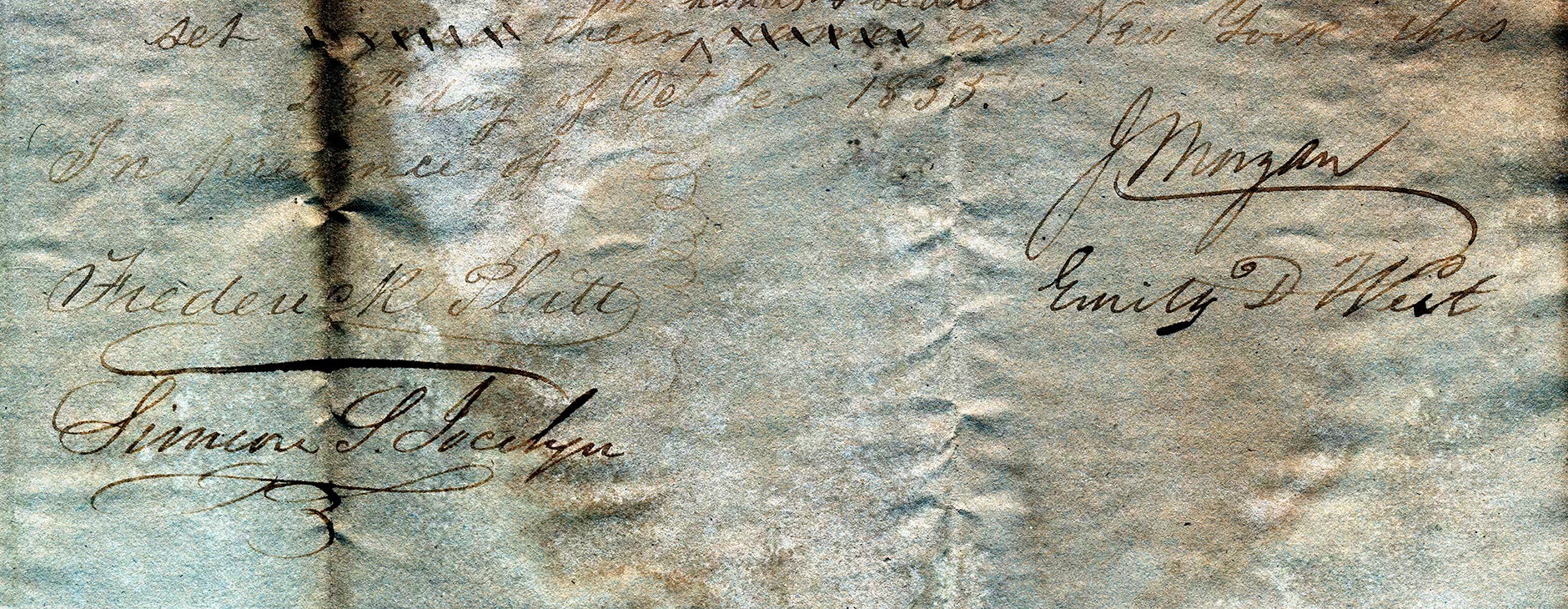
Emily has sometimes been misidentified as Emily Morgan, as if she was Morgan’s slave. She was not. She was Morgan’s indentured servant—a free woman. She contracted with Morgan to accompany him from New York to Texas and work for him for a year, for one hundred dollars. The surviving contract, dated 1835, stipulates that Emily was originally from New Haven, Connecticut. Nothing in the contract indicates she was a mulatto.
The contract was witnessed by Simon S. Jocelyn, a prominent New Haven antislavery philanthropist, who sponsored a number of free Black organizations and institutions. The 1830 census recorded several persons living in his household: six Whites and one “free colored female” between the ages of ten and twenty-four—likely Emily West.
✭
That Emily came to Texas in 1835 with James Morgan and had been captured by Santa Anna and his troops are historical facts and are without question. But whether she occupied Santa Anna in his tent on the afternoon of April 21, 1836, presumably distracting him with her sexual favors, is murky at best. Undoubtedly, she had some information, if not vital information, useful to Santa Anna about the situation in Texas. In all probability she was interrogated, if not by Santa Anna himself at least by one of his officers—Colonel Juan Almonte most likely since he spoke English.
The first historical record of the presence of a woman named Emily within the Mexican camp on that momentous day came from the pen of Englishman William Bollaert, a traveler through Texas from 1842–1844 who wrote a report about the new Republic of Texas for the British admiralty. During his travels he spoke with many notable Texans, including Sam Houston.
Bollaert’s book contains a footnote—but a bombshell of a footnote—which was written into the margin of his original manuscript. Next to his transcription of the Emily West story was the thrice underlined word “private.”
The Battle of San Jacinto was probably lost to the Mexicans, owing to the influence of a Mulatto Girl (Emily) belonging to Colonel Morgan, who was cloistered in the tent with General Santana, at the time the cry was made, “the enemy! they come! they come!” and detained Santana so long that order could not be restored readily again.”
Bollaert claimed the story of the mulatto girl—Emily—came from “an officer who was engaged in it [the battle of San Jacinto] in his own words.” Historian James Lutzweiler asserts that officer was Sam Houston. Houston probably heard the story of Emily West after visiting the ailing Isaac Moreland on June 5, 1842, just before Moreland’s death, before passing this “private” story onto Bollaert. Moreland claimed to have met Emily in April 1836.
✭
The first connection of Emily West with the song “The Yellow Rose of Texas” came from journalist and folklorists Frank Tolbert. He writes (without a source), “What became of Emily? She lived . . . to inspire a wonderful song. Musical historians seem to agree that the folk song ‘The Yellow Rose of Texas’ was inspired by a good-looking mulatto slave girl. And in one set of original lyrics—not the ones popularized by Mitch Miller—the girl of the song is called, ‘Emily, the maid of Morgan’s Point.’”4
Whether Emily West was in fact the inspiration for “The Yellow Rose of Texas” cannot be claimed as declaratively as Tolbert asserts. What can be claimed declaratively, however, is what happened to Emily immediately after the battle of San Jacinto. While she had her papers proving her freedman status when she was captured by Santa Anna, she lost her papers at some point during the eighteen minutes melee. When the Texians burned the prairie the day after the battle the prospects of finding her papers were as good as holding smoke in your hand. Without proof that she was a free woman, she could be claimed as a slave and sold.
Moreland must have encountered her within days of battle’s aftermath, probably on the battlefield as Mexican prisoners were being processed. She told Moreland who she was and that she was a free woman—a claim Morgan could affirm. It’s assumed Emily served out her indentured contract with Morgan, but once the contract had been fulfilled she sought a passport to return to New York. She wrote to the newly appointed secretary of state Robert Irion, who demanded verification of her freedman status. Since Moreland kept in touch with her throughout 1836 and into 1837, Emily appealed to him to vouch for her by sending a letter to Irion.
Moreland wrote Irion on Emily’s behalf on July 7, 1837:
Capitol, Thursday Morning
To the Hon. Dr. Irion
The bearer of this—Emily D. West has been since my first acquaintance with her, in April of –36 a free woman—she emigrated to this County with Col. Ja’s Morgan from the state of N. York in September of 35 and is now anxious to return and wishes a passport—I believe myself, that she is entitled to one and has requested me to give her this note to you.
Your Obed’t Serv’t
I. N. Moreland
Next to his signature, Moreland wrote an additional note, which he signed with his last name. This post script may have been added at Emily’s insistence as proof that she had lost her papers on April 21, 1836:
Her free papers were Lost at San Jacinto as I am Informed and believe in April of –36.
Moreland
We can say for certain Irion issued Emily a passport after receiving Moreland’s letter, but we can’t say for certain that Emily returned to New York because the Yellow Rose of Texas simply faded from the pages of history.
✭
The first known version comes from handwritten lyrics circa 1836 which can found in the archives of the University of Texas at Austin.
Ironically, Melchora legally married that very same sergeant after he rose to the rank of lieutenant colonel.
At least six women from Morgan’s plantation were among the Mexican prisoners captured after the battle of San Jacinto.
Tolbert writes, “Colonel Morgan bought Santa Anna’s tent at an auction after the battle. He sent it to a friend in the United States with this explanation: ‘This was the den of the tiger, which once echoed to the cries of helpless womankind.’”
✭
Lora-Marie Bernard, The Yellow Rose of Texas: The Song, the Legend and Emily D. West (The History Press, 2020).
William Bollaert, William Bollaert Texas, W. Eugene Hollon and Ruth Lapham, eds. (University of Oklahoma, 1956).
James Lutzweiler, Santa Anna and Emily D. West at San Jacinto: Who Edits the Editors? M.A. thesis (North Carolina State University, 1997).
Stephen L. Moore, Eighteen Minutes: The Battle of San Jacinto and the Texas Independence Campaign (Republic of Texas Press, 2004).
Frank X. Tolbert, An Informal History of Texas: From Cabeza de Vaca to Temple Houston (Harper & Brothers, 1961).
Y’allogy is an 1836 percent purebred, open-range guide to the people, places, and past of the great Lone Star. We speak Texan here. Y’allogy is created by a living, breathing Texan—for Texans and lovers of Texas—and is free of charge. I’d be grateful, however, if you’d consider riding for the brand as a paid subscriber, it helps offset research and writing expenses—and ensures that Y’allogy remains cost free.
You can also show your support by purchasing my novel.
Be brave, live free, y’all.
What an absolutely fascinating and intriguing read. Echoing in my head at the start of the story was Elvis singing his version of the same song. By the end of the piece, I’m left wondering whatever happened to the obviously wiley, clever woman who managed to keep herself alive thru the dying days of that frontier war. I hope she lived wonderfully for the rest of her days.
Learned this song in my school music classes many years ago. I doubt the old spinster who taught us had a good understanding of the lyrics.