


“Used to be, you had to have talent to get published. Now you just have to shoot people.”
Woody Harrelson
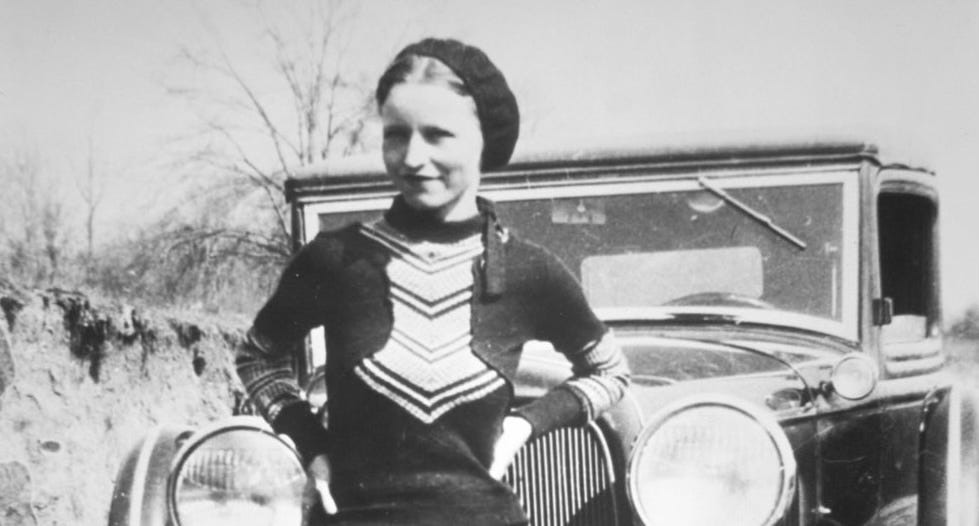
No parent looking into the cherubed face of their newborn hopes their child will grow and choose a life of crime only to die in a hail of bullets. That was not the hope of Charles and Emma Parker for their newborn daughter Bonnie Elizabeth when they first looked in her baby blue eyes. And yet, that’s exactly what Bonnie became—a thief and a murderer—and how Bonnie died—bullet riddled.
Bonnie Parker met Clyde Barrow, a two-penny con, in 1930 in West Dallas. They began their homicidal crime spree in 1932. Over the next two years, they murdered at least twelve people, nine of whom were law enforcement officers. Bonnie, a petite shotgun-wielding blonde, fancied herself a poet. In a poem that came to be known as “The Trail’s End” (or “The Story of Bonnie and Clyde”), she penned a romanticized view of their criminal life together, accurately predicting their violent deaths but inaccurately predicting their side by side burials.
In the 2019 film The Highwaymen Woody Harrelson’s character, Maney Gault, reads the first few lines of Bonnie’s poem and comments, “Used to be, you had to have talent to get published. Now you just have to shoot people.”
He was right.
✭
You have read the story of Jesse James,
of how he lived and died.
If you are still in need of something to read
here is the story of Bonnie and Clyde.
Now Bonnie and Clyde are the Barrow gang,
I’m sure you all have read
how they rob and steal
and how those who squeal
are usually found dying or dead.
There are lots of untruth to their write ups,
there are no so merciless as that.
they hate all the law.
the stool pigeons, spotters and rats.
They class them as cold blooded killers.
they say they are heartless and mean
but I say this with pride,
that I once new Clyde
when he was honest, upright and clean.
But the law fooled around,
kept taking him down
and locking him up in a cell
till he said to me
“I will never be free,
so I will meet a few of them in HELL.”
This road was so dimly lighted.
there was no highway signs to guide,
but they made up their minds
if the roads were all blind
they wouldn’t give up until they died.
The road gets dimmer and dimmer,
sometimes you can hardly see,
still it’s fight, man to man,
and do all you can
for they know they can never be free.
If they try to act like citizens
and rent them a nice little flat,
about the third night they are invited to fight
by a sub machine gun Rat-Tat-Tat.
If a policeman is killed in Dallas1
and they have no clues for a guide,
if they just wipe the slate clean
and hang it on Bonnie and Clyde.
Two crimes have been done in America,
not accredited to the Barrow Mob,
for they had no hand
in the kidnapping demand
or the Kansas City depot job.
A newsboy once said to his buddy,
“I wished old Clyde would get jumped
in this awful hard times,
we might make a few dimes,
if 5 or 8 laws got bumped”.
The police haven’t got the report yet,
Clyde sent a wireless today,
saying “we have a peace flag of white,
we stretch out at night,
we have joined the N. R. A.”2They don’t think they are too tough or desperate, they know the law always wins, they have been shot at before, but they do not ignore, that death was the wages of sin.
From heartbreaks some people have suffered,
from weariness some people had died,
but take it all in all,
our troubles are small,
till we get little Bonnie and Clyde.
Some day they will go down together
and they will bury them side by side,
to a few it means grief,
to the law it is relief,
but it is death to Bonnie and Clyde.
End.
✭
On May 23, 1934, on a back road in Gibsland, Louisiana, Bonnie and Clyde were ambushed by two former Texas Rangers, Frank Hamer and B. M. “Maney” Gault, the Bienville Perish sheriff and his deputy, Henderson Jordan and Prentiss Morel Oakley, Dallas Country Deputy Sheriffs Bob Alcorn and Ted Hinton, who knew Bonnie from her Dallas days. Clyde was buried on May 25 in Western Heights Cemetery in Dallas. Bonnie was buried on May 26, in Fishtrap Cemetery (also known as La Reunion Cemetery) in Dallas before being moved to Crown Hill Cemetery in Dallas in 1945.
✭
1 This could be a reference to Dallas Deputy Malcolm Simmons Davis who was gunned down by the Barrow Gang on January 6, 1934.
2 This is not the National Rifle Association but the New Deal National Recovery Administration program.
✭
Bonnie Parker, “Poem by Bonnie Parker,” date unknown, University of North Texas Libraries, The Portal to Texas History, crediting Dallas Municipal Archives.
Y’allogy is an 1836 percent purebred, open-range guide to the people, places, and past of the great Lone Star. We speak Texan here. Y’allogy is created by a living, breathing Texan—for Texans and lovers of Texas—and is free of charge. I’d be grateful, however, if you’d consider riding for the brand as a paid subscriber, it helps offset research and writing expenses—and ensures that Y’allogy remains cost free.
You can also show your support by purchasing my novel.
Be brave, live free, y’all.
https://youtu.be/FImzLFaU5zE?si=wac7bbB0v1Diwsi4
She's cute, I'd likely rob a bank for her