

The Martyrs of the Alamo (1915)

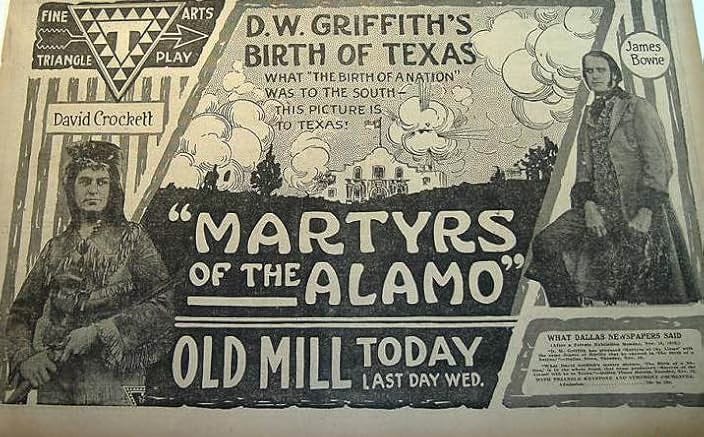
On the martyrdom of those fallen heroes was built “The Lone Star State.”
William Christy Cabanne & Theodosia Harris
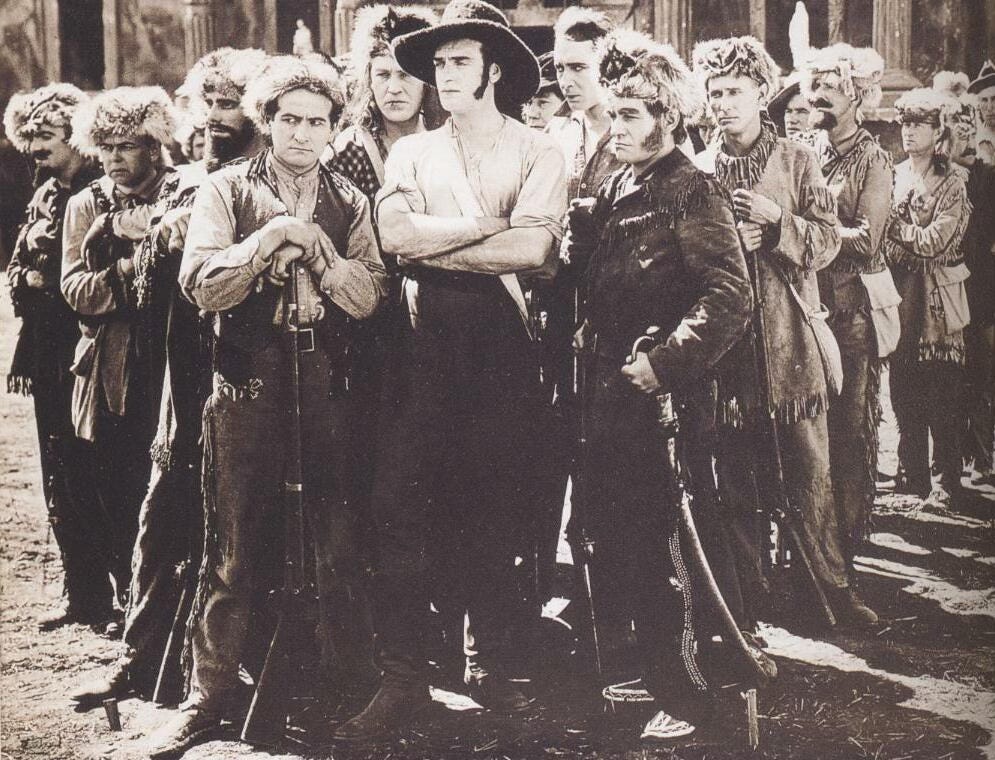
Martyrs of the Alamo is the furriest Alamo movie I’ve ever watched. Virtually every male actor wears a coonskin cap, which is a distinguishing departure from the typical Alamo production. But the fact that Martyrs of the Alamo is the earliest Alamo movie to have survived intact is what really makes this film unique.
A Fine Arts Production, released through Triangle Film Corporation on five reels on November 21, 1915, Martyrs of the Alamo was co-written by Theodosia Harris and twenty-seven-year-old William Christy Cabanne, who also directed it. An acolyte of D. W. Griffith of The Birth of a Nation fame, which was released to nationwide acclaim in February of that year, Cabanne’s film carries a Griffithian look.
Griffith is credited as a supervisor on Martyrs of the Alamo—though his contribution is so slight as to be nonexistent. That didn’t prevent the production company from marketing Martyrs of the Alamo as a Griffith film, removing Cabanne’s name from its promotion. To capitalize on Griffith’s connection, and to pass it off as a Griffith production, the film was given the subtitle The Birth of Texas, implying a sequel-like connection to The Birth of a Nation, Griffith’s epic extolling the “Lost Cause” and glorifying the Ku Klux Klan.
Not everyone was taken in with the marketing ploy, however, or happy about it. Frank Wood, writing for The New York Dramatic Mirror on April 22, 1916, called out the deception.
To each of the Fine Arts five-reel pictures, Mr. Griffith gives a measure of supervision both before and after they are filmed. But it is the policy of the organization to give to the individual directors the fullest possible freedom to work out their own artistic salvation. It is “up to them” individually and when one of these features is called a “Griffith picture,” it is a misnomer.
Thus the term, “a Griffith director” is quite as significant as the often misunderstood “supervised by David W. Griffith.” For while this supervision is actual, both before and after the filming of a picture, it is the director whose production it really is.
Martyrs of the Alamo mirrors The Birth of a Nation in its sweeping scale, its intricate and exciting battle sequences, many of which required numerous extras, and its use of cavalry and artillery. But one notable deviation from Griffith is the understated performances of Cabanne’s actors. According to Frank Thompson, Alamo film historian, “If Cabanne did not quite share his mentor’s genius as a director, it might also be pointed out that his actors’ performances also lack the more annoying mannerism that sometimes afflicted Griffith’s. The performances in Martyrs of the Alamo are, for the most part, subdued and effective with few of the tics and mannered gestures that sometimes passed for characterization in a Griffith film.”
Unfortunately, Cabanne didn’t deviate from Griffith where it mattered most. Though the opening title card calls it “An historical account” of the Texas Revolution against Mexican dictator Antonio López de Santa Anna for abolishing the Constitution of 1824, Martyrs of the Alamo is really a reflection of the racial hatred characterized in The Birth of a Nation. Replace black skin for brown skin and you can hardly tell the difference. Just as in The Birth of a Nation, where Reconstruction blacks are depicted as rapacious and lecherous, Mexican soldados in Martyrs of the Alamo are damned for their disrespect of white men and their animalistic appetite for white women. The link between the two films is strengthened by the casting of Walter Long. In The Birth of a Nation he portrays the renegade negro Gus whose attempted rape of Little Sister (Mae Marsh) drives her to her death. In Martyrs of the Alamo he plays Santa Anna who keeps the blonde-haired daughter of an old American soldier in his tent after the battle of the Alamo. His intentions are unambiguous.
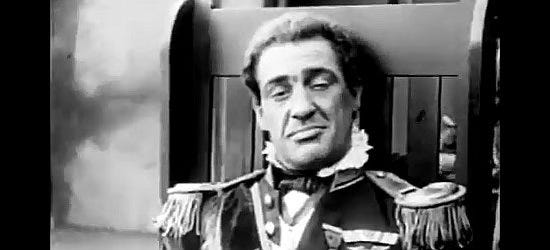
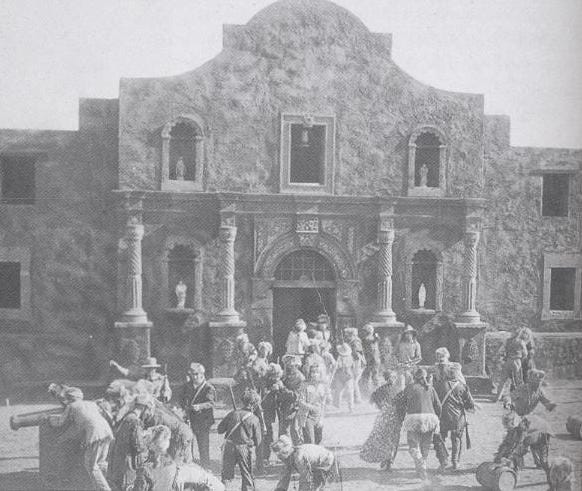
Martyrs of the Alamo was an ambitious film, depicting the battle of Béxar, the fall of the Alamo, the battle of San Jacinto, and the signing of the Treaty of Velasco—covering the months of December 1835 to May 1836. It was also ambitious in it production. Filmed entirely on the backlot of the Fine Arts Studio on Sunset Boulevard in Hollywood, the company constructed buildings to represent the village of San Antonio de Béxar, as well as an impressive baroque-style version of the Alamo chapel, with its iconic hump.1
The film opens with a hint of the racial tensions between Mexicans and “Americans”—as the Texians were called by Cabanne and Harris. When the old Irish-American patriot’s daughter is accosted on the streets of San Antonio by drunken soldados, the old man becomes angry and pulls out his American flag and recalls, as a title card reads, “Memories of the days when the Stars and Stripes gave them the right to protection.” Susannah Dickinson (Ora Carew) faces a similar fate while making her way home. She catches the eye of a Mexican officer who flirts with her and follows her home. When her husband Almeron (Fred Burns) learns of it he grabs his gun and sets out to find the man. When he does, he shoots and kills him. Dickinson is arrested and put in prison inside the Alamo.


Thompson writes, “Since the threat of miscegenation is clearly more fearful for Martyr’s Americans than the reality of Santa Anna’s dictatorship, it is logical that the Dickinsons and another couple become the focus for the film’s drama.” The other couple is “Silent” Smith (Sam de Grasse), loosely based on Texian scout “Deaf” Smith, and the beautiful blonde daughter (Juanita Hansen) of the old Irish-American patriot (Augustus Carney). These two couples create the emotional underpinnings of the story, leading to two different endings: one in tragedy, the other in hope.


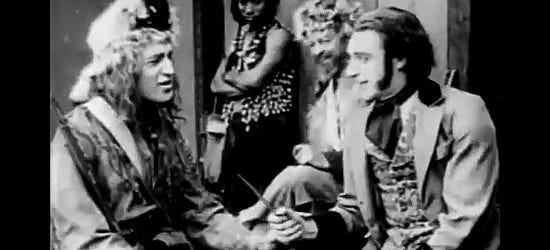
David Crockett (A. D. Sears), James Bowie (Alfred Paget), and William Barret Travis (John Dillon) are relatively minor characters in this drama. Nothing about them is historical. Crockett, who in real life was forty-nine in 1836, is depicted as a youthful, longhaired blonde. Bowie is the dandy in this picture who seems to be obsessed with keeping his boots clean, often wiping them with a bandana, and wields a none too impressive knife. And Travis, who in reality was a snappy dresser, is put in a coonskin cap and buckskin (the only film in which he’s portrayed as a frontiersman).
Seeking to avenge their ladies fair, the Americans bide their time while Santa Anna remains headquartered in the Alamo. When he departs, riding through the streets with flags waving, he places his brother-in-law General Martín Perfecto Cos in charge. With Santa Anna out of town, Cos and his men get drunk—and the Americans attack. Unable to put up an effective defense, Cos is driven from San Antonio.
The Americans now occupy the Alamo. When Santa Anna learns of Cos’s defeat, he returns to San Antonio and assaults the mission-fort in well staged battle sequences that appear as one continuous battle, blunting the sense of desperation needed for Travis to call the garrison together and to draw a line in the sand. That scene comes on suddenly. A title card flashes: “On the morning of the tenth day Travis told his men death was inevitable in the Alamo, but escape or surrender was possible. He had waited vainly hoping for reinforcement.” Travis says, “Those who wish to die like heroes and patriots, cross the line to me.” One man crosses immediately, the others hold back—the only Alamo movie in which the men seem to consider other options. Crockett, with a what-the-hell smile crosses the line and the others follow. The last man to cross is Bowie, “now near death.” Instead of being carried across on his cot, Bowie staggers over the line. One man doesn’t cross. Thompson writes, “Perhaps an earlier version of the film included the story of Moses Rose. If so, the filmmakers obviously thought better of it and deleted any reference to him; he exists in the film now only as a tantalizing glimpse.”2
The final assault on March 6, 1836, occurs when a group of soldados pop up inside the chapel via a secret tunnel, stories of which have persisted for many years.3. A more conventional retelling of the Alamo’s fall occurs when one of the walls is destroyed and soldados pour into the Plaza and overwhelm the defenders.
To enhance the racial stereotype of Mexicans as immoral brutes, Cabanne cuts to a blonde-headed, blue-eyed boy in hiding. A menacing brown hand enters the screen left and grabs the boy by the throat before a bayonet slowly empales the lad. Cabanne then cuts from that closeup to a middle shot of the soldado picking the boy up and throwing his lifeless body into the melée.
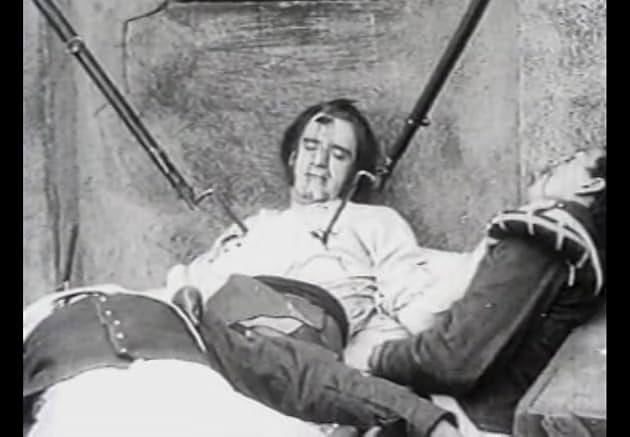
Once the Alamo falls, Cabanne fades into a series of tableaux of the dead defenders. Crockett slumps in front of the chapel, surrounded by Mexican dead. Bowie lays on his cot, two bayonets (with rifles attached) protruding from his chest, with his slave Joe (portrayed in blackface) laying beside him. Cabanne also depicts a group of surrendered survivors being executed.4
Martyrs of the Alamo ends with Santa Anna sending Susanna Dickinson to Sam Houston (Tom Wilson) with a warning of what will happen to all who oppose him. Houston retreats to San Jacinto. Santa Anna follows and encamps, where “Silent” Smith, feigning deafness, is (unbelievably) granted free reign, allowing him to overhear Santa Anna’s battle plan and to rescue his lady love—the blonde daughter of the old patriot—from the lustful clutches of the Mexican dictator.
As Sam Houston prepares for his attack, Santa Anna is shown in a drug induced fandango with beautiful women—an homage to the legend of the “Yellow Rose.” The title card informs us Santa Anna was a “drug fend” indulging in “shameful orgies.” (Though the women are fully clothed, the come-hither look by one implies that Santa Anna in particular and Mexicans in general enjoy engaging in group sex.)
A brief but exciting battle scene follows, with Santa Anna fleeing and exchanging his general’s uniform for a private’s uniform and hiding from Houston’s troops. Santa Anna is discovered and brought before a wounded Houston. The Americans want to hang Santa Anna but Houston convinces them to spare his life. The film concludes with Santa Anna signing the Treaty of Velasco: “And thus on May 14, 1836, Antonio Lopez de Santa Anna, President of Mexico, signed the treaty, acknowledging Texas free and independent.”
The final scene shows “Silence” Smith and his girlfriend embracing, while the distraught Susanna Dickinson “could not forget at what price came victory. But on the martyrdom of those fallen heroes was built ‘The Lone Star State.’” The film dissolves to the flag of Texas, the Stars and Bars of the Confederacy, and the Stars and Stripes of the United States, and fades out.
The film received raving reviews. The New York Dramatic Mirror, on October 30, 1915, claimed, no doubt to the chagrin of Cabanne, that “D. W. Griffith has again proved his mastery in the staging of spectacular scenes. [The film is] wonderfully realistic and wonderfully exciting.”
Variety, in the November 5, 1915, edition agreed: “To just call this a ‘stirring drama’ would be a slur upon one of the best features in its class and of its length (five reels) that has been turned over to the screen. Some of his battle scenes excel those in Griffith’s immortal ‘The Birth of a Nation.’”
The hump wasn’t present in 1836. It was added by the United States Army in the early 1850s to hide a newly constructed roof.
I cover the historicity of this this event in my “The Legend and Legacy of “The Line.”
This tunnel supposedly connected either the old Grenet home on Crockett Street to the Alamo Plaza or Mission Conceptión to the Alamo chapel. A yarn also persists that Crockett escaped through that tunnel.
Only The Alamo: Shrine of Texas Liberty (1938), Seguin (1982), and Houston: The Legend of Texas (1986) include a scene of surrendered men facing a firing squad. (The execution of David Crockett is included the 2004 film The Alamo.)
Martyrs of the Alamo, directed by William Christy Cabanne (1915; Delta Entertainment Corporation, 2004), DVD.
Frank Thompson, Alamo Movies (Old Mill Books, 1991).
Y’allogy is an 1836 percent purebred, open-range guide to the people, places, and past of the great Lone Star. We speak Texan here. Y’allogy is created by a living, breathing Texan—for Texans and lovers of Texas—and is free of charge. I’d be grateful, however, if you’d consider riding for the brand as a paid subscriber, it helps offset research and writing expenses—and ensures that Y’allogy remains cost free.
You can also show your support by purchasing my novel.
Be brave, live free, y’all.