


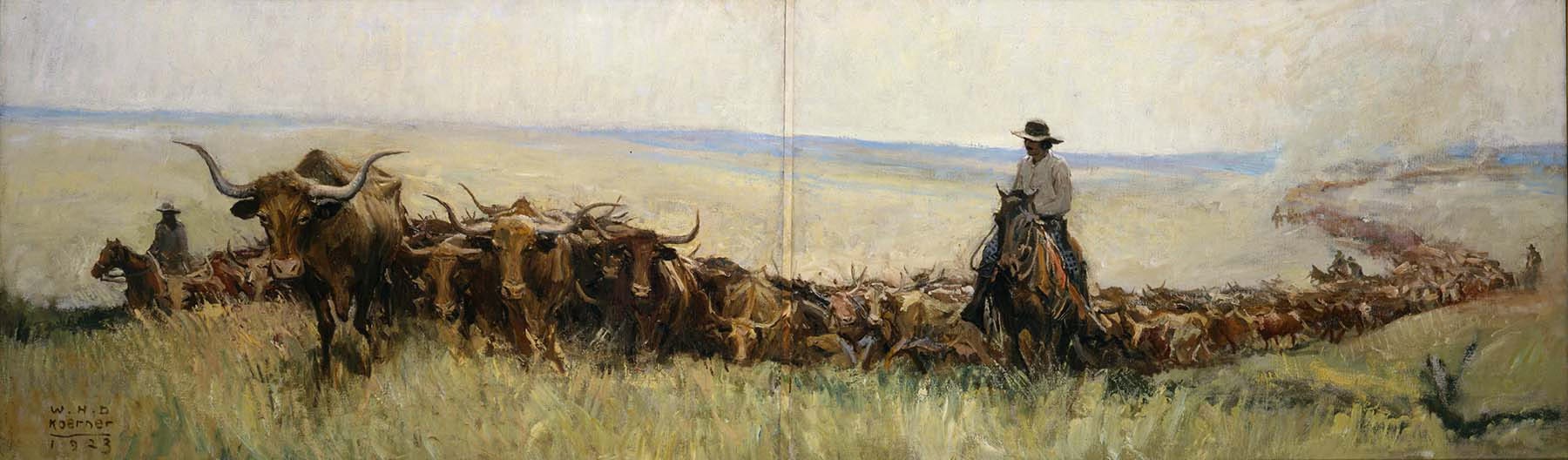
When I reached my eighteenth birthday . . . I was hired as a cow punch at twenty dollars a month and chuck. ¶ About the first thing I done in the line of work . . . was to go with some other cow punchers over to the T-Anchor.
W. H. Childers
Clichés become clichés because there’s a kernel of truth in them, including this well-known gem: “Everything is bigger in Texas”—bigger hats and hair, bigger egos and mouths, bigger prom mums and football rivalries, bigger land and sky, bigger guns and trucks, as well as the biggest cattle drive on one of the biggest ranches in Texas in the big sky country of the Panhandle.
The T-Anchor Ranch (though it wasn’t called that at the time) was established on a 320-acres tract at the Spring Draw near the junction of Palo Duro and Tierra Blanca Creeks (near present-day Canyon) in Randall County in the fall of 1877 by Leigh R. Dyer, the brother-in-law of Charles Goodnight. It was the first ranch in Randall County, the second in the Panhandle—Goodnight’s JA Ranch being the first. Shortly after its formation, Leigh and his brother Walter cut cedar logs from Palo Duro Canyon and constructed a two-room “dog-trot” cabin—the first substantial structure in the Panhandle. From there, under the DY brand, Dyer ran four hundred head of shorthorn cattle crossbred with JA bulls.
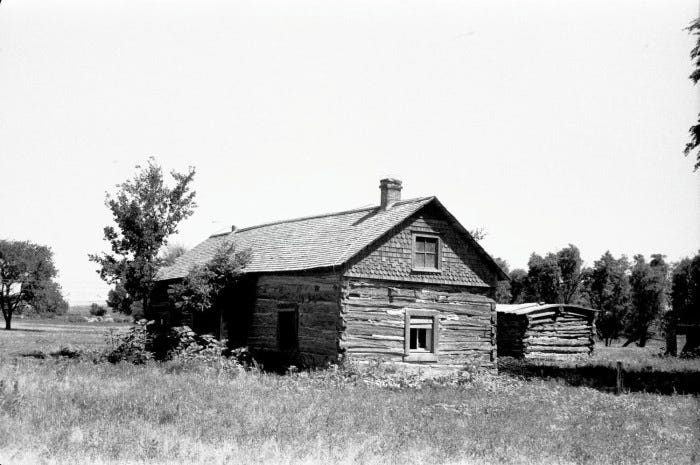
A year later, Dyer sold the ranch to railroad surveyors Jot Gunter and John S. Summerfield, and their partner Willam B. Munson Sr. In the fall of 1880, Jud Campbell trailed 3,800 cattle from Louisiana, Arkansas, and East Texas to the Randall County ranch and were branded GMS. This herd faired poorly during the winter of 1880–1881 and had to be replenished the following spring when Campbell drove another bunch to the ranch. Those that survived the winter had scattered. To keep their cattle from drifting, Campbell and the GMS hands fenced in the operation’s growing landholdings: a “small pasture” of 240,000 acres, which comprised the eastern half of Randall County. It was the first extensive fencing in the Panhandle.
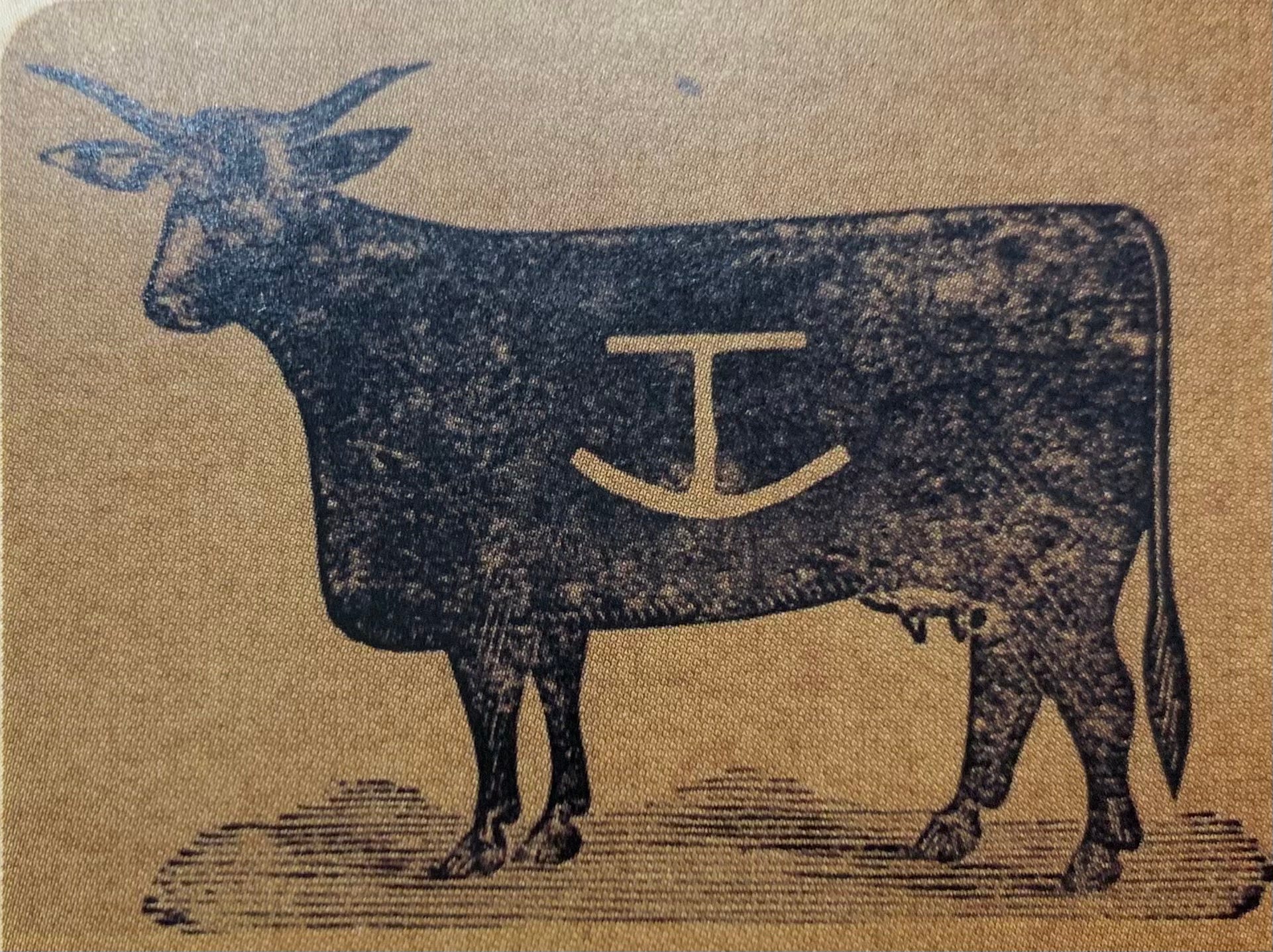
In the fall of 1881, Jule Gunter, Jot’s nephew, bought Summerfield’s interest. For a time the ranch continued to brand cattle with GMS but added the Crescent G. However, when Jule brought 3,500 head branded with the T-Anchor from his Burneyville Ranch in Indian Territory (present-day Oklahoma), the company dropped the other brands in favor of the T-Anchor.
The following summer, on August 24, 1882, sixteen punchers from the T-Anchor fanned out over the ranch that now consisted of all or part of seven Panhandle counties: all but a small portion of Randall, most of Deaf Smith, as well as portions of Swisher, Castro, Armstrong, Briscoe, and Oldham. Cowboys flushed cattle from the canyons and gathered them at Big Lake near Tulia to water and bed them down. Once bedded, it took a rider, at a fast trot, an hour to circle the herd.
The next day, the outfit threw the cattle on the trail, driving them to the main ranch outside of Canyon. Waiting to count them were Jule Gunter and Vas Stickley, the T-Anchor foreman. Six hours and thirty-two some odd miles later the leaders passed through the gate at 2:00 in the afternoon—the drag or the stragglers hadn’t even started. They didn’t pass through the counters until well after dark.
The final tally was 10,652 head of cattle and 125 horses in the remuda—the largest cattle drive in history. A record that still hasn’t been broken.
W. H. Childers, in Texas Cowboys: Memories of the Early Days, ed. Jim Lanning and Judy Lanning (Texas A&M University Press, 1984), 18.
C. Boone McClure, “A Review of the T-Anchor Ranch,” Panhandle-Plains Historical Review, vol. 3 (1930), 64–77.
Y’allogy is an 1836 percent purebred, open-range guide to the people, places, and past of the great Lone Star. We speak Texan here. Y’allogy is created by a living, breathing Texan—for Texans and lovers of Texas—and is free of charge. I’d be grateful, however, if you’d consider riding for the brand as a paid subscriber, it helps offset research and writing expenses—and ensures that Y’allogy remains cost free.
You can also show your support by purchasing my novel.
Be brave, live free, y’all.
What sight that must have been.
Fortunately, the cabin survived.
According to panhandleplains.org:
"And in 1883, the headquarters played a central role in a heated cowboy strike between dissatisfied hands and ranch management. Fearing a takeover by force, ranch manager Jule Gunter filled a keg with horseshoes and dynamite, intending to blow the cabin apart if necessary. Thankfully, the matter was resolved."