

The Banner of Independence

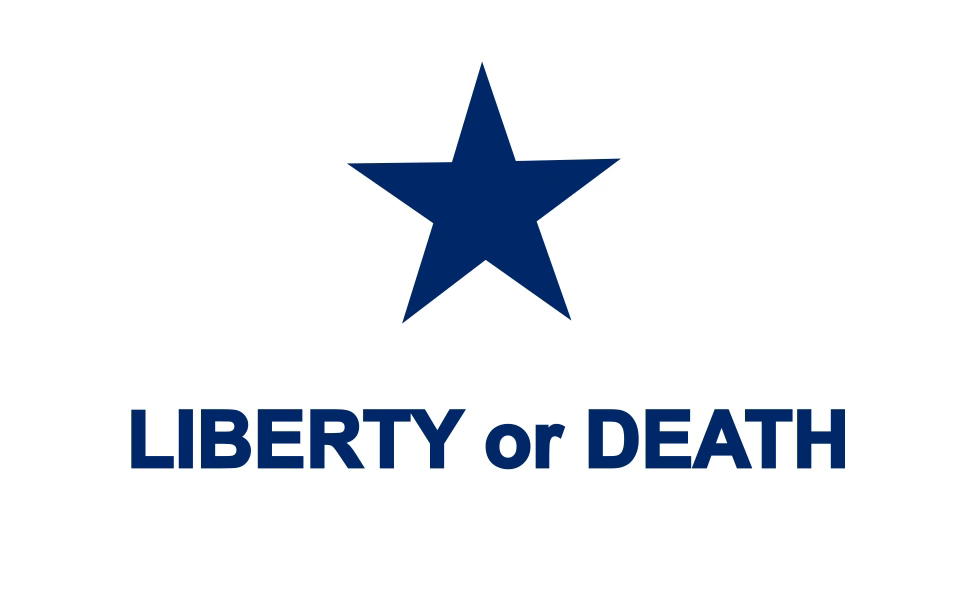
The new star gleaming on a blue flag over Goliad for the first time was fluttering and fighting with the winds of a raging storm.
Herman Ehrenbert
He was an enigmatic character—soldier, adventurer, prospector, cartographer, and memoirist, even if much of his memoir is made up.
Herman Vollrath Ehrenberg was born in the village of Steuden, Prussia on November 17, 1816. At the age of eighteen he emigrated to the United States, sailing aboard the Ludwig, disembarking on the docks of New York City. He was alone. Nothing is known of his activities in New York, except a mention in his memoir of eating in John Jacob Astor’s restaurant and of the young attractive women he saw on Broadway. A year later, in 1835, he was in New Orleans volunteering to fight in the Texas Revolution as a member of the New Orleans Greys.
When he arrived in Texas, Ehrenberg took part in the siege of Béxar (1835) and fought at the battle of Coleto (1836), where he was captured with the rest of Colonel James W. Fannin’s command and sent to Presidio La Bahía (Goliad), where on March 27, 1836, Mexican soldados under the command of José de Urrea massacred the Texians. Ehrenberg was one of twenty-eight men to escape the bloodletting, receiving a saber slash across his forehead.
Making his way west as far as the Colorado River he was recaptured by Mexican troops. This time he was sent to Matagorda Bay, where he and other prisoners labored for the Mexican army. However, after Antonio López de Santa Anna was defeated by Sam Houston at San Jacinto, and the rest of the Mexican army retreated across the Rio Grande, Ehrenberg escaped a second time.
He became a citizen of the Republic of Texas and served in a ranging company in 1840. While on the frontier, he became ill and sailed for Europe for medical treatment. While recuperating in the university city of Halle he wrote his memoir. Finished sometime in 1842, Ehrenberg sent the manuscript to Otto Wigand, a Leipzig publisher, who released Ehrenberg’s autobiography in three volumes: Texas und Seine Revolution [Texas and Its Revolution] (1843), Der Freiheitskampf in Texas im Jahre 1836 [The Struggle for Freedom in Texas in the Year 1836] (1844), and Fahrten und Schicksale eines Deutschen in Texas [Wanderings and Fortunes of a German in Texas] (1845). His memoir became the most popular German-language publication on Texas, though he never saw any in print. He had returned to America in the summer of 1843.
Ehrenberg’s narratives are as enigmatic as the man himself. According to historian James E. Crisp, Ehrenberg filled his work with “embellishments and outright lies . . . [made] up stories . . . [putting] his own words in other people’s mouths, and [inventing] imaginary Texans.” But Crisp admires Ehrenberg and offers an explanation for this mystifying man.
To understand Ehrenberg is to appreciate a young Texas “everyman” as he presents himself as a proud citizen of the Texas Republic. To a great extent, the early Texan character was molded by the experience—both factually and in popular mythic memory—of the Texas Revolution. Ehrenberg’s memoir embodies both the facts and the myths. To understand him is, to a great extent, to understand Texas, even the Texas of today—which still carries the legacies—the glory and the burden—of that iconic history.
The following passage from Ehrenberg’s memoir recounts when the defenders at Goliad first heard about the signing of the Texas Declaration of Independence. It is both fact-based and fairy-tale, making ample use of the glory and burden that has become the iconic history of Texas.
Der 2. März [March 2, 1836]
On March 5, we received a refreshing bit of news from the representative assembly at Washington [-on-the-Brazos].1 On the second of March, our first congress had solemnly proclaimed the independence of the former province of Texas from the Mexican confederation of states, and declared that the territory between the Rio Grande, the Sabine River, and the Red River from that day on was taking its place as the Republic of Texas among the nations of the world.2
The weather that day was as stormy as the jubilation that resounded through the colony. The new star gleaming on a blue flag over Goliad for the first time was fluttering and fighting with the winds of a raging storm. It had been waving in all its glory over the walls of Goliad for hardly an hour when suddenly a fresh assault by the storm sent the flag with flagstaff and star swirling down inside the fort. Its fall was indeed a bad omen, but what new nation, as it bounds into existence, does not have to put up with some adversity? Only a little time elapsed, however, before the blue banner was whipping again in the wrathful winds. Soon the winds subsided and the departing sun was gilding the purple clouds on the western horizon that for us was the farewell signal to the abating storm.3


Ehrenberg guessed at the date of March 5, 1836, when the men at Goliad heard the news of the Texas Declaration of Independence. A missive from prolific letter-writer John Sowers Brooks from Goliad on March 4 made no mention of the Texas Declaration of Independence. The first allusion of it from the presidio came from Thomas B. Rees on March 8, and Brooks, writing on the ninth, only speaks of the Declaration as a probability, not a certainty. Burr Duval, captain of volunteers from Kentucky at Goliad, considered the news unofficial on the ninth. The following day, the tenth, Books wrote that the news of a declaration of independence was merely “rumored.” Fannin, writing on March 11, said he had received no official word from the Convention that a declaration had been issued.
Though Ehrenberg used the word “congress,” it was the Convention of 1836 that declared independence on March 2 and wrote the Constitution of the Republic of Texas before adjourning—and fleeing the oncoming Mexican armies. The delegates at the Convention of 1836 did not determine the boundaries of the Republic of Texas. The eastern and northern boundaries with the United States along the Sabine and Red Rivers were essentially inherited from Spain and Mexico. The Rio Grande boundary with Mexico was anticipated by the Treaties of Velasco signed with Antonio López de Santa Anna following his capture after the Battle of San Jacinto, but these treaties were never ratified by Mexico or Texas. The First Congress of the Republic of Texas, on December 19, 1836, “declared the southern and western boundary of Texas to be the Rio Grande from its mouth to its source and thence a line due north to the forty-second parallel”—known as the Stovepipe.
The flag Ehrenberg describes is most certainly the banner of the Georgia Battalion, which had been organized by William Ward in Macon, Georgia, after a town meeting on November 12, 1835. Volunteers, primarily, from Macon, Milledgeville, and Columbus marched through Knoxville, Georgia, on their way to Texas, when a flag was presented to them by seventeen-year-old Joanna Troutman. It was flown by the unit upon arrival in Velasco, Texas, on December 20, and again as they arrived with Fannin at Copano on February 1, 1836.
Though Ehrenberg says the banner was “a blue flag,” most eyewitnesses describe the flag as a white field of silk with an “azure” five-pointed star attached on each side. On one side was affixed the words “Texas and Liberty” and on the other side, the Latin phrase, “Ubi Libertas habitat, ibi nostra patria est”—“Where Liberty dwells, there is our country.”
Lewis Washington, a survivor of the Georgia Battalion at the Goliad Massacre, remembered the wording “Liberty or Death” instead of “Texas and Liberty.” He also stated that at some point the flag was being lowered from the flagstaff at Goliad at sunset “when by some unlucky mishap, the beautiful silken banner became entangled in the halyards, and was torn into pieces. Only a small fragment remained adjusted to the flag-staff; and when Col. Fannin evacuated Goliad, to join Gen. Houston, in accordance with received orders, the last remnant of the first ‘Flag of the Lone Star,’ was still fluttering at the top of the staff from which floated the first ‘Flag of Independence’”—the so-called bloody-arm flag raised with the “Goliad Declaration of Independence” on December 20, 1835.
Herman Ehrenberg, Inside the Texas Revolution: The Enigmatic Memoir of Herman Ehrenberg, trans. Louis E. Brister and James C. Kearney, ed. James E. Crisp (Texas State Historical Association, 2021), xvi, 227. On the notes, see pages 209, n. 20; 221; 234–35, n. 27, 28, 30.
Y’allogy is an 1836 percent purebred, open-range guide to the people, places, and past of the great Lone Star. We speak Texan here. Y’allogy is created by a living, breathing Texan—for Texans and lovers of Texas—and is free of charge. I’d be grateful, however, if you’d consider riding for the brand as a paid subscriber, it helps offset research and writing expenses—and ensures that Y’allogy remains cost free.
You can also show your support by purchasing my novel.
Be brave, live free, y’all.
I cover 6 counties but Goliad is the only one of mine to call it a holiday…so I took the day off!
Happy Birthday 🎂 Great article as usual!