

Thanksgiving Along the Rio Grande

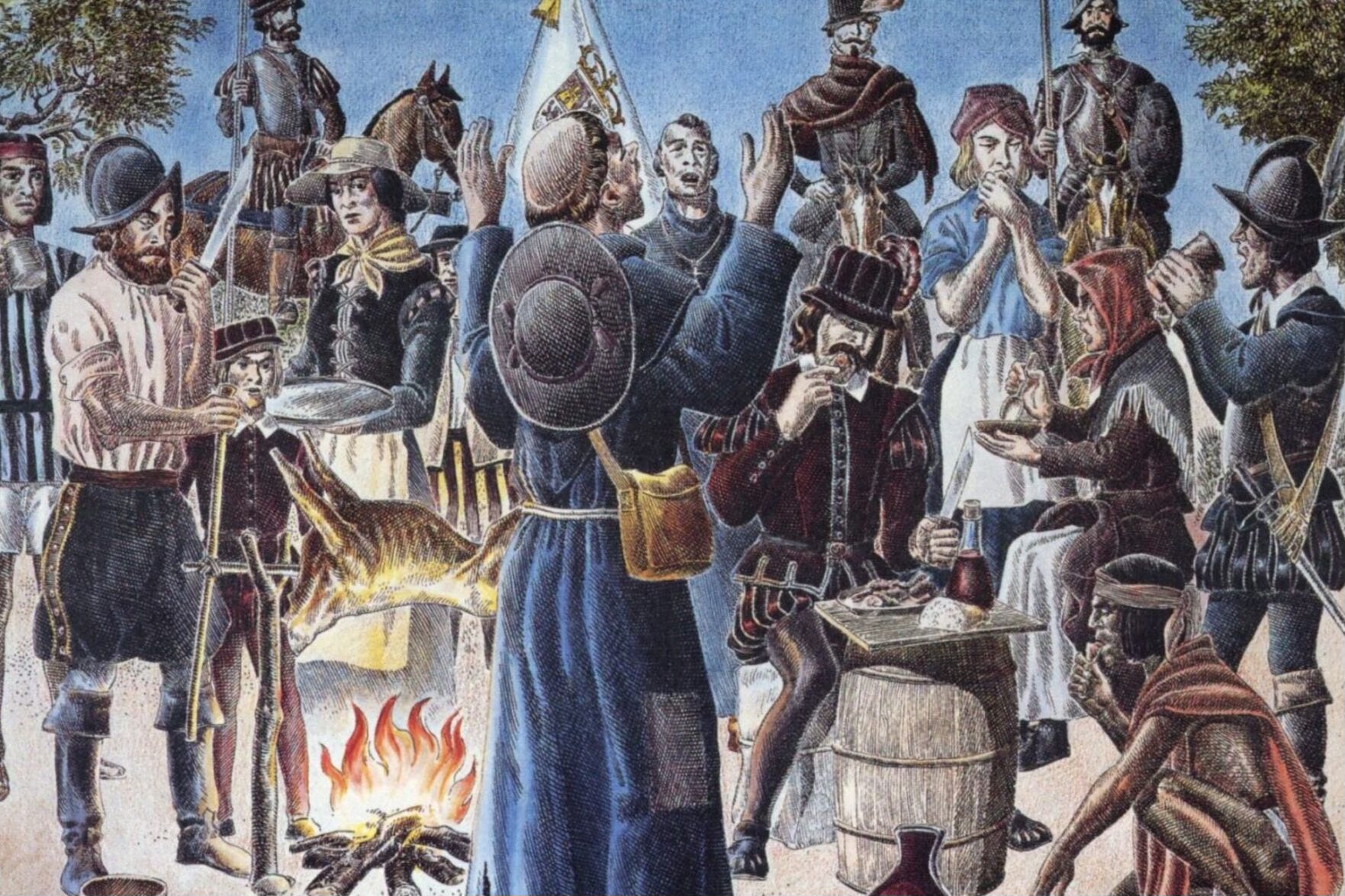
We built a great bonfire and roasted meat and fish.
Gasper Pérez de Villargá
It should come as no surprise to anyone who has encountered a true Texan that we’re apt to brag that everything in our state is either the biggest or best or first, even if it doesn’t make a bit of sense, like jumbo shrimp (which of course, we have the best and biggest). Such braggadocio is charming to some and exasperating to others—bless their hearts.
One of the things Texans would brag about, if more knew about it, is that the first Thanksgiving held in North America was in Texas, eighty years before the celebrated 1621 Thanksgiving of the Plymouth Colony Pilgrims in Massachusetts. In May 1541, the expedition of Fransisco Vázquez de Coronado celebrated a Feast of Thanksgiving in Palo Duro Canyon during his search for the Seven Cities of Gold.1 Located in the middle of the foreboding llano estacado, Coronado and his men found much needed water and game along the canyon floor—signs of God’s provision and blessing—leading Fray Juan Padilla to celebrate a Thanksgiving Mass.2
But this wasn’t the only early Texas celebration of Thanksgiving. Nearly sixty years later, on April 30, 1598, another Spanish expedition, led by Juan de Oñate, offered thanks for their salvation.
✭
Don Juan de Oñate was a member of a distinguished family in service to the Spanish crown who married a woman of noble Castilian and Aztec blood—a descendant of both Hernán Cortés and Moctezuma II. Oñate’s father had discovered and developed mines in Zacatecas, Mexico, a profession the young Oñate adopted, speculating in and opening mines in San Luis Potosí.
Granted land in Nuevo México in 1565 by the viceroy of New Spain, Oñate cobbled together an expedition of four to five hundred soldiers, colonists, wives and children, and 7,000 head of livestock. Three years later, in early March 1598, Oñate set out across the Chihuahuan desert. Bypassing the traditional route from the Rio Conchos to the Rio Grande and following its course northward, Oñate ordered Vicente de Zaldívar to blaze a wagon trail from Santa Barbara in southern Chihuahua to what became the city of El Paso. (The modern highway between Chihuahua and El Paso follows Zaldívar’s trail.)
Almost immediately the expedition encountered difficulties. Seven days of consecutive rain mired them in miserable mud. Then the skies cleared and brought endless days of dryness. Five days from the Rio Grande the expedition ran out of food and water, forcing members to dig for roots and hunt edible desert plants. Waterlessness nearly drove them insane, including the livestock. Captain Gasper Pérez de Villargá, a member of the expedition, composed an epic poem about their journey in 1610 and wrote of their terrible thirst and their arrival at the Rio Grande, near San Elizario:
The gaunt horses approached the rolling stream and plunged headlong into it. Two of them drank so much that they burst their sides and died. Two others, blinded by their raving thirst, plunged so far into the stream that they were caught in its swift current and drowned.
Our men, consumed by the burning thirst, their throats parched, threw themselves into the water and drank as though the entire river did not carry enough to quench their terrible thirst. Then satisfied, they threw themselves upon the cool sands, like foul wretches stretched upon some tavern floor in a drunken orgy, deformed and swollen and more like toads than men.
After recuperating for ten days, on April 30, 1598, Oñate ordered a day of Thanksgiving, celebrating their salvation with Mansos Indians, who later became absorbed into one or another Apache band. The Spaniards provided wild game and the Mansos provided fish. A Mass was held by Franciscan missionaries. Oñate read the La Toma—the taking—declaring the land drained by the Rio Grande to be the possession of King Philip II of Spain.
De Villargá wrote of their Thanksgiving celebration: “We built a great bonfire and roasted mean and fish, and then all set down to a repast the like of which we had never enjoyed before. We were happy that our trials were over; as happy as were the passengers in the Ark when they saw the dove returning with the olive branch in his beak, bringing tidings that the deluge had subsided.”
After their feast, the Oñate expedition continued through el paso del rió del norte—the pass across the river of the north—following the waterway until they settled near Santa Fé.
✭
According to the Texas Almanac, “The Texas Society of Daughters of the America Colonists placed a marker in 1959 just outside the Canyon. It declared that that the expedition of Francisco Vázquez de Coronado in May 1541 celebrated the first feast of Thanksgiving in Palo Duro Canyon.” Some claim this was a celebration of the Feast of the Ascension.
Other early Thanksgiving celebrations, predating the Plymouth Thanksgiving, include the June 30, 1564, French Huguenot celebration near present-day Jacksonville, Florida, and the September 8, 1565, Spanish celebration at St. Augustine, Florida.
✭
Gasper Pérez de Villagrá, Historic de la Nueva México, trans. Gilberto Espinosa (The Quivira Society, 1933).
Y’allogy is an 1836 percent purebred, open-range guide to the people, places, and past of the great Lone Star. We speak Texan here. Y’allogy is created by a living, breathing Texan—for Texans and lovers of Texas—and is free of charge. I’d be grateful, however, if you’d consider riding for the brand as a paid subscriber, it helps offset research and writing expenses—and ensures that Y’allogy remains cost free.
You can also show your support by purchasing my novel.
Be brave, live free, y’all.
Well by God, we are not going to let them damn Yankees claim they had the first Thanksgiving.
I proclaim April 30th as the official, day of the Spanish American Thanksgiving in Texas.
The meal to be served shall consist of Fajitas, Tamales, and Tacos and all of the sides dishes associated with Tex-Mex fine dining.
Thank you for your attention to this matter. 😁