


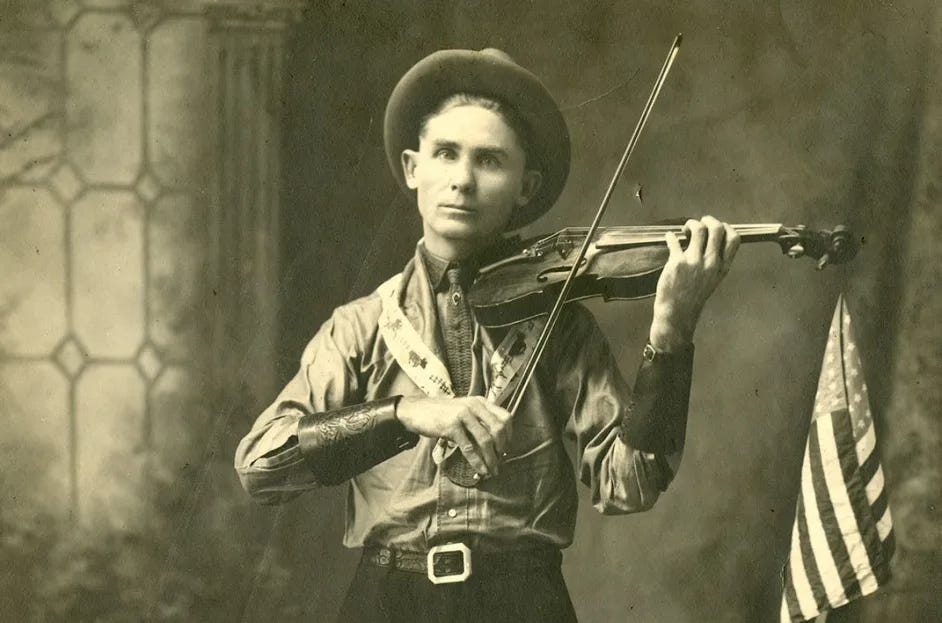
“If fiddlers is thick in hell, damned if I know why they ain’t populating Sherman.”
Tom Gilroy
Novelist and essayist Larry McMurtry was no fan of J. Frank Dobie, though he recognized that to Texans of a certain generation Dobie “was a notch above Homer and a notch below Shakespeare, while the world outside reckoned him almost as good as Carl Sandburg.” Whether those comparisons were true or not when McMurtry wrote that in 1968, today, very few Texans, to say nothing of the world outside, know who Dobie was, much less have read anything from him. But of that generation, in the 1940s and 1950s, he was the preeminent Texas chronicler—the keeper of Texas stories, myths, and folklore.
Dobie was still establishing his reputation as a Texas writer in 1928. At the behest of his uncle Jim, Dobie met with Tom Gilroy, an old cowman and horseman, who told Dobie a story about a traveling fiddler. The story was first published in 1931 but was retold by Dobie and his wife Bertha in 1958 as part of their Christmas letter. Portions of that story are reprinted here for your holiday enjoyment.
One day I was in my livery stable at Sherman. This was in the [1870s]. A tramp-looking feller with something in a sack that I took to be a fiddle limped up. He appeared all wrung out. “Mister,” he says, “I’ve come to Texas all the way from Illinois. I ain’t got but fifty cents left, I’m dead tired, and I wish you’d let me sleep in your hay.”
“Hell,” I says, “you won’t hurt the hay. Crawl in back yonder and sleep all you want.”
Well, he hadn’t been in the hay more’n an hour when I herd a noise like hell emigrating on cart wheels, and a big iron-gray horse with a cowboy a little bit bigger on top of him lit inside the stable door. . . . He was six-foot-six and as trim as an ash. His name was Yarborough. He didn’t lose no words, and his voice shook the mangers back in the corral.
“By God,” he said, “we’re all ready to start up the trail in the morning. Herd counted, cook sober, a sackful of buffalo chips gathered, water keg full, whisky jug nearly empty, everything in shape. We got to have a dance tonight and I’m hunting a fiddler. If fiddlers is thick in hell, damned if I know why they ain’t populating Sherman, but I can’t find even one. Tell me where in all outdoors I can find a fiddler. We just got to have a fiddler.”
“Now hold your potatoes a minute,” says I, “and I’ll tell you something. There’s a feller asleep back there in the hay that I’m pretty certain is a fiddler.”
By this time Yarborough was off his horse and clanking back to the hay shed. I heard a scuffle and the man from Illinois came out rubbing his eyes. His name was Mathis, he said, and yes, his profession was fiddling.
“How’ll I get out to the dance?” he asked.
“Right behind me,” yelled Yarborough.
He was already on his big gray horse and had the horse headed towards the street. Mathis handed up the sack with the fiddle in it. It was evident he’d never mounted a horse in his life, and I kinder shoved him up. He’d barely locked his arms around the cowboy when that devil socked in the spurs and the gray gave a snort and a leap that landed them, I’ll swear, more than halfway across the street. If you ever tried to look at greased lightning through a dust storm you’ll know how the fiddler, the six-foot-six cowboy, and the iron-gray horse left town. . . .
The crowd was already gathering. They gave [Mathis] a good stiff drink, and he began sawing. He could make that fiddle talk. Every time he’d fag, they’d give him some whiskey. Between drinks of whisky, they’d give him coffee, and they’d saucer it and blow it for him so he wouldn’t lose no time swallering it. They shore wanted to keep on dancing. He played “Hell Among the Yearlings” so many times that some of the boys went to bawling like bull calves, and when he’d switch to “Rye Whiskey” they’d make out like they was swallering from bottles. . . .
He could fiddle down a possum from a mile-high tree,
He could fiddle up a whale from the bottom of the sea.
Swing yore pardners—up and down the middle!
Sashay now—oh, listen to that fiddle!
Flapjacks flippin’ on a red-hot griddle. . . .
The sun was coming up before Mathis played “I’m A-leaving Cheyenne,” and everybody for the last time joined in on “My Horses Won’t Stand.” As the crowd broke up he wanted to know how he was going to get back to town.
“Well, me and that iron-gray has got to go to the herd and pint it for the North Pole,” says Yarborough, “and so we can’t take you. But we’ll get you to town all right. We’ll get you there in a comfortable way, too, and won’t punish you with riding double. Hey there, some of you fellers hitch up a pair of horses to that buggy.”
The corral was full of horses, not one of which had ever looked through a collar and half of which would pitch at the sight of a saddle. The boys were all feeling juicy and they roped out a couple of browns as strong as buffalo bulls and as skittish as wild turkeys fresh trapped in a covered pen. Then they hitched this pair to the buggy.
“Git in!” Yarborough bellered to the fiddler. “Grab them lines, and we’ll head you off in the right direction. When you get to town, jest leave the rig at the livery stable, and somebody’ll get it some time.”
The fiddler got in and grabbed the lines. Two cowboys on each side of the team pointed them out of the lot and towards Sherman. There wasn’t any road to speak of and the browns didn’t seem to have any idea of going in any particular direction. In spite of all the herders could do, the team began making parabolas, circles, acute triangles and parallelograms and do-ce-do-ing over about five acres of prairie.
“Hold up, hold up!” Yarborough yelled, loping his horse up to the buggy. “Say, how much do we owe you for the fiddling?”
“If you’ll get somebody in this buggy that can drive these horses you won’t owe me anything,” Mathis called back as the browns gave an extra wild tug.
Well, they gave the fiddler twenty dollars and put a man in the buggy who could, with the help of two herders, get the equipage to town. The boys were still gay when they whoaed down in front of my livery stable. . . .
Wherever you whoa this Christmas season, I hope it’s a merry old time. Merry Christmas, y’all.
J. Frank Dobie, “Tom Gilroy’s Fiddler,” in I’ll Tell You a Tale: An Anthology (Boston: Little, Brown and Company, 1931), 133–6.
Larry McMurtry, “Introduction: The God Abandons Texas,” In a Narrow Grave: Essay on Texas (New York: Liveright Publishing Corporation, 2018), 25.
Y’allogy is an 1836 percent purebred, open-range guide to the people, places, and past of the great Lone Star. We speak Texan here. Y’allogy is created by a living, breathing Texan—for Texans and lovers of Texas—and is free of charge. I’d be grateful, however, if you’d consider riding for the brand as a paid subscriber, it helps offset research and writing expenses—and ensures that Y’allogy remains cost free.
You can also show your support by purchasing my novel.
Be brave, live free, y’all.
What a marvelous story! Mr Dobie at his best.
Great story! Merry Christmas 🎅🎻