

Texas Tales: Sancho, the Tamale-Loving Longhorn

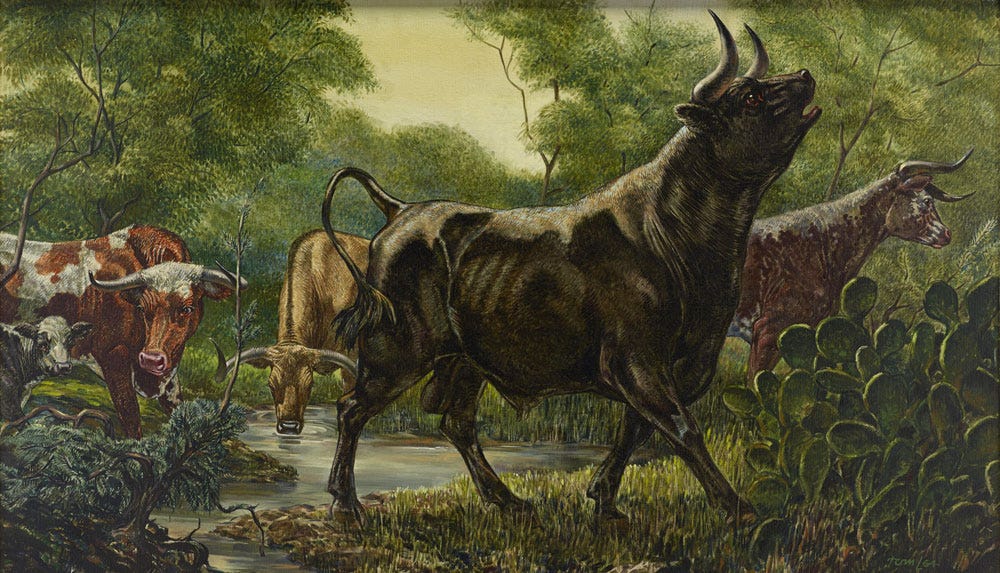
Old Sancho lived right there on the Esperanza, now and then getting a tamale, tickling his palate with chili peppers in season, and generally staying fat on mesquite grass, until he died a natural death.
J. Frank Dobie
John Rigby was a Beeville, Texas cowhand, trailing cattle from south Texas to railheads in Kansas and ranches as far north as Wyoming. He worked as a drover, a segundo (second-in-command), and a trail boss. When the open range closed and cattle drives became a things of the past and fodder for mythologies, Rigby became a brand inspector—that’s when he met and befriended Texas folklorist J. Frank Dobie and passed on the story of Sancho, the tamale-loving longhorn.
I first encountered the story of Sancho (told here in abridgment) in Dobie’s The Longhorns, which contains certain details Rigby, as a good teller of cowboy tales, probably fabricated. Dobie, himself, wasn’t Pharisaical about the finer points of the truth when it came to telling Texas tales, confessing that he “did some constructive work on Sancho over the years.”
In his introduction of the story in The Longhorns Dobie wrote: “[Sancho] is entitled to be remembered along side of Old Blue, who led Goodnight’s heard, Alamo in Emerson Hough’s North of 36, “The Blue Roan Outlaw,” in Will C. Barnes’s Tales from the X-Bar Horse Camp, and the Poker Steer in Andy Adams’ Cattle Brands. And I would add: Old Dog from Larry McMurtry’s Lonesome Dove.
✭
A man by the name of Kerr had a little ranch on Esperanza Creek in Frio County, in the mesquite lands south of San Antonio. He owned several good cow ponies, a few cattle, a little bunch of goats that a dog guarded by day. At night they were shut up in a brush corral near the house. Three or four acres of land, fenced in with brush and poles, grew corn, watermelons and “kershaws” [squash]—except when the season was too drouthy. A hand-dug well equipped with a pulley wheel, rope and bucket furnished water for the establishment.
Kerr’s wife was a partridge-built Mexican named María. They had no children. She was clean, thrifty, cheerful, always making pets of animals. . . .
Late in the winter of 1877, Kerr while riding over on the San Miguel found one of his cows dead in a bog-hole. Beside the cow was a mud-plastered little black-and-white paint bull calf less than a week old. It was too weak to run. . . . Kerr pitched his rope over its head, drew it up across the saddle in front of him, carried it home, and turned it over to María.
. . . The first thing she did . . . was to pour milk from a bottle down the orphan’s throat. With warm water she washed the caked mud off its body. But hand-raising a calf is no end of trouble. The next day Kerr road around until he found a thrifty brown cow with a young calf. He drove them to the pen. By tying the cow’s head up close to a post and hobbling her hind legs, Kerr and María forced her to let the orphan suckle. . . . After being tied up twice daily for a month, she adopted the orphan as a twin to her own offspring.
[. . .]
The dogie was a vigorous little brute, and before long he was getting more milk than the brown cow’s own calf. María called him Sancho, a Mexican name meaning “pet.” She was especially fond of Sancho, and he grew to be especially fond of her.
She would give him the shucks wrapped around tamales. Then she began treating him to whole tamales, which are made of ground corn rolled around a core of chopped-up meat, this banana-shaped roll, done up in a shuck, then being steam-boiled. Sancho seemed not to mind the meat. As everybody who has eaten them knows, Mexican tamales are highly seasoned with pepper. Sancho seemed to like the seasoning.
In southern Texas the little chiltipiquin peppers, red when ripe, grow wild in low, shaded places. Cattle never eat them, leaving them for the wild turkeys, mockingbirds and blue quail to pick off. Sometimes in the early fall wild turkeys used to gorge on them so avidly that their flesh became too peppery for human consumption. By eating tamales Sancho developed a taste for the little red peppers growing in the thickets along the Esperanza Creek. In fact, he became a kind of chiltipiquin addict. He would hunt for the peppers.
[. . .]
Every night Sancho came to the ranch pen to sleep. His bed ground was near a certain mesquite tree just outside the gate. He spent hours every summer day in the shade of this mesquite. When it rained and other cattle drifted off, hunting fresh pasturage, Sancho stayed at home and drank at the well. He was strictly a home creature.
In the spring of 1880 Sancho was three years old and past white of horn and as blocky of build as a long-legged Texas steer ever grew. Kerr’s ranch lay in a big unfenced range grazed by the Shiner brothers. That spring they had a contract to deliver three herds of steers, each to number 2500 head, in Wyoming. Kerr was helping the Shiners gather cattle, and, along with various other ranchers, sold them what steers he had.
Sancho was included. One day late in March the Shiner men road-branded him 7Z and put him in the first herd north. The other herds were to follow two or three days apart.
It was late in the afternoon when the “shaping up” of the herd was completed. It was watered and thrown out on open prairie ground to be bedded down. But Sancho had no disposition to lie down—there. He wanted to go back to that mesquite just outside the pen gate at the Kerr place on the Esperanza. . . . Perhaps he had in mind an evening tamale. He stood and roamed about on the south side of the herd. A dozen times during the night the men on guard had to drive him back. As reliefs were changed, word passed to keep an eye on that paint steer on the lower side.
When the herd started on next morning, Sancho was at the tail end of it, often stopping and looking back. It took constant attention from one of the drag drivers to keep him moving. By the time the second night arrived, every hand in the outfit knew Sancho, by name and sight, as being the stubbornest and gentlest steer in the lot. About dark one of them pitched a loop over his horns and staked him to a bush. This saved bothering with his persistent efforts to walk off.
[. . .]
One day the cattle balked and milled at a bank-full river. “Rope Old Sancho and lead him in,” the boss ordered, “and we’ll point the other cattle after him.” Sancho led like a horse. The herd followed. As soon as he was released, he dropped back to the rear. After this, however, he was always led to the front when there was high water to cross.
[. . .]
When, finally, after listening for months, day and night, to the slow song of their motion, the “dogies” reached their “new home,” Sancho was still halting every now and then to sniff southward for a whiff of the Mexican Gulf. The farther he got away from home, the less he seemed to like the change. He had never felt frost in September before. The Mexican peppers on the Esperanza were red ripe now.
The Wyoming outfit received the cattle. Then for a week the Texas men helped brand CR on their long sides before turning them loose on the new range. When Sancho’s time came to be branded in the chute, one of the Texans yelled out, “There goes my pet. Stamp that CR brand on him good and deep.” Another one said, “The line riders had better watch for his tracks.”
And now the Shiner men turned south, taking back with them their saddle horses and chuck wagons—and leaving Sancho behind. . . .
Spring comes early down on the Esperanza. The mesquites were all in new leaf with that green so fresh and tender that the color seems to emanate into the sky. The bluebonnets and the pink phlox were sprinkling every hill and draw. The prickly pear was studded with waxy blossoms, and the glades were heavy with the perfume of white brush. It was a good season, and tallow weed and grass were coming together. It was a time for the spring cow hunts and the putting up of herds for the annual drive north. The Shiners were at work.
“We were close to Kerr’s cabin on Esperanza Creek, John Rigby told me, “when I looked across a pear flat and saw something that made me rub my eyes. I was riding with Joe Shiner, and we both stopped our horses.”
“Do you see what I see?” John Rigby asked.
“Yes, but before I say, I’m going to read the brand,” Joe Shiner answered.
They rode over. “You can hang me for a horse thief,” John Rigby will tell, “if it wasn’t that Sancho paint steer, four years old now, the Shiner 7Z road brand and the Wyoming CR range brand both showing on him as plain as boxcar letters.”
The men rode on down to Kerr’s.
“Yes,” Kerr said, “Old Sancho got in about six week ago. His hoofs were worn mighty nigh down to the hair, but he wasn’t lame. I thought María was going out of her senses, she was so glad to see him. She actually hugged him and cried and then she begun feeding him hot tamales. She’s made a batch of them nearly every day since, just to pet that steer. When she’s not feeding him tamales, she’s giving him piloncillo [lumpy brown sugar from Mexico].”
Sancho was slicking off and certainly did seem contented. He was coming up every night and sleeping at the gate, María said. She was nervous over the prospect of losing her pet, but Joe Shiner said that if that steer loved his home enough to walk back to it all the way from Wyoming, he wasn’t going to drive him off again, even if he was putting up another herd for the CR owners.
As far as I can tell, Old Sancho lived right there on the Esperanza, now and then getting a tamale, tickling his palate with chili peppers in season, and generally staying fat on mesquite grass, until he died a natural death. He was one of the “walking Texas Longhorns.”
✭
J. Frank Dobie, The Longhorns (Bramhall House, 1941), 259–266.
Y’allogy is an 1836 percent purebred, open-range guide to the people, places, and past of the great Lone Star. We speak Texan here. Y’allogy is created by a living, breathing Texan—for Texans and lovers of Texas—and is free of charge. I’d be grateful, however, if you’d consider riding for the brand as a paid subscriber, it helps offset research and writing expenses—and ensures that Y’allogy remains cost free.
You can also show your support by purchasing my novel.
Be brave, live free, y’all