

Texas Tales: Marvels of a Changing World

That hideous monster, belching smoke and hissing steam, and with glaring lights bore down upon us at terrific speed, and we ran, scrambling over rocks and through the brush, to get away from it.
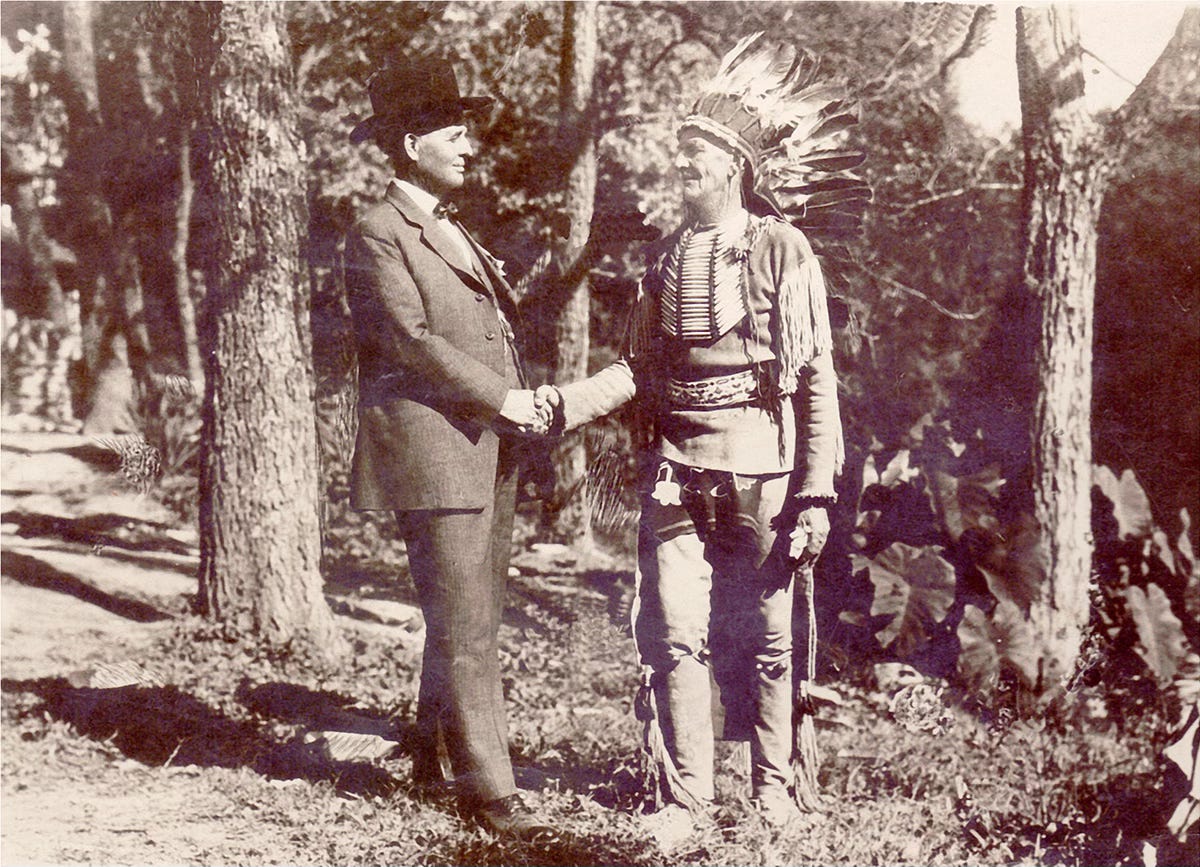
Herman Lehmann
The rain poured down in Loyal Valley when on May 12, 1878, a patrol of five cavalry troopers and a four-mule ambulance skidded to a stop in the middle of town. The soldiers escorted a blue-eyed Indian who spoke the language of the Apaches and the Comanche but couldn’t utter a syllable of English or his native German. A crowd gathered round to gape at the nearly nineteen-year-old they believed was Herman Lehmann—a young man who had been captured some nine years before in an Apache raid.
A woman forced herself to the front of the gathered gawkers and looked the young man in the face. She didn’t recognize him. He didn’t recognize her. But one of her daughters pointed out a scar on his arm—the same scare she had given Herman when they were children while playing with a hatchet. His mother spoke his name, “Herman.” Other family members joined in, repeating his name over and agin. He began to think the word sounded familiar, then realized it was his own name.
Herman Lehmann was born to German immigrants—Moritz (Maurice) and Augusta Johanna—on June 5, 1859, near Loyal Valley in Mason County. Nearly eleven years later, on May 16, 1870, a raiding party of eight Apaches captured Herman and his eight-year-old brother Willie while they were in a field shooing birds away from the family wheat crop. Their two sisters escaped.
Four days later, the Apaches ran into a patrol of Buffalo Soldiers (black cavalry troopers), under the command of Sargent Emanuel Stance, who had been dispatched from Fort McKavett in search of the two boys. A skirmish ensued and Willie was able to escape. The Apaches fled with Herman. Willie was returned home and Sargent Stance was awarded the Medal of Honor (conferred on June 28, 1870—the first black regular to receive it).
Herman was adopted by his Apache captor, Carnoviste, and given the name En Da—“Pale Boy.” He was initiated into the brutal training of a warrior, raiding against Texas settlers, Mexicans, and Comanches from the Guadalupe Mountains to Mexico. One of his most memorable battles was a running fight with Texas Rangers on August 24, 1875, which took place near Fort Concho, about sixty-five miles west of San Angelo. Ranger James Gillett nearly shot Lehmann before he realized he was a white captive.
A year later, in the spring of 1876, Lehmann murdered an Apache medicine man, avenging the death of Carnoviste. To save his life, Lehmann fled into the West Texas wilderness, where he wandered for a year. Spying out a Comanche tribe, Lehmann walked into their camp at night in hopes of joining their band. The Comanches planned to kill him, but one of them spoke Apache. Lehmann explained he had been captured six years before and that he had avenged the killing of his adopted Apache father. The tribe adopted him into their band, giving him the name, Montechena (or Montechina)—its meaning is unknown.
Lehmann continue to take part in raids, now as a Comanche. On March 18, 1877, after having attacked buffalo hunters on the Llano Estacado, Lehmann was wounded when hunters retaliated, surprising him and his Comanche band in Yellow House Canyon (present-day Lubbock)—the last major fight between Comanches and Texans.
A year later, he would be with his German family in Loyal Valley. Before his death in 1932, he dictated his story to J. Marvin Hunter, who published it as Nine Years Among the Indians, 1870–1879. The following passage recounts some the changes Lehmann witnessed over his lifetime.
I am an old man now, I will soon reach the total of three score and ten years allotted to man, if death does not claim me—-seventy years of wonderful experience. I have seen many changes since I came into the world, the ox-cart gave way to the horse-drawn vehicle, and the automobile has surpassed that mode of travel. Speeding railway trains, flying machines, radios, and many other wonders have come to pass. We are living in a fast age. I am glad God has spared my life and permitted me to live to see these wonderful changes. I gave reverence to Him in the only way I knew how when I was an Indian; I worship Him now after the manner of an enlightened white man.
When I look upon these changes I marvel and wonder how it can be so. Of many of these things I am yet in ignorance; I cannot understand how the human voice can be wafted over the radio thousands of miles without the aid of wires, but it is done, for I have heard it. It is as much a mystery to me as the first telegraph line I ever saw. A party of Indians were coming down into the settlements on a raid when, at a point in the vicinity of Fort Concho, we came upon a newly constructed telegraph line. We stopped and considered it, and wondered what it meant. Each Indian had his own notion about what it was intended for, but we were all wrong. The chief said he believed it was to be a fence to be made so high that the Indians could not get through, and so we proceeded to cut it down. Coming on down into the settlement we stole some horses and went back away with the drove, and we found the line had been rebuilt and the wire was in place again.
And the puffing locomotive and railway train was also an object of wonder, when I came back to civilization and beheld them. The first train I ever saw was while I was with the Indians, and of course we did not know what it was, and in consequence got a scare that almost drove us frantic. We had come far down into the settlements on a raid, it may have been near Austin, and one night while we were waiting in a secluded spot in a little ravine, for the moon to come up, a train suddenly came around a curve from behind a mountain and was right on us before we had time to mount our horses. That hideous monster, belching smoke and hissing steam, and with glaring lights bore down upon us at terrific speed, and we ran, scrambling over rocks and through the brush, to get away from it. It followed us for a little ways, but we thought it lost our trail, as it went rushing on away from us. We were somewhat scattered when things became quiet, and I was uneasy for fear the awful thing had caught three of our comrades. But when we gave our agreed assembly signal the Indians came forth from their hiding places and we held a consultation. We decided to leave that region at once and not attempt to steal horses there, for that monster might return and catch us. It was generally agreed among us that it was the Evil Spirit that was abroad, and was seeking to devour all mankind, the white folks included. When we went back to camp and told what we had seen the Indians were greatly alarmed, and the medicine men warned us to stay out of that region.
Before his death from pneumonia on February 2, 1932, at his brother’s ranch, Herman performed at county fairs, dressing in native garb and showing off his skills as a horseman, roper, and bowman. He also enjoyed trail driver’s reunions, catching up with old cowboys and ranchers whose cattle he once stole as an Apache and a Comanche. He’s buried in Loyal Valley cemetery.
Herman Lehmann, Nine Years Among the Indians, 1870–1879: The Story of the Captivity and Life of a Texan Among Indians (1927: Arcadia Press, 2018), 89–90.
Y’allogy is an 1836 percent purebred, open-range guide to the people, places, and past of the great Lone Star. We speak Texan here. Y’allogy is created by a living, breathing Texan—for Texans and lovers of Texas—and is free of charge. I’d be grateful, however, if you’d consider riding for the brand as a paid subscriber, it helps offset research and writing expenses—and ensures that Y’allogy remains cost free.
You can also show your support by purchasing my novel.
Be brave, live free, y’all.
My grandfather(born 1917)told me stories of Herman when my grandfather was a young man. They would have a "hunt" in Mason and would turn a calf loose. Herman would spear it and eat the liver raw and hot. It made a lifelong impression on my grandfather
I found out that John B. Jones the famous Ranger is kin! I live about 5 mins from his grave in Austin.