


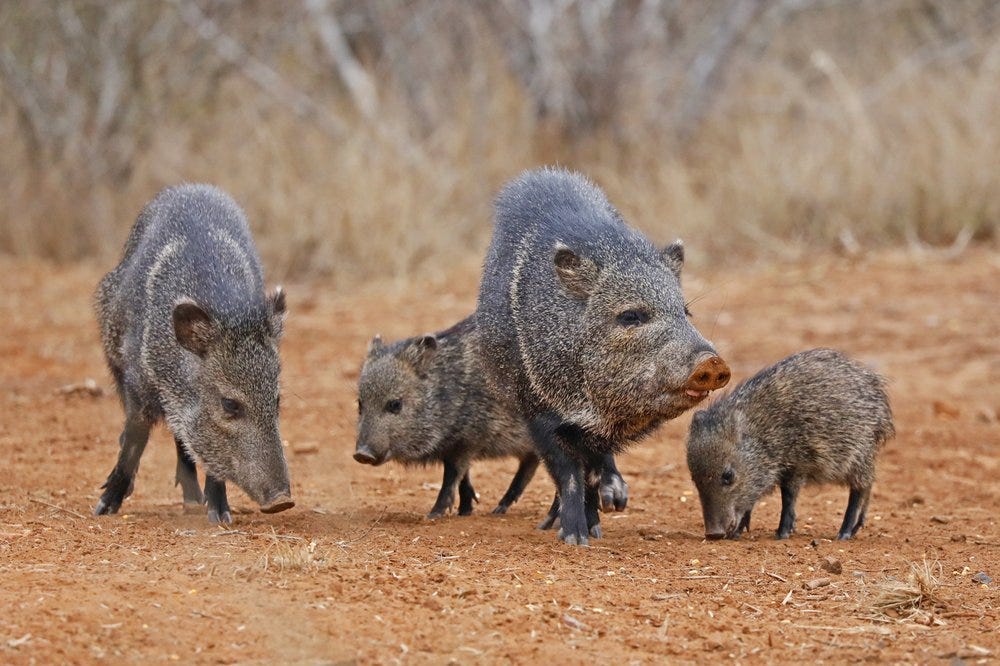
A lone javelina will jump at its own shadow, but a dozen javelinas will charge the walls of the Alamo.
Derrick G. Jeter
Most Texans will whoa when first coming across the pig-like, tusked creatures known as javelinas. Since these stout-bodied, hairy critters avoid urban areas where most Texans live, chances are many folks have never seen one in the wild. And being unfamiliar with them, javelinas usually cause Texans a little scare on their first encounter. But there’s no reason for concern. Despite their dangerous-looking appearance and their ferocious reputation—more hype than fact—javelinas, unless cornered or startled, will run away and find a place to hide. In general, javelinas aren’t aggressive toward humans—but that doesn’t mean you should try and pet one.
Spanish explorers, the first Europeans to encounter javelinas, called them jabeli (“wild boar”) and jabalina (“spear” for its javelin-like tusk). In Mexico they’re sometimes called “skunk pigs” or “musk hogs” because of the pungent, musky odor they emanate to mark their territory, which stretches from Argentina to the southwest United States.
Many folks mistake them for some kind of pig. They’re not. Pigs belong to the swine family. Javelinas belong to the peccary family. Specifically, javelinas are collared peccaries—tayassu tajacu (“new world pigs”)—because they sport a gray or white ring of hair (a collar) around their necks.
Though javelinas do have pig-like features—a flat snout and hoofed feet—they are a peculiar critter. Javelinas have only three hoofed toes, instead of four like a pig. Javelinas don’t have a tail, while one of the cutest traits of a pig is its curled tail. Female javelinas have only two pair of mammary glands and are located between her hind legs, instead of a row of mammary glands running along the female pigs’ belly. Javelinas also have a more complex stomach than pigs, and fewer teeth.
These are just some of the distinguishing traits that set these pig-like animals apart, but let’s see what else we can scare up about javelinas.
✭
The most distinctive feature of javelinas are their tusks (or javelins) that protrude from their lower jaws. These, and their razor-sharp canine teeth, become lethal weapons during fights, cutting and slashing an opponent’s face and ears.
When threatened, javelinas will clack or pop their teeth together, sort of like a rattlesnake warning you to back away.
In the United States, javelinas can be found throughout Arizona, New Mexico, and Texas, particularly in the Trans-Pecos region of far West Texas around Big Bend, as well as the oak and juniper woodlands around the Edwards Plateau and the brush country of South Texas..
Javelinas are omnivores and will eat just about anything, particularly small animals and vegetation. They especially enjoy prickly pear and sotol fruit, berries, wild grapes, ground cherries, and mesquite beans.
Javelinas are hogs when it comes to feeding. They will eat upwards of six hours a day during the summer months and upwards of fifteen hours a day during the winter months. Mature javelinas can weight between 40–60 pounds.
Though javelinas have tough mouths and can eat prickly plants, they are also ingenious when it comes to removing large thorns from prickly pear pods. They snip off the pods and drag them along rocks to snap off large thorns before consuming them.
Despite popular lore, javelinas do not chase down prey, nor do they eat snakes.
While feeding, javelinas make guttural murmurings. If startled, they squeal and usually emit a strong, pungent oder from a musk gland in their rumps.
Though generally not aggressive toward humans, if you encounter a javelina while walking your dog they may become pugnacious since they can’t distinguish between Fido and Wile E. Coyote. Like humans, coyotes have a special hankering for bacon, especially for young pork chops.
Javelinas are family folk, remaining in family groups or herds containing anywhere from five to thirty peccaries. They are territorial, ranging between 300 and 550 acres.
Baby javelinas are born year round, weighting in at about a pound, with reddish or yellowish brown hair, along with a distinctive dark stripe or mane running from head to their non-existent tail down their backs. When angry or frightened their mane will spike.
Unlike invasive wild pigs, javelinas do not root in a destructive manner.
Though javelinas are game animals, they are rarely hunted because the meat is tough and gamey. They were hunted in the past for their hides. Once the hair was removed, hides were tanned and made into gloves, bags, purses, and shoe tops. Their coarse hair was used to make brushes.
Well, there you have it, (almost) everything you (secretly) wanted to know about the javelina. But before we stop rooting around with these hairy peccaries, young Texans, or their parents, might be interested to know that a number of delightful children’s books have been written about javelinas.
✭
Rick Taylor and David R. Synatzske, The Javelina in Texas (Texas Parks & Wildlife, 2008).
Y’allogy is an 1836 percent purebred, open-range guide to the people, places, and past of the great Lone Star. We speak Texan here. Y’allogy is created by a living, breathing Texan—for Texans and lovers of Texas—and is free of charge. I’d be grateful, however, if you’d consider riding for the brand as a paid subscriber, it helps offset research and writing expenses—and ensures that Y’allogy remains cost free.
You can also show your support by purchasing my novel.
Be brave, live free, y’all.
Yeah, I remember my first close encounter with a javelina years ago when I was out hunting not many miles from San Angelo. The little booger startled me when I startled it out from under the cedar tree where it had been enjoying a short nap. It ran. I sighed in relief, happy not to have to use my loaded rifle in self defense.