

Sam Houston Canes William Stanbery

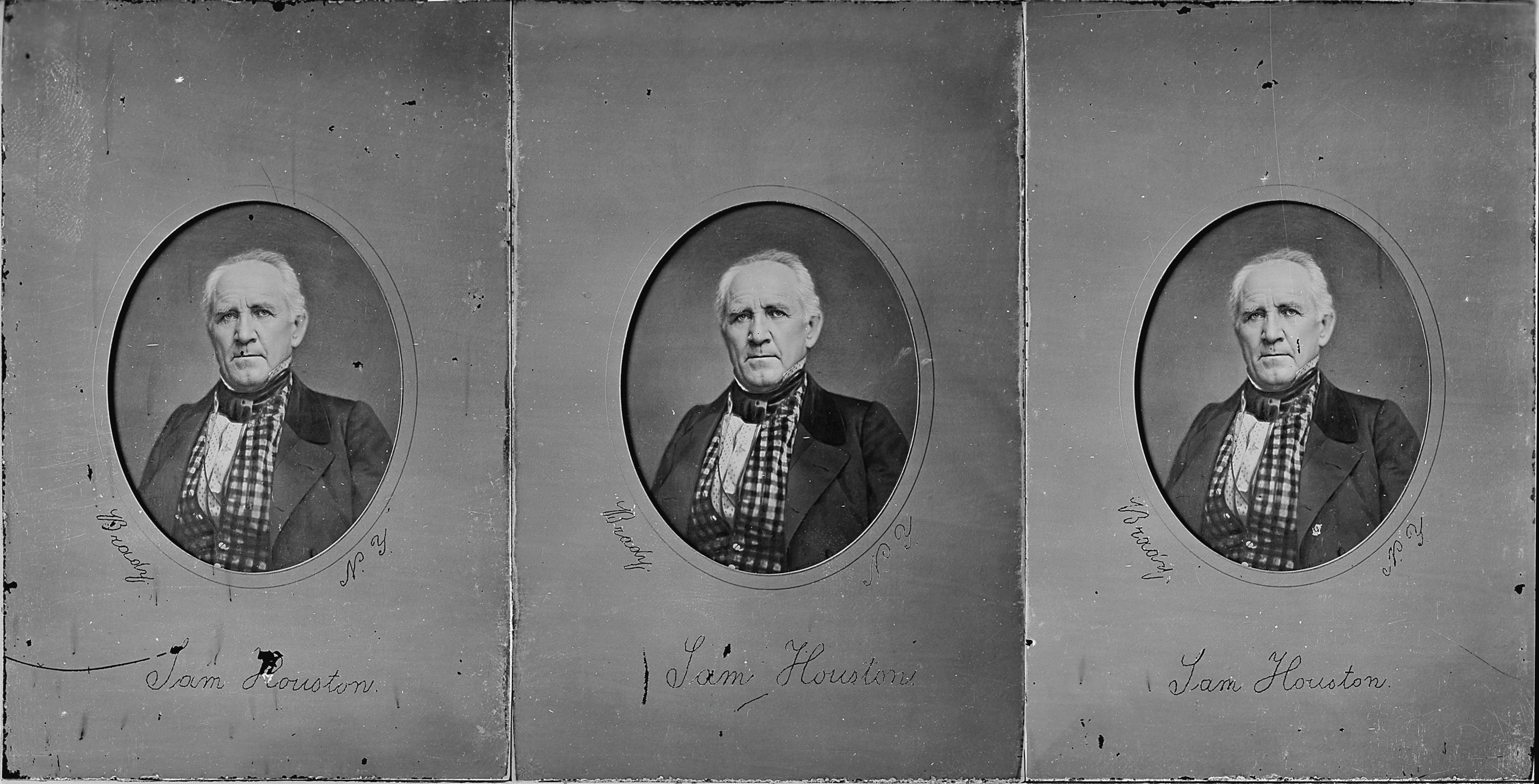
I’ll introduce myself to the damned rascal.
Sam Houston
“Mr. Sumner, I read your speech with care and as much impartiality as was possible and I felt it was my duty to tell you that you have libeled my state and slandered a relative who is aged and absent and I am come to punish you for it.” So was the reason why South Carolina United States Representative Preston Brooks gave to Massachusetts United States Senator Charles Sumner right before Brooks began beating Sumner about the head with his walking cane.
Days prior, Sumner railed about the “Crime Against Kansas,” accusing proslavery factions of “raping” Kansas and condemning Southern “plantation manners” and his Southern colleagues’ habit of “trampling” congressional rules “under foot.” Sumner called for the admittance of Kansas as a free state and attacked, among others, South Carolina Senator Andrew Butler, a relative of Brooks. During the speech Illinois Senator Stephen Douglas, who came under Sumner’s withering rhetorical blows as well, paced in the back of the chamber and was overheard muttering, “That damn fool will get himself killed by some other damn fool.”
On May 22, 1856, that damn fool was sitting at his senate desk postmarking copies of the speech that so infuriated that other damn fool who beat Sumner nearly to death.
✭
The caning of Charles Sumner by Preston Brooks wasn’t the first time a member of Congress was beaten with a walking stick for political remarks. Twenty-four years earlier, in 1832, former Congressman and then-Tennessee governor Samuel Houston caned Ohio Representative William Stanbery on Pennsylvania Avenue.
✭
On March 31 Stanbery stood in the well of the House and accused President Andrew Jackson as scoundrel and charged Sam Houston for taking part in a scheme to defraud the Cherokee nation as part of Jackson’s controversial Indian Removal Act—the same piece of legislation (among other anti-Jackson activities) that cost David Crockett his Tennessee congressional seat when he opposed it, spurring him to tell his constituents, “You may all go to hell, and I will go to Texas.” Hinting at bribes that had swirled around the Jackson administration when it came to relocating eastern tribes to Indian Territory (present-day Oklahoma), Stanbery asked, “Was not the late Secretary of War [John Eaton] removed because of his attempt fraudulently to give Governor Houston the contract for Indian rations?”
Houston, who happened to be in Washington, D.C. with a delegation of Cherokees, was outraged. A citizen of the Cherokee nation and a noted defender of native rights, Houston had exerted efforts to protect them from unscrupulous designs and knew Stanbery’s accusation was a lie perpetrated for political expediency. Stanbery was a vocal anti-Jacksonian. Houston knew he couldn’t sue the congressman for slander due to congressional privilege, but he meant to extract a retraction from Stanbery, even if he had to beat it out of him.
After Stanbery spoke in the House, Houston marched into the foyer determined to “settle” the matter then and there, brandishing his hickory walking stick as a warning to Stanbery. James K. Polk hustled Houston outside. Later, Houston dispatched Tennessee Representative Cave Johnson to Stanbery with a formal challenge to a duel. Stanbery refused to acknowledge or reply to “a note signed Sam Houston,” but decided the best course of action was to carry on his person a brace of pistols.
When Houston learned Stanbery rejected his challenge, Houston said, “I’ll introduce myself to the damned rascal.”
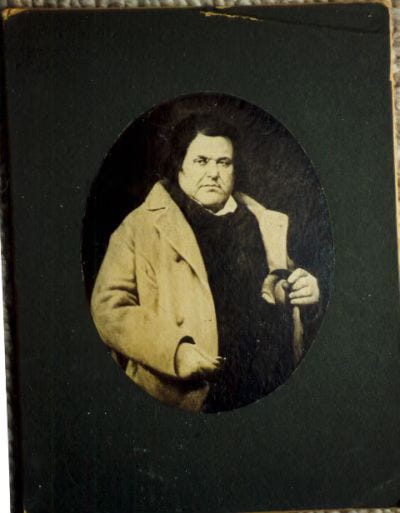
Two weeks later, on the evening of April 13, Houston was walking down Pennsylvania Avenue with Missouri Senator Alexander Buckner and Tennessee Representative John Blair when Blair recognized Stanbery coming out of the Brown Hotel and crossing the street. In the dim light of the streetlamps, Houston approached the Ohio congressman. “Are you Mr. Stanbery?” Stanbery stopped and bowed and said, “Yes, sir.” “Then you are a damned rascal.” Houston then lifted his cane and brought it down on Stanbery’s head, knocking his hat off.
Stanbery cried out, “Oh, don’t,” and threw up his hand to protect himself as Houston rained blows upon him. At one point in the melee, Houston jumped on Stanbery’s back and tackled him. With Stanbery bleeding from the head, the two men wrestled on the pavement, Stanbery yelling for help. He was able to pull one of his pistols and placed it against Houston’s chest and pulled the trigger. Buckner later testified he heard the gunlock snap and saw the flint flash against the frizzen and the powder fire. But the charge did not explode. Houston knocked the pistol away and stood up and continued striking Stanbery with the hickory stick. As a finishing and humiliating touch, Houston grabbed one of Stanbery’s feet and lifted it and, according to Buckner, “struck him elsewhere”—such was his testimony in the presence of ladies.
Buckner further testified: “By this time, a crowd had gathered round and some person . . . spoke to Houston. Houston replied, ‘That he attended to his business, and that he had chastised the damned scoundrel; if he had offended the law, he would answer for what he had done.’”
✭
Propped up in his bed, Stanbery wrote to Speaker of the House Andrew Stevenson describing how he had been “waylaid in the street . . . attacked, knocked down by a bludgeon and severely bruised and wounded by Samuel Houston, late of Tennessee, for words spoken in my place in the House of Representatives.”
On April 17 Stanbery’s note was read before the assembled House. A resolution was offered for the arrest of Houston. James Polk objected, arguing the House didn’t not have the authority to arrest Houston. Polk was overruled—the resolution passed 145 to 25. Houston was ordered detained, the first private citizen to be arrested by the House for an attack on one of its members “as a result of words spoken before Congress.”
Trial was set for April 19 and dragged on for a month. It was the most important political event in the spring of 1832. With the author of the National Anthem—“The Star Spangled Banner”—Francis Scott Key as his legal counsel, Houston argued he didn’t molest Stanbery for words spoken in the House, but for words printed in a newspaper attributed to Stanbery. (Never mind that the paper merely printed a transcript of Stanbery’s House speech.)
In the end, by a vote of 106 to 89, the House found Houston guilty of contempt of Congress and sentenced him to stand in the well of the House to endure a tongue lashing from Speaker Stevenson, who on May 14 beat Houston with a wet noodle: “I forbear to say more than to pronounce the judgment of the House, which is that you . . . be reprimanded at this bar by the Speaker, and . . . I do reprimand you accordingly.”
It’s good to have friends in high places, like the Speaker of the House of Representatives.
✭
Understandably, Stanbery was outraged by the House’s paltry penalty and sought greater redress by suing Houston for assault in a United States Circuit Court. In July 1832 the court found Houston guilty and ordered him to pay Stanbery five hundred dollars. Houston, in turn, wrote to Andrew Jackson, “[praying] that the fine and cost of suit may be remitted your PARDON.” Jackson accommodated: “I regard this fine as excessive and therefore remit it.”
✭
Several weeks after winning his pyrrhic victory in court, Stanbery was censured by the House for insulting the Speaker. That fall, Stanbery lost his bid for reelection and disappeared from the pages of history. Houston left for Texas and became a legend.
Thinking on this episode later in life, Houston wrote, “I was dying out and had they taken me before a justice of the peace and fined me ten dollars it would have killed me; but they gave me a national tribunal for a theater, and that set me up again.”
✭
Joanne Freeman, The Field of Blood: Violence in Congress and the Road to the Civil War (Farrar, Straus and Giroux, 2018), 218–20, 222.
Marquis James, The Raven (Halcyon House, 1929), 163–66, 171–72.
R. G. Ratcliffe, “Poncho Nevárez, The New Sam Houston?” Texas Monthly, June 8, 2017.
John Hoyt Williams, Sam Houston: A Biography of the Father of Texas (Simon & Schuster, 1993), 92–96.
Y’allogy is an 1836 percent purebred, open-range guide to the people, places, and past of the great Lone Star. We speak Texan here. Y’allogy is created by a living, breathing Texan—for Texans and lovers of Texas—and is free of charge. I’d be grateful, however, if you’d consider riding for the brand as a paid subscriber, it helps offset research and writing expenses—and ensures that Y’allogy remains cost free.
You can also show your support by purchasing my novel.
Be brave, live free, y’all.
Do Deaf Smith!
Love the Big Drunk.