


I was born in a land of freedom, and taught to lisp the name of liberty with my infant tongue, and rather than be driven out of the country or submit to be a slave, I will leave my bones to bleach on the plains of Texas.
Giles A. Giddings
Reverberations of revolution were already rolling across Texas when twenty-four-year-old Giles Albert Giddings arrived in March 1836 from Herrick, Pennsylvania. He came to work as a surveyor on the frontier but was soon caught up in the Texian cause of independence. On April 9, he enrolled as a private in Captain William Wood’s Company A, known as the “Kentucky Rifles” because they were originally formed in that state on December 18, 1835.
The day after joining the Texian army, Giddings posted a letter to his parents explaining his decision and expressing his love and bidding them farewell if he should fall in battle.
✭
Texas, Four Miles from Headquarters
April 10, 1836.
Dear Parents:
Since I last wrote you I have been engaged in arranging an expedition against the Indians, who have committed many depredations against the frontier. On my return to the settlements, I learned that our country was again invaded by a merciless horde of Mexicans, who were waging war or extermination against the inhabitants. A call was made for all friends of humanity to rise in arms and resist the foe. Men were panic stricken and fled, leaving their all behind them. I could not reconcile it to my feelings to leave Texas without an effort to save it. Accordingly, I bent my course for the army and arrived last evening at this place. I shall enter Camp this morning as a volunteer. The army, commanded by General Houston, is lying on the west side of the Brazos [River], 20 miles from San Felipe. The enemy is in that place awaiting an attack. It is reported Houston will attack them in the morning.1 What will be the result, or the fate of Texas, is in the bowels of futurity. Yet, I think we are engaged in the cause of justice, and hope the God of battles will protect us. The enemy’s course has been the most bloody that has ever been recorded on the page of history. Our garrison at San Antonio was taken and massacred; another detachment of seven hundred, commanded by Colonel Fannin, and posted at La Bahia, after surrendering prisoners of war, were led out and shot down like beasts.2 Only one escaped to tell their melancholy fate.3 In their course they show no quarter to age, sex, or condition, all are massacred without mercy. If such conduct is not sufficient to arouse the patriotic feelings of the sons of liberty, I know not what will. I was born in a land of freedom, and taught to lisp the name of liberty with my infant tongue, and rather than be driven out of the country or submit to be a slave, I will leave my bones to bleach on the plains of Texas. If we succeed in subduing the enemy and establishing a free and independent government, we shall have the finest country the sun ever shown upon, and if we fail we shall have the satisfaction of dying fighting for the rights of men. I know not that I shall have the opportunity of writing to you in some time, but shall do so often as convenient.
Be not alarmed about my safety. I am no better, and my life no dearer, than those who gained the liberty you enjoy. If I fall you will have the satisfaction that your son died fighting for the rights of men. Our strength in the field is about 1,500. The enemy is reported 4,000 strong; a fearful odds, you will say; but what can mercenary hirelings do against the sons of liberty!
Before this reaches you the fate of Texas will be known. I will endeavor to acquaint you as soon as possible. I am well and in good spirits, and as unconcerned as if going to a raising. The same Being who has hitherto protected my life can with equal ease ward off the balls of the enemy.
My company is waiting, and I must draw to a close, and bid you farewell, perhaps forever. More than a year has elapsed since I saw you, yet the thought of friends and home are fresh in my memory, and their remembrance yet lives in my affections and will [be] a secret joy to my heart till it shall cease to beat. Long has it been since I heard from you. How often do I think of home and wish to be there. The thoughts of that sacred spot haunts my night-watches. How often, when sleep has taken possession of my faculties, am I transported there, and for a short time enjoy all the pleasures of home; but the delusion is soon over and the morning returns and I find my situation the same. Dear friends, if I see you no more remember Giles still loves you. Give my love to my sister, brothers, friends, and neighbors.4 I would write more if time would permit, but its fleeting steps wait for none. You need not write to me, as I do not know where I shall be. With sentiments of sincere respect I bid you fare-well.
Your affectionate son,
G. A. Giddings
✭
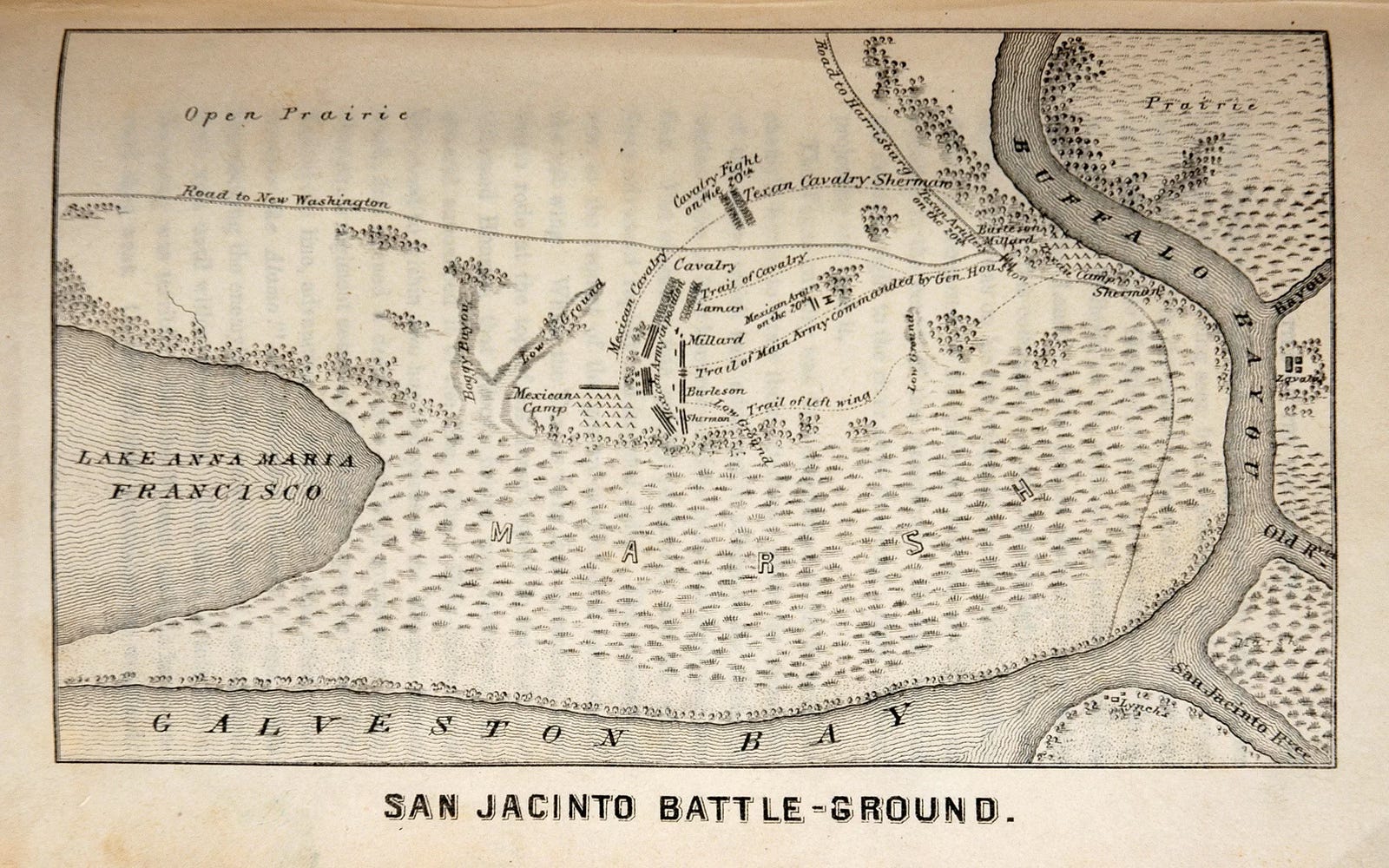
Giddings saw action on April 21, 1836, at the battle of San Jacinto and was mortally wounded, passing away on June 10. He was one of nine Texians to either die during the battle or succumb from wounds afterward. He was the final Texian to die in the Texas Revolution.
Two years later, on June 7, 1838, a Headright Certificate was issued to Giddings’s heirs for one-third of a league of land by the Fort Bend County Board. The following year, on March 4, 1839, his heirs received 640 acres of land for having participated in the battle of San Jacinto. Later, his heirs were given 1,920 acres of land for having served in the army from April 11 to June 10, 1836, and for having died in service.
✭
1 This was typical military scuttlebutt. Houston didn’t attack on April 11, 1836, but continued his easterly retreat toward the Sabine River, attacking ten days later at a place called San Jacinto.
2 This number is greatly exaggerated. The actual number of men who surrendered at Goliad was 370—the men under Fannin’s command who surrendered after the battle of Coleto Creek on March 20, 1836, and the George Battalion under the command of William Ward who surrendered on March 22.
3 More than one man escaped the massacre at Goliad, as I point out in “John C. Duval’s Escape from Goliad.”
4 Giles was one of thirteen Giddings children.
✭
Louis W. Kemp, “Giles Albert Giddings,” The Kemp Sketch, San Jacinto Museum and Battlefield.
Y’allogy is an 1836 percent purebred, open-range guide to the people, places, and past of the great Lone Star. We speak Texan here. Y’allogy is created by a living, breathing Texan—for Texans and lovers of Texas—and is free of charge. I’d be grateful, however, if you’d consider riding for the brand as a paid subscriber, it helps offset research and writing expenses—and ensures that Y’allogy remains cost free.
You can also show your support by purchasing my novel.
Be brave, live free, y’all.
The kid knew how to write. A beautiful remembrance for his family and the generations to follow.
I'm still standing awestruck having read this letter. Have been suffering from a toothache for a while but the tears in my eyes are not because of that.
Thank you, Derrick, for sharing his letter, and thank you, God, for having sent such a men amongst us.
We all must preserve his name.