

Oscar Wilde in Texas

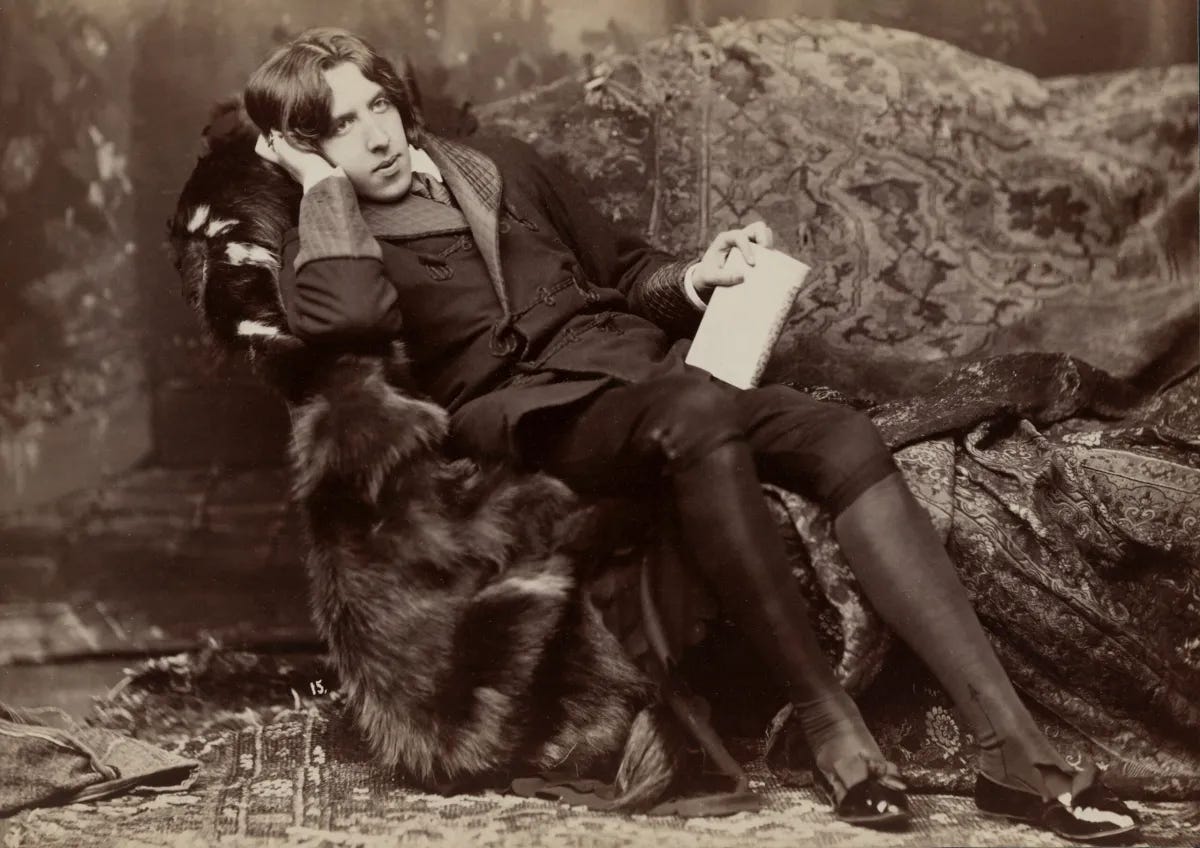
Men in Texas cannot survive more than an hour between beers.
Oscar Wilde
To say that Oscar Wilde was flamboyant is to state the obvious, sort of like saying water is wet or jalapeños are hot. In the words of one writer, he was “known for his affections, including dressing opulently in purples and broaches, often with an eccentric sunflower in his lapel.” Heck, even his name was flamboyant: Oscar Fingal O’Flahertie Wills Wilde.
He was one of the leading lights of nineteenth century aestheticism—the movement that rejected the Victorian notion that art should fulfill some ethical end rather than the mere conveyance of beauty. “Art for Art’s Sake” was the their motto—the Latin of which is captured in Metro Goldwyn Mayer’s Leo the Lion logo: Ars Gratia Artis. Composers W. S. Gilbert and Arthur Sullivan, of Gilbert and Sullivan fame, penned an operetta, Patience (1881), lampooning aestheticism and its colorful proponents, including Wilde. When the production toured the United States, Wilde lectured across America in hopes of bolstering his fame. Wilde’s summer speaking tour of 1882 included stops in the land of cowboys—Texas—where he drew curious crowds who came to gawk at this Irish dandy’s dress and manner. He was twenty-seven, a decade and more from publishing A Picture of Dorian Grey (1891) and The Importance of Being Earnest (1895).
✭
Wilde began his Texas tour in Galveston on June 19, 1882. Curiosity seekers, especially among the ladies of the town, poured into The Pavilion to hear him lecture on “Decorative Art,” which was covered in the June 21 edition of The Daily Decatur Daily Republican: “Oscar Wilde lectured before an immense audience at Galveston the other night. His lecture was flat and insipid and many left disgusted before the talk concluded.”
Not an auspicious beginning.
The following day, the editor of The Galveston Daily News criticized Wilde for a dreary delivery, an off-putting manner, and presenting an obscure subject. These “elements,” the editorial read, “will cause the brightest and purest language to fall flat on the general public.” The editor’s conclusion was unsparing:
So of the work last night, Mr. Wilde’s lecture was not a success by any means and were he to appear to-night he would scarcely rally a corporal’s guard. Curiosity to see the so throughly advertised young gentleman has been gratified, and that done, there is nothing more to enjoy, for what of real pleasure could be extracted from his work is overbalanced by the martyrdom that must be endured in getting to it.
Ouch!
Though the Galveston newspaper was brutal in its assessment, Wilde was taken with the city. “Galveston, set like a jewel in a crystal sea,” he told a reporter for the New Orleans Picayune, “was beautiful. Its fine beaches, its shady avenues, or oleander, and its delightful sea breezes were something to be enjoyed.” Of the citizens, he said, “The people of Galveston were wonderful to me. They made me an honorary Colonel in the Texas Rangers. So I wrote immediately to my friends and told them that they should henceforth address me as Colonel Wilde.”
A year later, on September 24, 1883, after he had returned to England, while giving a speech on his “Impressions of America,” he told an audience at Wandsworth Town Hall in London, “When I went to Texas I was called ‘Captain’; when I got to the centre of the country I was addressed as ‘Colonel,’ and, on arriving at the border of Mexico, as ‘General.’”
✭
Wilde faired little better in Houston, where on June 23 he delivered the same lecture at Gray’s Opera House. According to a reporter for The Dallas Weekly Herald, the audience was “small.” Though he conceded “The subject-matter is good,” Wilde’s “style is exceedingly drawling and affected.” As a result, “He has not caught on here very effectively.”
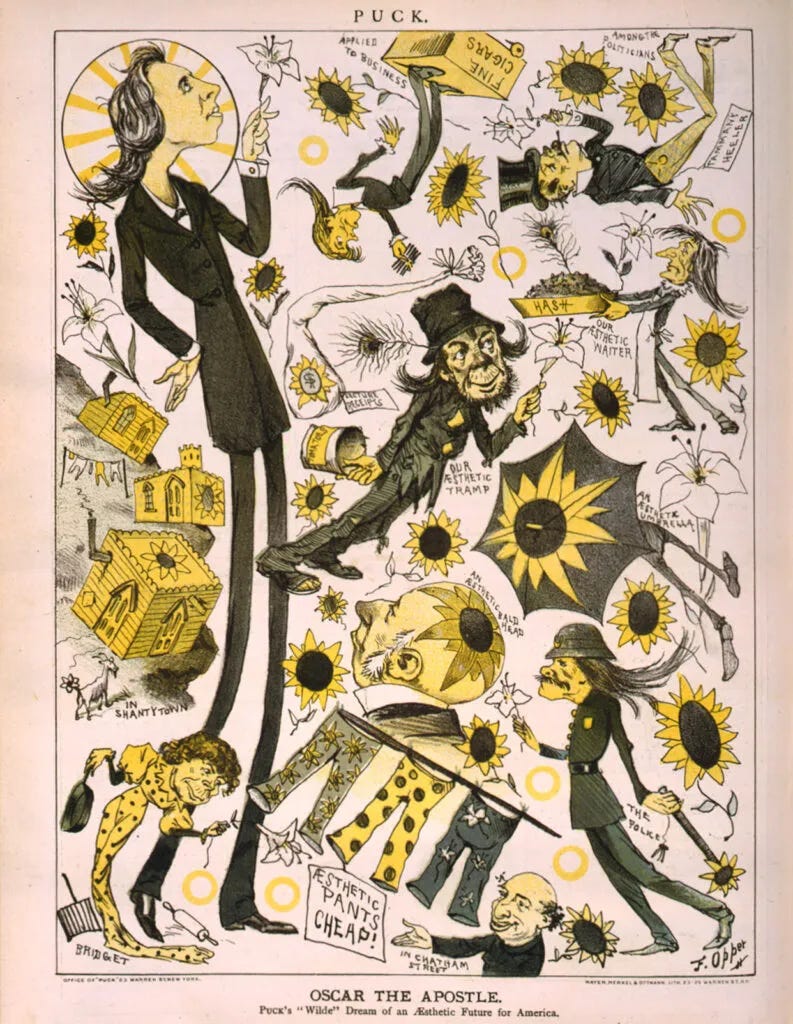
Wilde’s appearance at the Turner Opera Hall in San Antonio on June 21, according to the June 22 edition of The Evening Light, was met with “a large audience” of San Antonio’s “intelligent and elite” citizens. The editor didn’t mention Wilde’s delivery, again on “Decorative Art,” but on his features and flamboyant dress.
About nine o’clock Mr. Wilde made his appearance upon the platform. His face is distingue [distinguished] in feature, exhibiting decided force of character, combined with a considerable indication of nervous temperament, which is toned and effemmalised [sic] by his long, rough hair, which falls upon his shoulders. He was attired in a black velvet suit, ancient in design and picturesque in appearance; the coat and vest being cut a la courtier. From the vest was suspended the fob ribbon and seal. Instead of trouser he wore breeches gartered at the knee, silk stockings, low shoes and buckles. A plain white lace cravat of rather large dimension, adorned his neck. His appearance resembled much “the fine old English gentleman” of George III, and French courtier of Louise the XVI, such as we see represented upon our well mounted stages.
Wilde stayed in The Menger, one of the most luxurious hotels in Texas in 1882, which suited him just fine. He had famously quipped: “Let me be surrounded by luxury; I can do without the necessities.” While in San Antonio he toured the missions and was moved by “those old Spanish churches with their picturesque remains of tower and dome, and their handsome carved stonework, standing in the verdant and sunshine of the Texas prairie.” He was particularly impressed by Mission San Jose: “the finest example of beautiful architecture I came across in all of America.”
Of the Alamo, which sits next door to the Menger, he was unimpressed. In 1882 the Alamo’s Long Barracks was a general store—later that year, it became the warehouse for Hugo and Schmeltzer. The chapel had been used by the U.S. Army as a depot. When Wilde visited it was rundown, prompting him to comment on how the “noble” structure was in a “monstrous” state. He also believed it was shameful that Texas had allowed this most “sacred of shrines to fall into such Philistine conditions.”
When asked how his San Antonio lecture went, the Picayune reported that he believed the women enjoyed it very much but the men were too distracted to get much out of it. They were “walking in and out with their squeaky boots and clanky spurs,” he said. “The men were going out for beer, you see. Evidently, men in Texas cannot survive more than an hour between beers.”
That was especially true if he expected a Texas man to listen to an Irishman lecture on interior design and wallpaper—then and now.
✭
John Cooper, Oscar Wilde in America (website).
Roy Morris Jr., Declaring His Genius: Oscar Wilde in North America (Belknap Press, 2013).
W. F. Strong, Stories from Texas: Some of Them are True, vol. 1 (Berkeley Place Books, 2018).
Y’allogy is an 1836 percent purebred, open-range guide to the people, places, and past of the great Lone Star. We speak Texan here. Y’allogy is created by a living, breathing Texan—for Texans and lovers of Texas—and is free of charge. I’d be grateful, however, if you’d consider riding for the brand as a paid subscriber, it helps offset research and writing expenses—and ensures that Y’allogy remains cost free.
You can also show your support by purchasing my novel.
Be brave, live free, y’all.
So intriguing! Before the hurricane that wiped it out and led to Houston taking its place, Galveston was as posh as New York, London or Paris.