

On the Origins of July Johnson and Roscoe Brown

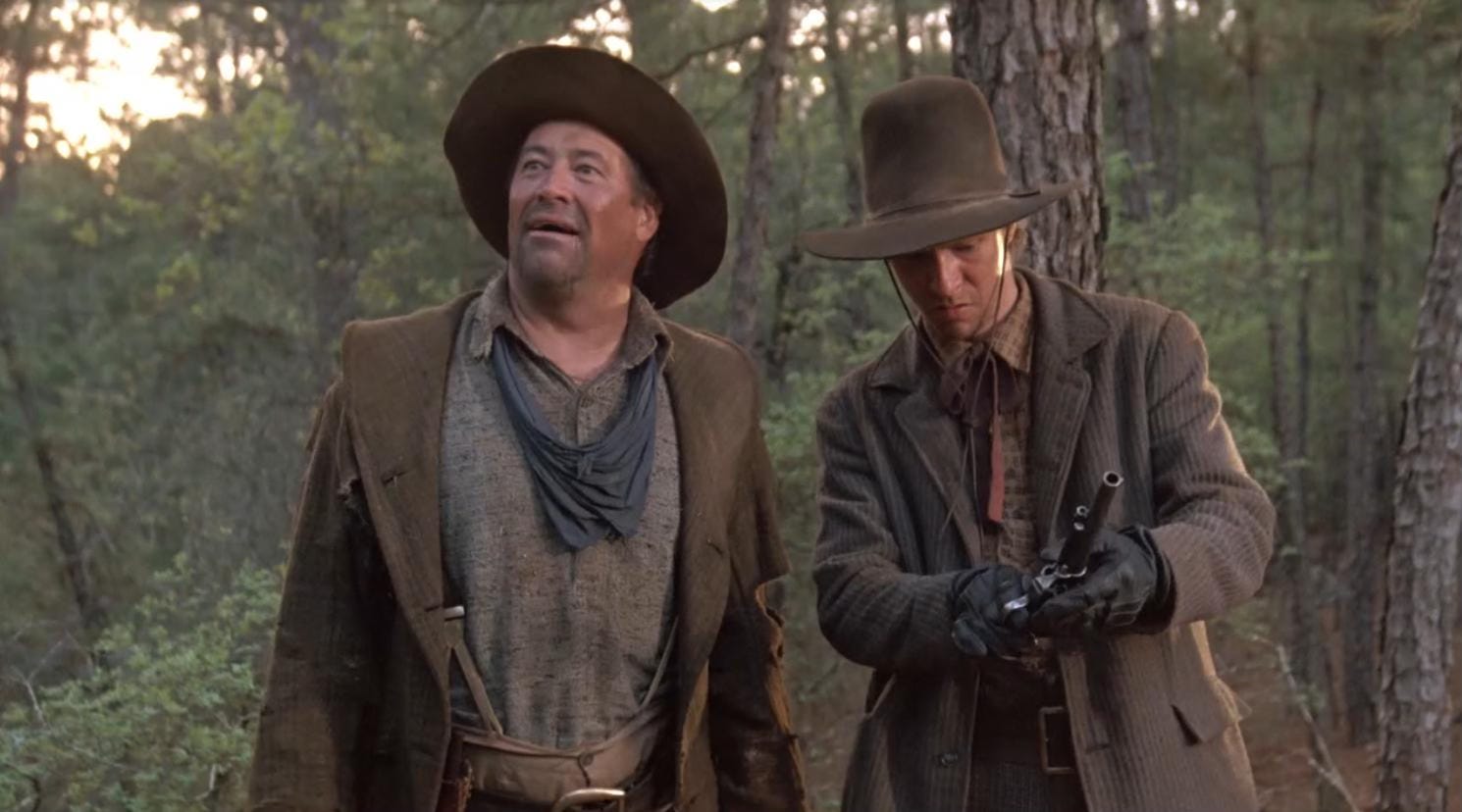
“My friends call me July, ma’am. I wish you were one. Well, I tell you what ma’am, I’ll be your friend and you just don’t bother about being mine.”
George Kennedy
One of the pleasures of working from home is that at lunchtime I can watch movies. I don’t watch a whole movie in one lunchtime sitting but stretch it out over a few days, fifteen or twenty minutes per lunch break. I typically watch a film I’ve seen many times or select a B-grade film I can abandon after fifteen or twenty minutes without feeling the need to pick it up the next day or two to finish it.
The other day I picked a movie I’d never seen before, and though it stars Jimmy Stewart and Dean Martin it didn’t look all that interesting beyond the first fifteen or twenty minutes—perfect for a lunchtime film. Based on a story by Stanley L. Hough, Andrew V. McLaglen’s 1968 Bandolero! (with an exclamation point) has Stewart playing Mace Bishop, a man pretending to be a hangman, rescuing his outlaw brother, Dee Bishop, played by Martin. The film also stars Raquel Welch as Maria Stoner.
I was perhaps five or ten minutes into the movie when I knew this was one I must finish, which I did later that evening, not even waiting for the next day’s fifteen minutes. What arrested my attention was not the storyline or the acting of Stewart or Martin, or even the presence of Welch, it was the characters portrayed by co-stars George Kennedy and Andrew Prine and their connection to Lonesome Dove.
I’ve written extensively on Larry McMurtry’s inspiration for his most famous novel, as well as the sources for some of his characters. And though I had read in Tracy Daugherty’s biography that McMurtry might have taken the names of July Johnson and Roscoe Brown from Bandolero! (in the film Roscoe’s last name is Bookbinder), that tidbit didn’t sit like a splinter until I watched the movie.
But it’s more than just the names McMurtry lifted from the film.
In both the novel and the movie, July and Roscoe hale from small towns: Fort Smith, Arkansas (in Lonesome Dove) and Val Verde, Texas (in Bandolero!). They also share the same profession: July is a sheriff and Roscoe is his deputy sheriff.
But McMurtry’s artistic theft doesn’t end there. He also took a portion of the July/Roscoe subplot from the screenplay for his novel. In the film, Welch’s character, Maria, a former prostitute, spurns the affections of Kennedy’s character, July, because she’s in love with Martin’s character, an outlaw whose name happens to be Dee. In the novel, July’s wife, Elmira, also a former prostitute, spurs his affections because she’s in love with an outlaw by the name of Dee Boot. At the end of both storylines, in the film and in the novel, both outlaws meet their end, but not before each woman has one last moment with them. Though Elmira in Lonesome Dove runs away to find Dee, and Maria in Bandolero! is kidnapped by Dee, the overlap of their stories is too coincidental to be a coincidence.
Nor can it be a coincidence that both July characters set out on a dangerous journey across unknown and desolate lands in search of the women they love, resulting in the deaths of both deputies. Roscoe in the film dies in Mexico and is buried under a pile of rocks in an abandoned village. Roscoe in the novel dies in Texas and is buried under a pile of rocks on a lonely hill overlooking the Canadian River.
✭
The obscure Australian playwright C. Haddon Chambers wrote an equally obscure play in 1888, Captain Swift, which is best known for one obscure line: “The long arm of coincidence has reached after me.” Whether McMurtry was familiar with that play or that line I don’t know. But he put that line to work in the novel, extending the long arm of coincidence back to an obscure film to reach for the names and professions and storyline of his July Johnson and Roscoe Brown in creating his renowned novel Lonesome Dove.
✭
Bandolero! directed by Andrew V. McLaglen (20th Century Fox, 1968).
Y’allogy is an 1836 percent purebred, open-range guide to the people, places, and past of the great Lone Star. We speak Texan here. Y’allogy is created by a living, breathing Texan—for Texans and lovers of Texas—and is free of charge. I’d be grateful, however, if you’d consider riding for the brand as a paid subscriber, it helps offset research and writing expenses—and ensures that Y’allogy remains cost free.
You can also show your support by purchasing my novel.
Be brave, live free, y’all.
What a wonderful and delightful association, Derrick! Thanks for revealing that connection!
This post my friends is why God invented the internets. What a treat to read this today.