

Fisticuffs in the Rio Grande

The battle will be swift and hard. . . . Fitz will have to knock me stone out to win.
Peter Maher
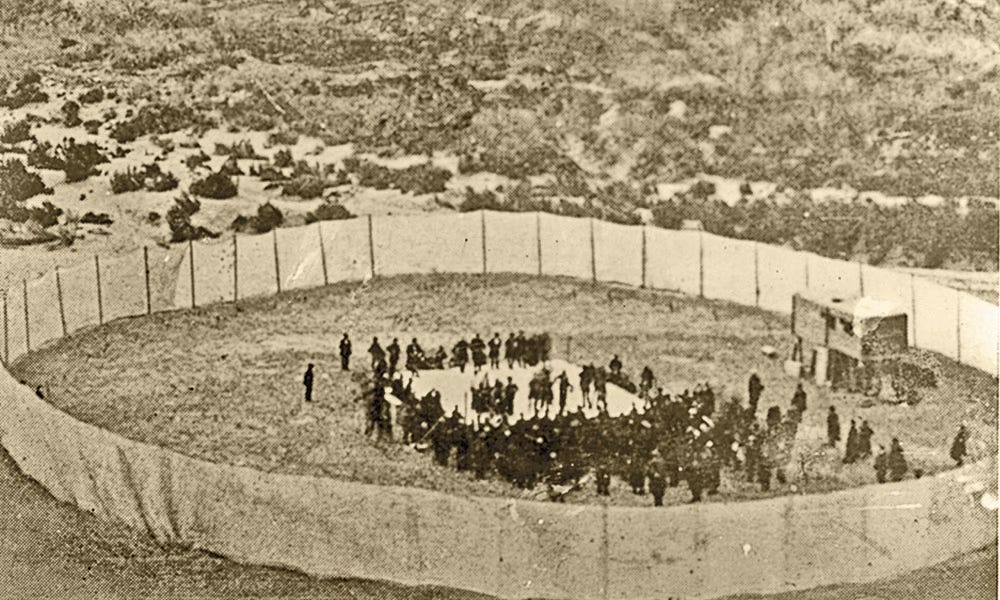
On the day of the fight, February 21, 1896, it had rained off and on over the arid Trans-Pecos where Langtry was situated. The 182 or so spectators and the two combatants had come by train from El Paso. To reach the battle site, according to The New York Times, they had to navigate a “precipitous descent of a seldom-used wagon road . . . over rocks and boulders” and across “500 yards of sand and mud” to reach the makeshift bridge over the Rio Grande. There, at the mouth of Eagle Nest Canyon, in the middle of the river, on the Mexican side, stood a boxing ring, encircled with a sixteen foot high canvas wall.
It was there, on a sandbar, Robert “Bob” Fitzsimmons and Peter Maher traded punches for the boxing heavyweight championship.


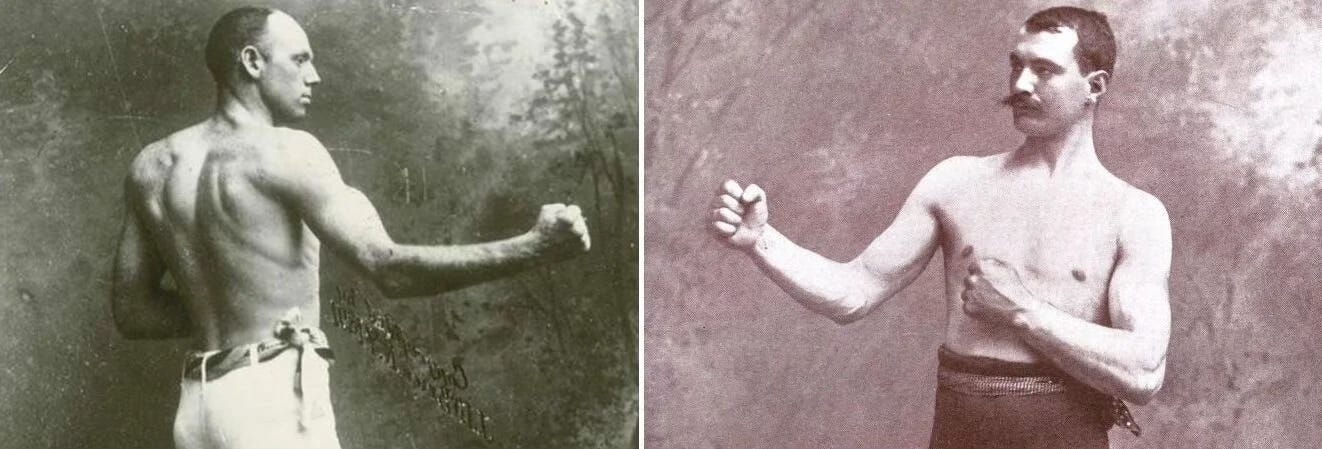
Robert Fitzsimmons was born in Cornwall, England but moved to New Zealand when he was ten-years-old. When he reached his teen years, he went to work in a factory, later hammering out horseshoes as a blacksmith. He got involved in bareknuckle fighting and became known as “The Fighting Blacksmith.” In 1883, under the encouragement of champion bareknuckler Jim Mace, Fitzsimmons moved to Australia and trained under black heavyweight champion Peter Jackson. Though Fitzsimmons had a powerful upper body, developed from years of hard labor, he had skinny legs, often appearing in the ring wearing woolen underwear to hide them, and never weighed more than a modern super-middleweight fighter: 168 pounds. But he was a cagy fighter. His punches were compressed but accurate. In time, he became known as the hardest hitter in the ring.
When Jackson and Mace believed he was ready, Fitzsimmons set sail, in 1890, for the United States, home of the undisputed world heavyweight champion: John L. O’Sullivan—the “Boston Strong Boy.”
Peter Maher was the “The Irish Giant,” where he was a boxing champion. He immigrated to America around the same time as Fitzsimmons. The two men squared off just two years later. Now fighting as “Ruby Robert,” because of his red hair and freckles, Fitzsimmons was nearly knocked from the ring in the first round by Maher, who was six years younger and at least one stone heavier (fourteen pounds). Fitzsimmons managed to regain his composure and fought Maher to twelve rounds, when Maher conceded the fight.
That same year, 1892, “Gentleman Jim” Corbett defeated the champion John O’Sullivan for the heavyweight title. In September 1894, Corbett fought and defeated Peter Courtney in what became the second boxing match recorded on film—the first was between Mike Leonard and Jack Cushing three months earlier.1
A year later, in 1895, Fitzsimmons challenged Corbett to a title fight. Corbett, who was more interested in the trappings of celebrity than defending his heavyweight title, put Fitzsimmons off for a time, but eventually relented. The Corbett-Fitzsimmons fight was publicized by East Texas promotor Dan Stuart, who announced the bout would take place in Dallas. But when wind of the fight reached the governor’s office, the reformed-minded Charles Culberson called a special session of the Legislature to outlaw prizefights.
With the law passed and signed, the fight was rescheduled for Hot Springs, Arkansas, for October 31, 1895. The governor there, however, dispatched the state militia to prevent the fight. In the process of trying to find a third venue, Corbett grew disgusted and vacated his title, conferring it onto Maher, who that year, had fought and scored a first round knock out of Steve O’Donnell, one of Corbett’s sparring partners. According to Maher’s biographer, Corbett said to Maher: “You are the champion of the world. Any title which I may hold I confer on you. My withdrawal from the prize ring is final. I regard you as a worthy man to hold the championship.”
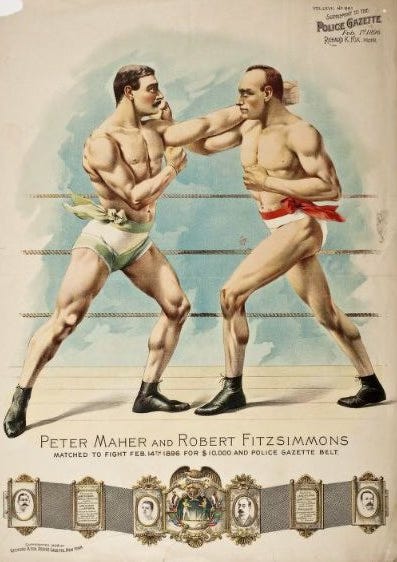
When Fitzsimmons heard that Corbett had bestowed his title on Maher, he cried foul. Since he had defeated Maher three years earlier, Fitzsimmons claimed the title for himself—and had the backing of many in the fighting community, which said that Maher’s title was merely “a gift championship.” The National Police Gazette, the leading boxing rag at the time, argued that Maher had to beat Fitzsimmons in the ring to authenticate his claim to the title, writing, “He has been hailed as the champion but conservative, reasonable, thinking people, appreciate the fact that the simple act of handing a title to a man on a gold plate is not the only thing that is required to make him a champion.”
A rematch between the two hard hitters was an easy sell, especially with a $10,000 purse put up by a party that wanted to film the fight.2 But where could Stuart schedule it? A group of El Paso businessmen were the answer to that question. Whether they were ignorant of the Texas law or simply ignored it, they approached Stuart with a bonus of $6,000 if he would stage the Fitzsimmons-Maher rematch in their city. Stuart, who was an old political adversary of the governor, agreed, taunting Culberson by declaring, “Nothing short of lightning or the destruction of the earth by fire can stop the contest we have arranged to pull off.”
Governor Culberson couldn’t destroy the earth with fire, but he could prevent a boxing match within the borders of Texas. He dispatched a company of twenty-six Texas Rangers under Woodford H. Mabry to El Paso. It wasn’t lightning, but it was enough to to ensure the match wouldn’t take place.
Then, on February 6, 1896, lightning did strike. On that day, President Grover Cleveland signed into law New Mexico Senator Thomas Benton Catron’s anti-fighting and gambling bill, outlawing, according to the Springfield, Massachusetts Morning Union, any “pugilistic encounter—between man and man . . . for money or for other things of value, or for any championship” within any state or territory within the United States. The Fitzsimmons-Maher fight was no exception. In fact, the U.S. Attorney General Judson Harmon said, “If they fight in any territory of the United States, we will follow them to the ends of the earth if necessary to bring them to justice.”
It looked like the rematch was off and Maher the conferred champion.
Enter justice of the peace Judge Roy Bean, the self-styled “Law West of the Pecos.” He had followed developments of the Fitzsimmons-Maher bout from his saloon, the Jersey Lilly, in Langtry, on the Texas-Mexico border. Bean proposed a solution to Stuart’s situation. He should skirt the law without breaking the law—stage the fight on a sandbar in the middle of the Rio Grande across the border in Mexico, outside the jurisdiction of Texas and the United States. Stuart agreed and scheduled the fight for February 21, 1896.
When Mabry learned about the change of venue, he telegraphed the Vale Verde County sheriff’s office. Deputy Sheriff J. G. Reagan went to Langtry to question Bean, who assured the lawman that no laws would be broken in his jurisdiction, and that as far as he knew the boxing match was to take place across the river. Reagan then dispatched a telegram to Governor Culberson: “Prize fight takes place across river whose jurisdiction are we under yourself or judge Roy Bean await your instructions.”
That same day, in El Paso, Fitzsimmons and Maher, along with 182 paying spectators—and the Texas Rangers—boarded a train for Langtry. When they arrived, Bean lead them, followed by local cowboys, down the main street, onto a wagon road down the limestone bluff to the river, then across a footbridge at Eagle Nest Crossing. There stood a boxing ring encircled with a sixteen foot high canvas wall.
The Texas Rangers, who had no authority in Mexico, remained on the Texas side and sat on a bluff to watch the fisticuffs. Mexican authorities, who knew nothing of the fight, could do nothing to stop it. The closest company of soldiers were stationed around Eagle Pass, some 120 miles away.


The men stepped into the square, took off their overcoats, caps, and trousers, and shook hands in the center of the ring. Fitzsimmons and Maher donned their five-ounce gloves as referee George Siler gave instructions and warnings. Returning to their corners, timekeeper Lou Houseman banged a gong and the fight was on.
Before leaving for Langtry, Maher bragged to a reporter for the El Paso Daily Herald: “When Fitzsimmons defeated me at our first engagement I was a big, strong fellow to be sure, but a mere novice in the art of boxing. I was hardly more than a boy and had but the most elementary knowledge of the game of stop, hit and get away. Even at that I had Fitz nearly out in the first round, but I didn’t know enough to take advantage of point I had gained. I do not mean to repeat my former mistake and stay away from him. I honestly believe I can win. . . . Of one thing the sporting public can rest assured—the battle will be swift and hard. . . . Fitz will have to knock me stone out to win.”
And that’s just what Fitzsimmons did. In ninety-five seconds after the bell rang, Ruby Robert knocked out The Irish Giant. Despite a bloody lip, Fitzsimmons said, “I got in on him with my right and caught him squarely on the jaw. I knew it was all over when I landed on him. It was dead easy from the start.”
For Maher’s part: “I thought I had him licked until he punched me under the jaw and then it was all over with me and I quit thinking.”
Corbett came out of retirement to reclaim his title by fighting Fitzsimmons in 1897, a fight that was also put on film—the longest film ever released at the time at 1.5 hours long. Fitzsimmons knocked out Corbett in the fourteenth round.
Because it had rain sporadically thoughout the day it was overcast and the light was too poor to film, though a kinescope had been set up. (If the bout had been recorded no film has ever been discovered.)
Matt Donnellon, The Irish Champ Peter Maher: The Untold Story of Ireland’s Only World Heavyweight Champion and the Records of the Men He Fought (Trafford Publishing, 2008).
Adam J. Pollack, In the Ring with Bob Fitzsimmons (Win by KO Publications, 2007).
Jack Skiles, Judge Roy Bean Country (Texas Tech University Press, 1996).
Y’allogy is an 1836 percent purebred, open-range guide to the people, places, and past of the great Lone Star. We speak Texan here. Y’allogy is created by a living, breathing Texan—for Texans and lovers of Texas—and is free of charge. I’d be grateful, however, if you’d consider riding for the brand as a paid subscriber, it helps offset research and writing expenses—and ensures that Y’allogy remains cost free.
You can also show your support by purchasing my novel.
Be brave, live free, y’all.
Judge Roy Bean continues to rise in my esteem everytime I learn something new about him.
Excellent article! Boxing & the old West, 2 of my favourite subjects. 🥊🤠