


All is calm, all is bright.
Joseph Mohr
This is the fourth article in a continuing series on my favorite Christmas carols. The first was a popular canticle in the nineteenth century, but rarely sung today: “God Rest Ye Merry, Gentleman.” The second was a classic that continues to enjoy widespread acclaim, even if it’s often truncated in our singing: “We Three Kings.” The third was one one taught to children early in life since they are the objects of the baby Jesus’s love: “Away in a Manger.” This year I offer the most beloved carol of all: “Silent Night” and the remarkable story of how it lead to a ceasefire during the fighting of War World I.
The Napoleonic War was a bloody affair, taking the lives of some three and half to seven million souls. But after more than a decade of warring between Napoleon Bonaparte and his enemies, the guns finally fell silent on November 2, 1815, when the Second Treaty of Paris was signed. During the years of fighting, blood ran thick and deep in the white snows of Austria. According to estimates, half a million military and civilian Austrians died as a result of combat.
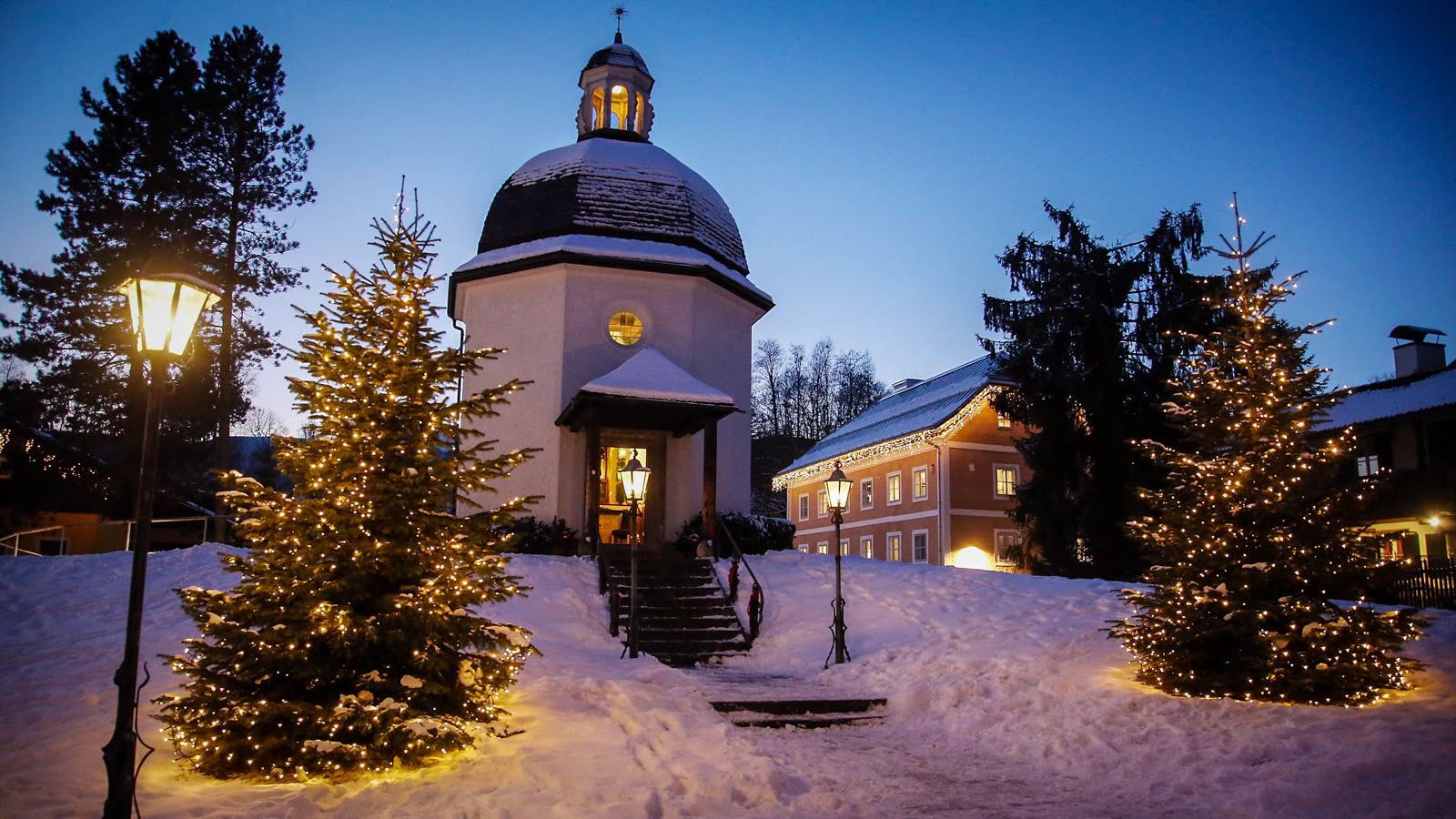
A year following the fighting, all was silent and calm, especially on a snowy winter’s eve. Joseph Mohr, the assistant priest of Saint Nicholas parish in the little village of Oberndorf bei Salzburg, was responsible for parish music, often composing poems and lyrics for special services. While walking from his grandfather’s house to his church in the silence of that night—the only sound the muffled crunch of his boots in the snow—the words of a poem began to form in his mind: Stelle Nacht, Heilige Nacht—“Silent Night, Holy Night.”
As best we know, Mohr penned the words that Austrian evening in 1816 and put it aside. Two years later, however, while preparing for the midnight Mass on Christmas Eve, Mohr discovered the organ of Saint Nicholas wouldn’t play a note. If he didn’t do something quickly, it certainly would be a silent night. Mohr prayed and then remembered his poem. Rushing home he found the piece of paper on which he penned the verses. But he didn’t have a melody to accompany the words. Then he though of his friend, music teacher and choral director, Franz Xavier Gruber. Mohr ran to Gruber’s home and found him shivering in his cold room. Mohr told Gruber about the organ and asked if he could put the poem to music with guitar accompaniment. Gruber assured his friend he could. Mohr returned to the church to finish preparations for Mass. An hour later, Gruber arrived with his guitar and taught the choir the four part harmony of “Silent Night.”
From that first singing on Christmas Eve in 1818 until today, “Silent Night” has been sung before kings and queens, and has been recorded more than any other song in history. The organ builder and repairman at Saint Nicholas learned the original six-verse carol and taught it to the villagers of his own home town. From there, it was picked up by two families of folk singers—the Strasser and Rainer families—and performed throughout Austria, northern Europe, and America. By 1834, the Strasser family performed it for Frederick William III, the King of Prussia. Five years later, in 1839, the Rainer family sang it outside Trinity Church in New York City. By the time of the Civil War, “Silent Night” was the most popular Christmas carol in America—on both sides of the Mason-Dixon Line—and brought peace, if only for a moment, to the battlefields of that terrible war.
But it was the Christmas Day truce during the so-called “war to end all wars” in 1914 that “Silent Night” grabbed the hearts of two warring factions, reminding them of their common humanity and the truth that the Prince of Peace had come to end all wars—spiritual and physical.
No one knows exactly where it started or how it started, but for one bitterly cold day peace settled over the killing fields of World War I.
Christmas Eve 1914 was, according to one British soldier, “a beautiful moonlit night.” Frost covered the ground, turning the bloodblack mud white. Sometime during the evening, somewhere along the Western Front a German soldier erected a Christmas tree outside his trench. He lit it with candles. Then, someone began to sing Christmas carols. German soldiers in their trenches sang in German. British soldiers in their trenches sang in English. Back and forth, throughout the night, the songs of Christmas echoed over no man’s land. And as the familiar strains of Stelle Nacht, Heilige Nacht was carried from the German trenches it was met with British voices singing the same carol in English, Silent Night, Holy Night.
The next morning—Christmas Day—German troops began popping up all along the line, shouting in broken English, “Merry Christmas, Englishmen!” Some waved arms as an invitation for the British to leave their trenches. Others held up crude signs: “You no shoot, we no shoot.” British troops, unsure if it was a trick, warily peered over the parapets . . . then quickly ducked behind the safety of their lines. However, it didn’t take long before men from both sides—German and British—began climbing out of their trenches. Soldiers laid aside their weapons and “met in the debatable, shot-riddled, no man’s land between the lines,” as British Captain Robert Patrick Miles described it. “Here the agreement . . . came to be made that we should not fire at each other until midnight tonight.”
But until midnight came, Germans and Englishmen shook hands and swapped gifts of cigarettes, cigars, and pipe tobacco. They exchanged buttons and hats. They shared schnapps and chocolate, and other food and drink. They passed around photographs of girlfriends and wives and families. And they played a friendly game of football (soccer).
Years later, Alfred Anderson of the British Black Watch recalled the Christmas Day truce:
All I’d heard for two months in the trenches was the hissing, cracking and whining of bullets in flight, machine gun fire and distant German voices. But there was dead silence that morning, right across the land as far as you could see. . . . [But the] silence ended . . . and the killing started again. It was a short peace in a terrible war.
And a terrible war it was, taking the lives of seventeen million and wounding at least twenty million more. Yet, for a brief moment in that long war, the prayer of all was answered: “Peace on earth, good will to men”—all because of the baby born on that silent night in Bethlehem.
It’s ironic that “Silent Night” is so closely associated with warfare. But wherever there are warring factions, there are always hearts longing for peace—for the silence of bombs and bullets, and of brutish screams in hatred and hurt—and praying that all might be calm and bright.
Fredrick William Faber, a Catholic priest and hymn writer, once remarked: “Whenever the sounds of the world die out in the soul, or sink low, then we hear the whisperings of God.” This is exactly what the Lord tells us in Psalm 46:10: “Cease striving and know that I am God.” And yet, the yuletide season is often the hardest time to be still and silent—to experience a holy hush.
To help you to “kill” the sounds of the world during the hustle and bustle of this Christmas season, stop what you’re doing and pull up a favorite recording of “Silent Night” and sing along.
Silent night! Holy night!
All is calm, all is bright.
Round yon virgin, mother and Child.
Holy infant so tender and mild,
Sleep in heavenly peace.
Sleep in heavenly peace.
Silent Night! Holy night!
Shepherds quake at the sight,
Glories stream from heaven afar,
Heavenly hosts sing Alleluia;
Christ, the Savior, is born!
Christ, the Savior, is born!
Silent night! Holy night!
Son of God, love’s pure light
Radiant beams from thy holy face,
With the dawn of redeeming grace,
Jesus, Lord, at thy birth!
Jesus, Lord, at thy birth!
Perhaps “Silent Night” is so popular because it bespeaks of what James Earl Jones said in Field of Dreams: “For it is money they have and peace they lack.” Do you need peace today? Then be quiet and know that He is God. Listen to the holy hush.
Y’allogy is an 1836 percent purebred, open-range guide to the people, places, and past of the great Lone Star. We speak Texan here. Y’allogy is created by a living, breathing Texan—for Texans and lovers of Texas—and is free of charge. I’d be grateful, however, if you’d consider riding for the brand as a paid subscriber, it helps offset research and writing expenses—and ensures that Y’allogy remains cost free.
You can also show your support by purchasing my novel.
Be brave, live free, y’all.
Paul Harvey would’ve been proud of this one.