

Echoes of Other Stories

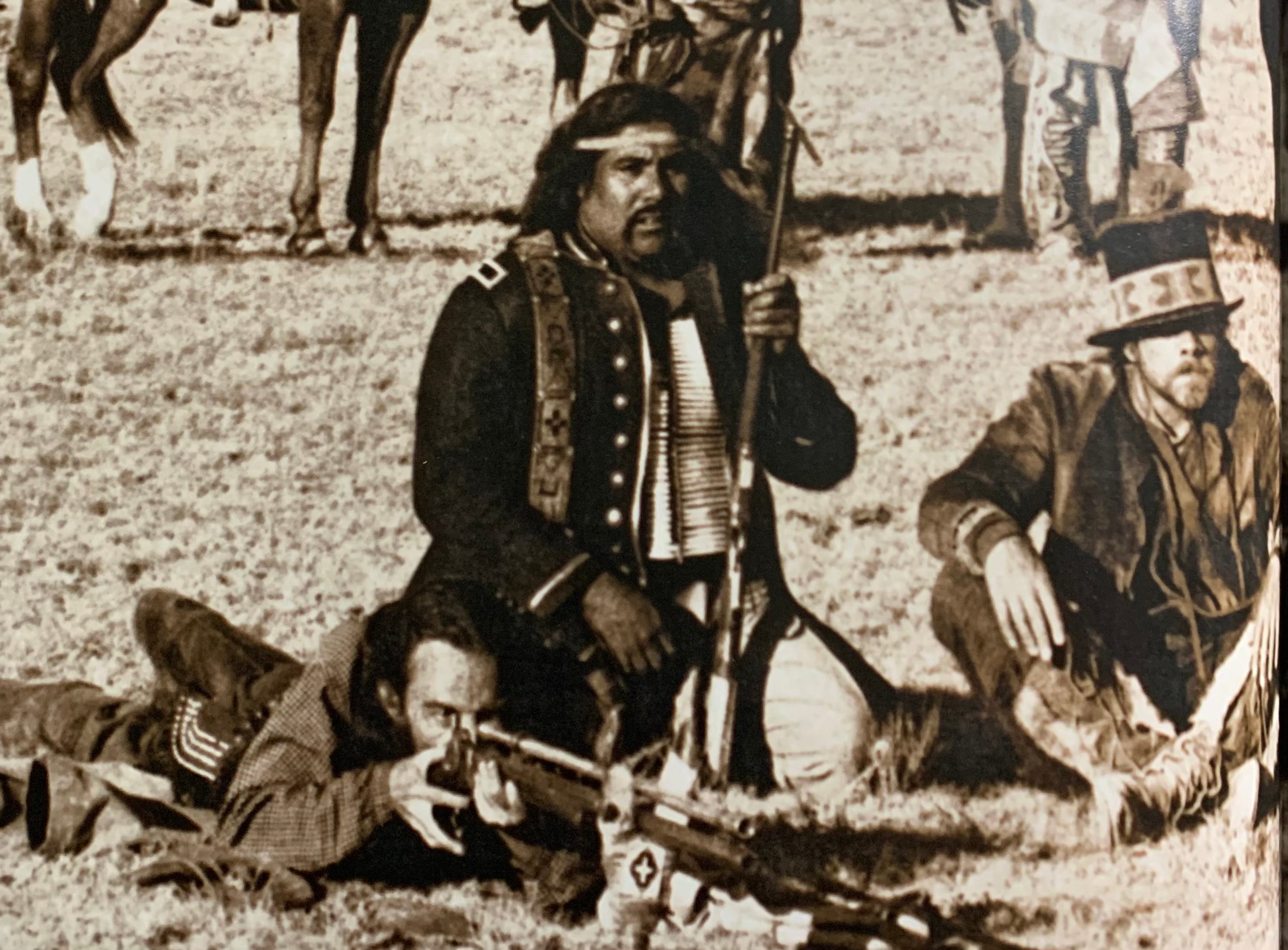
“The Goodnight-Loving relationship is echoed, but it’s just echoes.”
Larry McMurtry
Cormac McCarthy famously said, “Books are made out of books.” That was certainly true of Lonesome Dove. In an interview with John Spong of Texas Monthly on the twenty-fifth anniversary of the novel’s publication, Larry McMurtry confessed he echoed the relationship between Augustus McCrae and Woodrow F. Call on the Charles Goodnight and Oliver Loving relationship, which McMurtry would have encountered in J. Evetts Haley’s 1936 Charles Goodnight: Cowman and Plainsman. McMurtry also told Spong, he copied the words on Bose Ikard’s monument—a black cowboy who work with Goodnight—for Josh Deet’s epitaph, which he took from Haley’s biography of the cowman. McMurtry then added: “And I knew vaguely that I was paralleling part of [E.C.] Teddy Blue Abbott [We Pointed Them North: Recollections of a Cowpuncher (1939)]. But I’m not thinking about that when I’m writing.”
McMurtry might not have been conscious of pulling from or shadowing others but he was influenced and inspired by other works and historical facts, including the renegade in Lonesome Dove: Blue Duck. McMurtry told Chuck Thompson of Cowboys & Indians, “Belle Starr, a rather famous female outlaw, had a boyfriend named Blue Duck. The name is derived from him. I knew Blue Duck was a great villain. The face of evil, if you can harness it, is powerful.”
McMurtry’s reliance on other books or the historic record extends beyond the major characters in Lonesome Dove. His creation of minor characters—as I pointed out in “‘My Good Friend’: Xavier Wanz”—including one of Blue Duck’s henchmen, Ermoke, the funny-named bad man Frog Lip, and the wise beyond her years Janey, also were derived from others.
Ermoke, Renegade Kiowa
The real Ermoke is a man of mystery, whose history has been lost to the ravages of time and forgotten memory. (At least I’ve not been able to uncover his history.) Though little is known about the man’s life, his image is easily discovered. William “Billy” Dixon published a photograph of Ermoke, surrounded by a “band of [four] murderous Kiowas,” in his 1874 memoir, Life and Adventures of “Billy” Dixon, of Adobe Walls, Texas Panhandle, a volume well-known by McMurtry. The photograph was taken some two years before, in 1872, by William S. Soule at Fort Sill, Indian Territory.
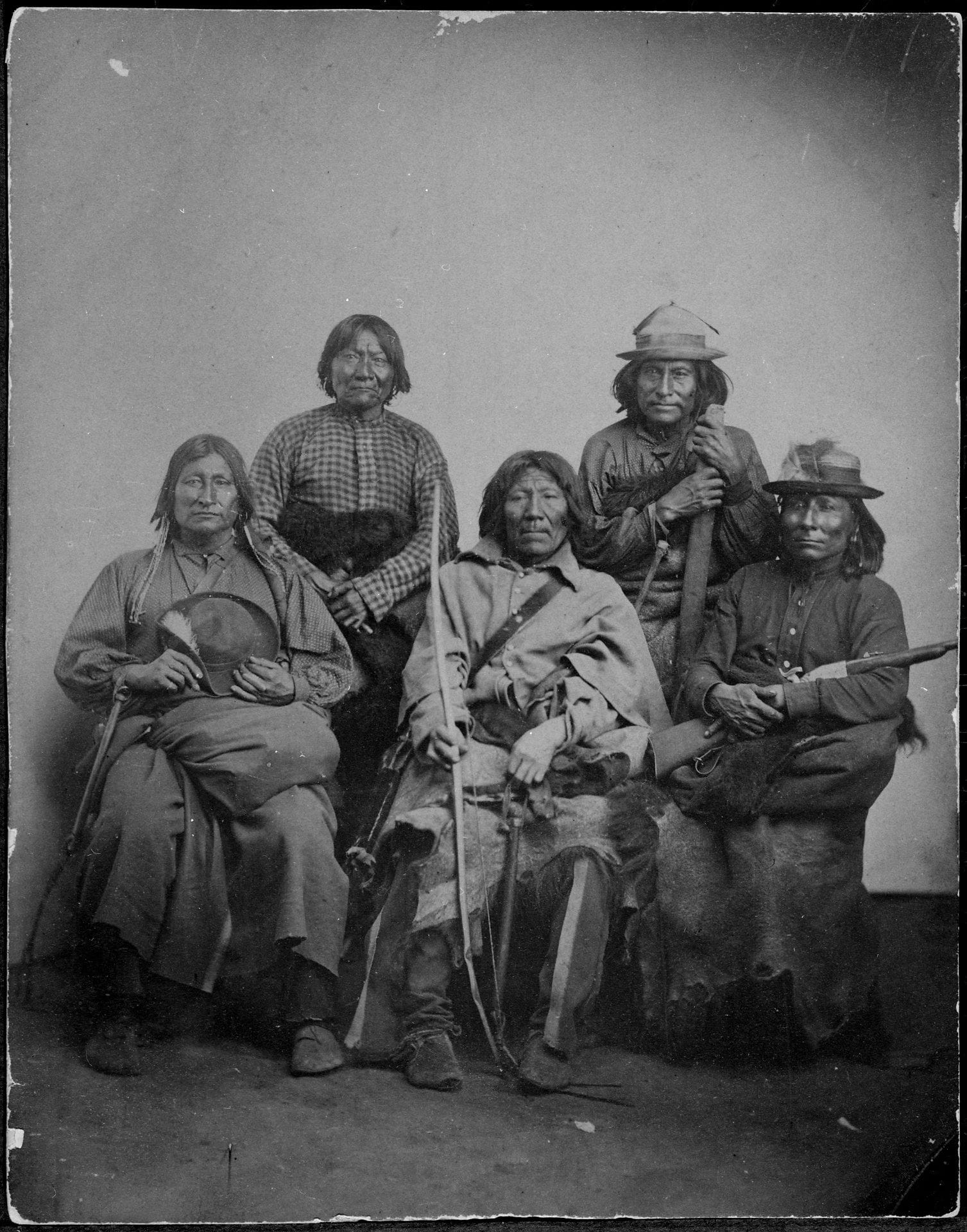
In keeping with Dixon’s brief description of the actual man, Ermoke the character in Lonesome Dove, along with his Kiowa renegades, are unquestionably a murderous bunch—they would have to be to join Blue Duck’s gang. But they are more than murderers. They are rapists—insurrectionists against mankind, renegades, not merely against the law, but against all that is good and decent.
Murderers take another person’s life. Rapists take another person’s humanity, reducing them to a bestial status, perverting them into objects in which the rapist consummates his lascivious violence. This is played out in Lonesome Dove by the multiple rapes of Lorena after being captured by Blue Duck. Once Ermoke and his Kiowas, as well as Monkey John and Dog Face (notice the animalistic names), have roundly abused her, Blue Duck cowers them into gambling. He makes a comment about winning most of the livestock in the camp except Lorena. “A woman ain’t livestock,” Dog Face says. “This one is,” Blue Duck responds. “I’ve bought and sold better animals than her many times.” He then adds: “You’d do better to buy a goat.”
Frog Lip, Taciturn Killer
From my first introduction of Lonesome Dove in 1989, the close-mouthed black member of the Suggs’s gang was just another one of those forgettable minor characters that serve their narrative purpose and are either left behind or killed off. I had always assumed McMurtry created Frog Lip from his imagination and given him an unusual name, perhaps in the hopes of making him more memorable by being a little coy in naming the intimidating man with a funny sounding moniker.
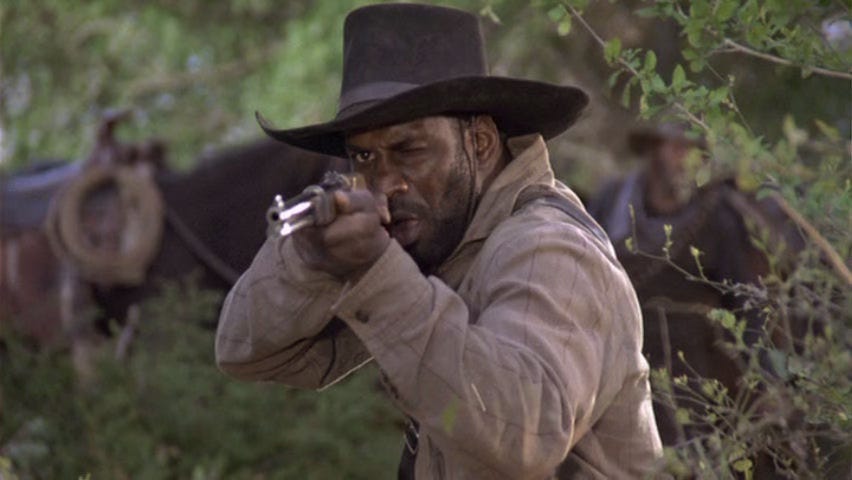
McMurtry describes Frog Lip as a man in need of no words to communicate the violence pent-up within him. He is “a fine marksman” who owns “five guns of various calibers,” spending most of his time silently cleaning each one. When he kills a deer at a distance Jake Spoon “considered impossible,” which “Frog Lip seemed to take for granted,” Jake becomes anxious “that the black man’s guns would soon be posted at something besides deer.” Jakes’s fears were well founded. Frog Lip was an intimidating presence. Not even the Suggs’s ordered the man about. McMurtry writes, “Jake didn’t notice anyone giving [Frog Lip] many orders. Little Eddie Suggs cooked the supper, such as it was, while Frog Lip sat idly, not even chopping wood for the fire. The horse he rode was the best in the group, a white gelding. It was unusual to see a bandit who used a white horse, for it made him stand out in a group,” especially a black man riding a white horse. “Frog Lip evidently didn’t care” because he was utterly devoid of fear.
You can detect McMurtry winking at the audience by giving such a man such a name. Though McMurtry invented the man, I’m convinced he didn’t invent the name. Rather, he was inspired by Andy Adams’s 1903 fictionalized memoir The Log of a Cowboy, where an old black family man and trail cook is introduced by the name of “Frog.”
While the two men couldn’t have been more different, they shared a common appellation—one so strange it stretches credulity to believe McMurtry wasn’t echoing Adams.
Janey, Sacagawea’s “Daughter”
Janey, the girl Roscoe Brown comes across in the East Texas woods, is one of the most tragic characters in Lonesome Dove. All that is known of her is that she was living with Old Sam, a hermit, who “gave twenty-eight skunk hides for her,” and that she appeared, in Roscoe’s eyes to be somewhere between fourteen and fifteen. Before book’s end she will be dead and buried in the treeless wilderness of the Llano Estacado, near the Canadian River.
Like Frog Lip, Janey isn’t merely an invention of McMurtry’s imagination. She comes from his reading of the Journals of Meriwether Lewis and William Clark, written after their 1804–1806 “Corps of Discovery” exploration of the northern reaches of the Louisiana Purchase, when they sailed and poled up the Missouri River, crossed the Continental Divide, and traversed the Columbia River to the Pacific Ocean. “Janey” is the nickname they gave to Sacagawea, the Shoshone woman who accompanied the American adventurers. In his essay, “Sacagawea’s Nickname,” McMurtry wrote,
During the seven months that it takes the Corps to get up the Missouri River, over the Rocky Mountains, and down the Columbia River, both Captain Lewis and Captain Clark struggle somewhat awkwardly with what to call Sacagawea. For long stretches, in their Journals, she is simply “the Indian woman,” or “Charbono’s Snake Indian wife,” or, more rarely, “the Squar.” . . . Reluctantly, and never very successfully, they begin to call her Sacagawea, which they spell several different ways. By this time both men have considerable respect for Sacagawea. . . .
Finally they . . . decide on a nickname, Janey. . . . The occasion on which the nickname is revealed . . . is itself of some interest. Mired in misery on the north bank of the Columbia, drenched almost every day, the captains decided to take a vote on where to construct a winter camp. All the men voted, including York, Captain Clark’s black servant; and Janey voted, too, indicating that she would prefer to camp where there were lots of potatoes. This sudden granting of suffrage-in-the-wilderness strikes me as pretty amazing, as does the offhand relation of the nickname.
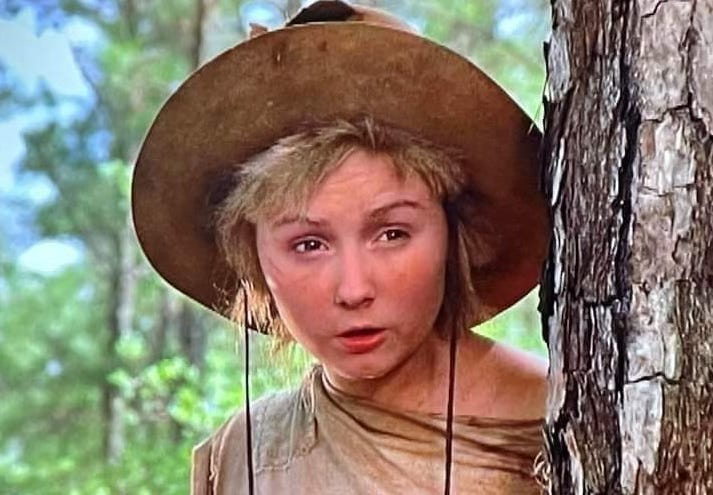
Like the real Janey, the fictional Janey is a child of nature and a worthy “daughter” of Sacagawea. She is adept at living off the land, skilled in hunting, dressing, and cooking wild game—including catching frogs and cooking their legs. Though the real Janey didn’t serve as a scout for the Corp of Discovery—her husband, the French trapper, Toussaint Charbonneau did—she did serve as an interpreter. The fictional Janey fulfills the role of Roscoe’s guide in his pursuit of July Johnson, as well as an interpreter of sorts. Long before Roscoe picked up the signs that Jim and Hutto, two bandits roaming the road between Fort Smith and Fort Worth, are dangerous, Janey warn him, “They’re followin.’ I been watching. I guess they want to kill you.” She guides Roscoe to a gully to hide, but he’s discovered. To protect him, Janey throws rocks at the two bandits with such accuracy Hutto, no doubt meaning it as insult, complimented her: “I suspect that girl has Indian blood.”
Indeed she does. The drop of an echo of blood from Sacagawea, her namesake.
✭
Larry McMurtry, Lonesome Dove (Simon & Schuster, 1985), 314, 384, 394, 417, 477, 498.
Larry McMurtry, Sacagawea’s Nickname: Essays on the American West (New York Review of Books, 2001), 157–58.
John Spong, “True West,” Texas Monthly, vol. 38, issue 7 (July 2010), 130.
Chuck Thompson, “Larry McMurtry: Reluctant Legend,” Cowboys & Indians, August 24, 2020.
Y’allogy is an 1836 percent purebred, open-range guide to the people, places, and past of the great Lone Star. We speak Texan here. Y’allogy is created by a living, breathing Texan—for Texans and lovers of Texas—and is free of charge. I’d be grateful, however, if you’d consider riding for the brand as a paid subscriber, it helps offset research and writing expenses—and ensures that Y’allogy remains cost free.
You can also show your support by purchasing my novel.
Be brave, live free, y’all.
I still have that issue of Texas Monthly! It's a treasured memento.
The Goodnight Loving vodka is pretty good