

Chuckwagon Grub: Cowboy Coffee

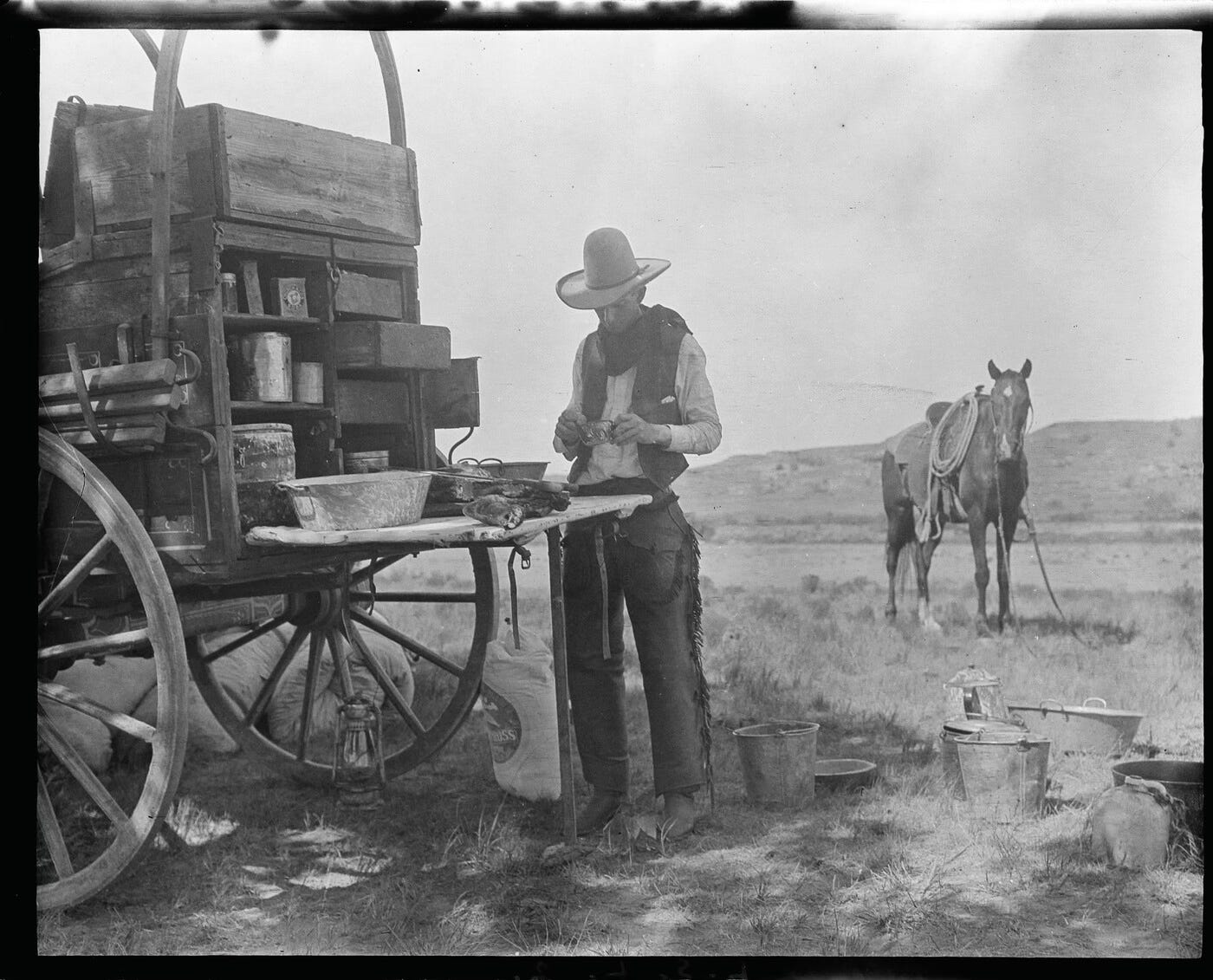
The cowboy’s recipe for making coffee was “take one pound of coffee, wet it good with water, boil over a fire for thirty minutes, pitch in a horseshoe, and if it sinks, put in some more coffee.”
Ramon F. Adams
This is the second in a continuing series on chuckwagon grub—the food and drink consumed by working cowboys sitting around an outfit’s chuckwagon while on the trail or back at the ranch in the bunkhouse. The first article included a recipe for a trail staple: pan de campo or camp bread. This article includes the recipe for another trail staple: coffee.
My friend Michael Svigel is a theologian and coffee aficionado. As such, he knows what he’s talking about when he writes, “There are two kinds of people in this world: people who like plain black coffee, and people who don’t really like coffee.” Applying his theological expertise to the nature of coffee drinkers he gets unapologetically biblical: “A cup of coffee is a sign that we are created in [God’s] image. Adding milk and sugar is a sign that we are fallen, depraved sinners.”
Except for all the horseback riding, cattle punching, roping, and branding, and sleeping in a bedroll on the ground, under the stars, I think Svigel would have felt right at home sitting around a chuckwagon where there were no French presses, filters, percolators, or pumpkin spice lattes, only black, strong, hot coffee—and plenty of it. For the average cowpuncher there was nothing better than a steaming cup of coffee—with meals, between meals, first thing upon waking, and last thing before sleeping. If a cook wanted to keep a mutiny from forming, he made sure he had a large pot of coffee on to boil at all times because cowboys drank it by the gallon. On one ranch, from August 1882 to August 1883, Oliver Nelson, an old cook, boiled up thirteen 160-pound sacks of coffee to keep his ranch hands satisfied.
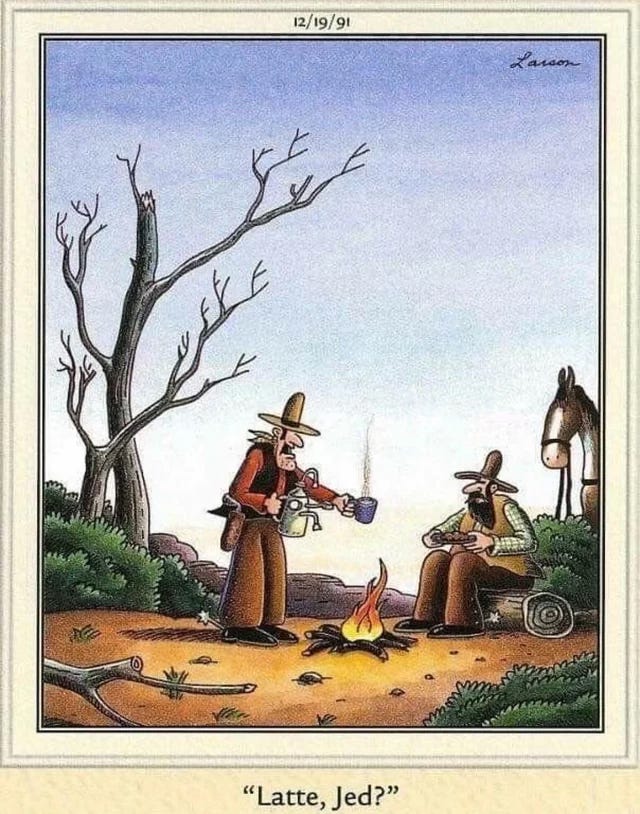
According to cowboy historian Ramon F. Adams, the old-time cowhand wanted his “coffee strong and black. He wanted no sweetened or cream-weakened concoction. Coffee that suited his tastes would doubtless be pronounced vile and undrinkable in more refined circles.” To prove his point, Adams quotes Joe Beal, an old puncher, who said to his cook: “Cookie, pour me a cup o’ that condensed panther y’u call coffee. This is the way I like it plumb barefooted. None o’ that dehorned stuff y’u git in town cafés for me”—what many cowboys called “bellywash.”
But not all cowboys wanted to swallow a bitter brew. A favorite brand, Arbuckles’ Ariosa Coffee, which came with a stick of peppermint packed in each one-pound bag of coffee beans, had to be ground by hand. When the cook hollered, “Who wants the candy?” some of the toughest men in the West fought for the privilege of cranking the grinder. So, if a cowboy was a little on the soft side, at least when it came to his coffee, he allowed his fallen, depraved nature to put a peppermint stick or sugar in his cup, if sugar was available, which was hard to keep stable on the trail. If ants weren’t carrying it off, rain and dampness made it lumpy. If sugar wasn’t at hand, molasses was and a cowhand who wanted to sweeten his coffee would stir in a dollop of “lick,” which cowboys called “long sweetenin’.”
Teddy Blue Abbott, a cowboy who trailed cattle from Texas to Montana, said of his fellow northern transplanted Texans: “for some of them [Montana] was the first they ever knew there was a world outside Texas. They knew cows and horses backwards and forwards, but when it came to anything else they were fresh from the sticks.” To illustrate, he told the story of a fellow Texan “who rode into a roundup camp at dinner time, and they passed him sugar, and he said, ‘No, thanks, I don’t take salt in my coffee.’ He had never seen sugar before; only sorghum syrup.”
No matter how a cowboy liked his coffee, the recipe was simple. According to Ramon Adams, “The cowboy’s recipe for making coffee was ‘take one pound of coffee, wet it good with water, boil it over a fire for thirty minutes, pitch in a horseshoe, and if it sinks, put in some more coffee.’” Jokes aside, cowboys, generally, did like their coffee black and strong. They sometimes called it “six-shooter coffee,” because it was said a pot of strong coffee could float a pistol. I don’t know if the following recipe will float a six-shooter, but it will make a stiff, bracing brew.
Cowboy Coffee
Fill a coffeepot with a quart of cold water per handful of coffee grounds and bring to a rolling boil.
Place coffee grounds directly in coffeepot and let boil three (3) to four (4) minutes.
Take coffeepot off heat and let cool. To settle coffee grounds before pouring, add in a splash of cold water.
Pour, drink, enjoy. And if you’re the fallen and depraved type, add milk and sugar.
E. C. “Teddy Blue” Abbott and Helena Huntington Smith, We Pointed Them North: Recollections of a Cowpuncher (New York: Farrar & Rinehart, 1939; Chicago: R. R. Donnelley & Sons, 1991), 216.
Ramon F. Adams, Come An’ Git It: The Story of the Old Cowboy Cook (Norman: University of Oklahoma Press, 1952), 67–68, 70.
David Dary, Cowboy Culture: A Saga of Five Centuries (Lawrence: University Press of Kansas, 1989), 286.
William H. Forbis, The Cowboy, The Old West (New York: Time-Life Books, 1973), 165.
Y’allogy is an 1836 percent purebred, open-range guide to the people, places, and past of the great Lone Star. We speak Texan here. Y’allogy is created by a living, breathing Texan—for Texans and lovers of Texas—and is free of charge. I’d be grateful, however, if you’d consider riding for the brand as a paid subscriber, it helps offset research and writing expenses—and ensures that Y’allogy remains cost free.
You can also show your support by purchasing my novel.
Be brave, live free, y’all.
My grandparents were both western refugees of the dustbowl and depression and were often on ranves and oil towns. They would tell me that cowboy coffee was ready when a mouse could run across the top and leave foot prints.
So interesting! Thank you!