

Blue Duck and the Cowardice of Bullies

Hard-boiled eggs are yellow at the core.
Texas Bix Bender
Bullies come in all shapes and sizes, ethnic and geographical backgrounds, and religious, political, and ethical persuasions. They are young and old, men and women, rich and poor. They are found in schoolyard playgrounds and churchyard pews, Fifth Avenue boardrooms and Pennsylvania Avenue statehouses. They traffic in bloody noses and black eyes (and bruised egos), courtroom lawsuits, and open warfare with other nations.
They are obsessed with power—“[lording] over” others, in the words of Jesus (Matthew 20:25). They are practicers of Thomas Hobbs’s philosophy: that mankind’s “perpetual and restless desire” is “after power, that ceaseth only in Death.” They live in a bifurcated world articulated by Thucydides’s maxim: “Right, as the world goes, is only in question between equals in power, while the strong do what they can and the weak suffer what they must.” They are egocentric, demanding others acquiesce to their power or be subject to intimidating and terrorizing violence—verbally and, if necessary, physically. They are thuggish, preying on the vulnerable, or those they perceive as weak. They lack empathy, compassion, mercy, humanity, or guilt for their words and actions. They are brutes and braggarts, surviving off their well-deserved cruel reputations.
But it is equally true that bullies are small-souled and waif-spirited—“ghostlike,” in the words of philosopher Peter Kreeft. “A person who sees himself as metaphysically weak, as ghostlike in his being, may want to assure himself of his substance, his reality, of the fact that he is alive, by the two most desperate acts of bullying: rape and murder, entering the living body of another forcibly to create or destroy life.” They are chicken-hearted—cowardly to the rotten center of their hard-boiled hearts, just as Texas Bix Bender said: “Hard-boiled eggs are yellow at the core.” With spines no stronger than a chicken’s neck, they snap under the force of equal or greater power.
Though camp cook Po Campo says of Blue Duck, the protagonist in Larry McMurtry’s Lonesome Dove, “There is no worse man. Only the devil is worse,” many of the bully’s cowardly traits are seen in this badman.
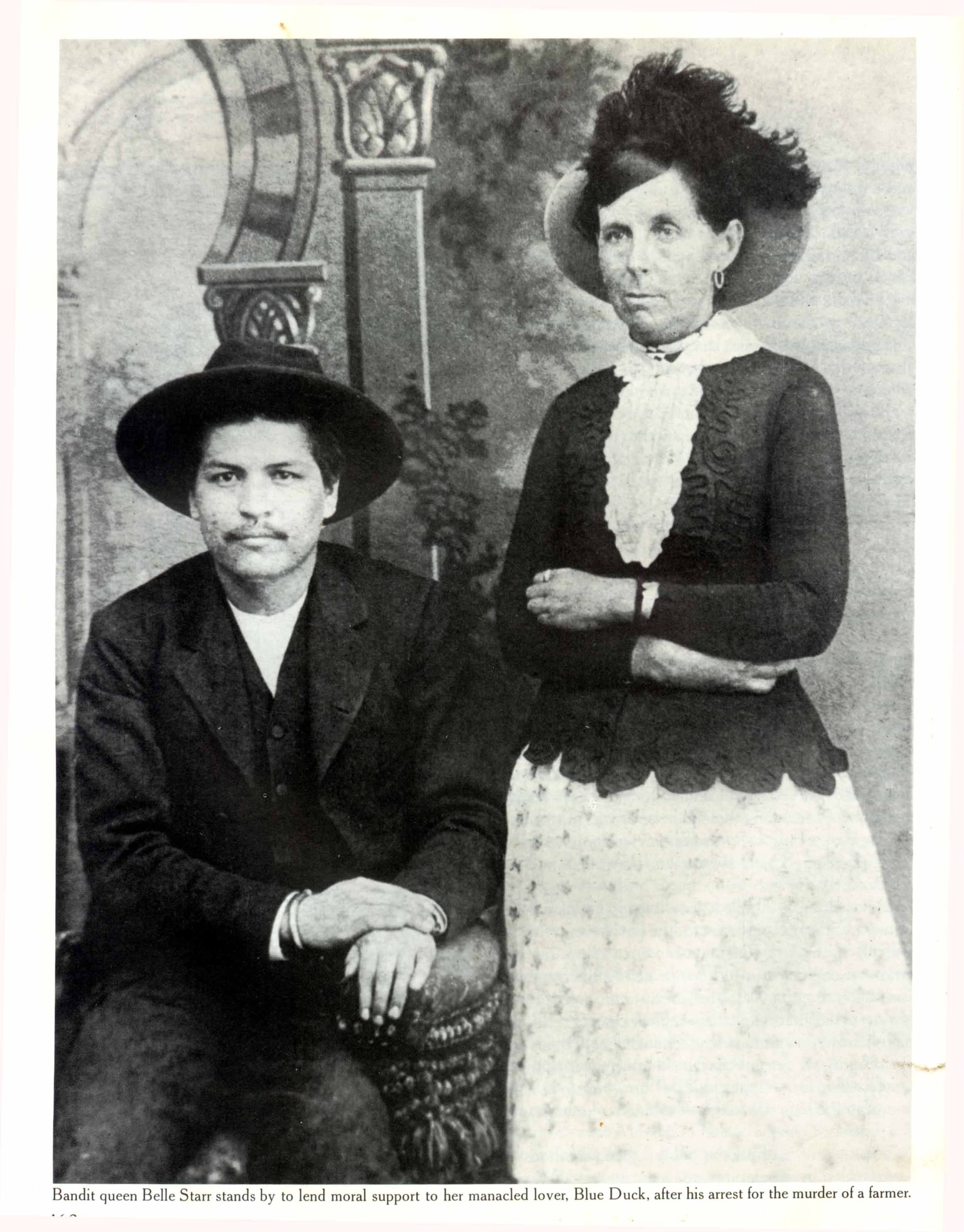
As McMurtry did with a number of characters, he based his fictional Blue Duck on the real Blue Duck, who was no devil. He was a hooligan and highwayman, born on June 17, 1859, in Cherokee Nation, Indian Territory (present-day Oklahoma) as Bluford Duck (Sha-Con-Gah). A member of Sam Starr’s cutthroats—and perhaps (but probably not) Belle Starr’s lover—Blue Duck plied his trade in armed robbery and cattle theft around the Red River.
But on June 23, 1884, along with William Christie, Blue Duck murdered farmer Samuel Wyrick in a drunken outburst. They were soon captured by Deputy U.S. Marshal Frank Cochran and presented to Judge Isaac C. Parker—the “hanging judge”—in Fort Smith, Arkansas, who sentenced them to death. Christie was later cleared of the charges and released. Blue Duck plea-bargained and was sent to Menard Penitentiary in Chester, Illinois for life—inmate 2486.
In 1895 he was diagnosed with tuberculosis. He appealed to President Grover Cleveland for a pardon, which was granted March 20. Blue Duck died some six weeks later on May 7, 1895, at the age of thirty-six. He is buried in Catoosa, Oklahoma.
When we meet Blue Duck in Lonesome Dove, he is a more menacing character than the real outlaw upon which he is drawn.* Physically, he is an imposing man, with a “heavy, square face,” cold, empty eyes”—“cold as snake’s eyes”—and large hands. “He held the rifle in the crook of his arm, handling it like a toy,” is how McMurtry described the man’s size.
And yet, unlike Judge Holden in Cormac McCarty’s Blood Meridian or Anton Chigurh in No Country for Old Men—both psychopathic—McMurtry’s Blue Duck is merely a dangerous bully. Yes, “He had survived twenty years or more in rough country, at a rough game, and could be expected to be formidable, if he was around,” but he is a bully nonetheless.
Blue Duck preys on the weak. When we are introduced to him, by the river where Augustus “Gus” McCrae and Lorena had been frolicking, Gus tells Lori that Blue Duck was “One we ought to have hung ten years ago. Couldn’t catch him. . . . He’s got a bunch of murderers and child-stealers. He used to work the Red River county from New Mexico all the way across to Arkansas, hitting settlers. They’d butcher the groups and take the horses and kids.”
A few pages later, McMurtry writes, “Blue Duck stole white children and gave them to the Comanches for presents. He took scalps, abused women, cut up men. What he didn’t steal he burned, always fleeing west onto the waterless reaches of the llano estacado, to unscouted country where neither Rangers nor soldiers were eager to follow.”
And in one of the climatic scenes, Blue Duck kills the frightened and inept Roscoe Brown, as well as the boy Joe and the girl Janey.
Blue Duck relies on his reputation. Folks in Texas and New Mexico continued to blame Blue Duck for heinous crimes even after he committed suicide by jumping through a jailhouse window—an episode McMurtry took from from the suicide of Kiowa chief Satanta who jumped from his Jacksboro, Texas prison window on October 11, 1878. McMurtry writes: “Blue Duck had ranged the llano for so long, and butchered and raped and stolen so often, that superstitions had formed around him.”
Blue Duck uses intimidation to force submission. After he steals Lori and they stop to water their horses, Blue Duck said to her: “I got a treatment for women that try to run away. I cut a little hole in their stomaches and pull out a gut and wrap it around a limb. Then I drag them thirty or forty feet and tie them down. That way they can watch the coyotes come and eat their guts.”
On the next page, Blue Duck tells Lori, “I oughta just gut you and leave you here and let [McCrae] bury whatever the buzzards and the varmints don’t eat.”
Blue Duck is a braggart. When we first encounter him, Blue Duck tells Gus, who’s sitting on a rock in the middle of the river with his pistol, “I can’t wait all day just for the chance to shoot two worn-out old Rangers”—referring to Gus’s partner Woodrow F. Call. “There are plenty that need killing besides you two.”
When Blue Duck threatens to gut Lori and leave her for the buzzards, he says, “I hope that goddamn old Ranger hurries along. I owe him a few.” Lori asks, “Gus? Gus won’t come. I ain’t his.” “He’s coming,” Blue Duck said. “I don’t know if its for you or for me, but he’s coming.”
And while sitting in a New Mexico jail, Blue Duck boasts to Call: “I should have caught [McCrae] and cooked him when I had the chance.” Call, “annoyed by the man’s insolent tone,” responds, “He would have killed you. Or I would have, if need be.” With an insolent smile, Blue Duck said, “I raped women and stole children and burned houses and shot men and run off horses and killed cattle and robbed who I pleased, all over your territory, ever since you been a law. And you never even had a good look at me until today. I don’t reckon you would have killed me.”
Blue Duck is a coward. For all his terror and danger and braggadocio about killing and cooking Gus, Blue Duck has a cowardly center—as all bullies do. He had more than one chance to go at Gus, but in the end Blue Duck tucked tail and ran. By the river he as much admitted his cowardice: “I can’t wait all day for the chance to shoot two worn-out old Rangers,” then mounted and rode away. Gus, a true tough man, was humble enough to tell Lori, “I don’t underestimate him, though he’d have to step quick to beat me and Call both.” Later, Gus tells Call, with a bit of humor, that “It would have been touch and go who got kilt. I might have got him or at least wounded him, but I’d have probably got wounded in the process and I don’t feel like traveling with no wound.”
When Gus comes after Lori, Blue Duck refuses to meet him barrel-to-barrel. He sends his “bunch of murderers and child stealers” to ambush Gus in the open expanse of the Llano Estacado. In their horse chase, Gus rides into a buffalo wallow—a small depression in the ground where a buffalo had rolled—and kills his horse to fort-up behind. He than engages Blue Duck’s men in a gun battle. They eventually skedaddle by July Johnson and his party.
When Gus joins July and the others, they track Blue Duck’s men to their hiding place and Gus says, “They don’t know it, but the wrath of the Lord is about to descend upon them. I dislike bold criminals of whatever race, and I believe I’ll go see that they pay their debts.” July then asks, “You want to go at them alone?” Gus says, “They’re easier to scare at night. I expect I’ll just run most of them off. But I do intend to kill Mr. Duck if I see him. He’s stole his last woman.”
Meanwhile, in Blue Duck’s camp, he’s preparing to leave, knowing Gus is on this way. Monkey John asks, “You gonna leave?” “That’s right,” Blue Duck said. “I aim to look for a better crew. The whole bunch of you couldn’t kill one man. You never even attacked that second bunch [July’s crew]. It was probably just a cowboy or two.”
Coward to the core.
Cowards blame others for not doing what they themselves bragged about doing but didn’t do. In Gus, Blue Duck found a man who met, unflinchingly, his aggression—and exceeded it. Gus would tangle with the whole bunch alone while Blue Duck would turn yellow and hightail it.
After Gus and Lori return to where Roscoe, Joe, and Janey were killed, Gus says to July, “If I ever run into Blue Duck I’ll kill him. But if I don’t somebody else will. He’s big and mean, but sooner or later he’ll meet somebody bigger and meaner. Or a snake will bite him or a horse will fall on him, or he’ll get hung, or one of his renegades will shoot him in the back. Or he’ll just get old and die.”
Sooner or later, every bully faces the justice they so richly deserve.
Edna Ferber, the author of Giant, who dealt with her share of bullies, wrote, “A bully must be met with instant repulse or he multiplies his own violence. A placated bully is a hand-fed bully.”
She’s absolutely right. You can’t negotiate, reason, or appease bullies. If you try they become more emboldened in their bullying. The only language they understand and respect is power and force. The only way to deal with a bully is to wack him. And wack him again. And again . . . until he turns the other cheek.
* McMurtry identifies Blue Duck as both an “Indian” and a “Comanchero”—traders with Plains Indians. This is an interesting contradiction since Comancheros—so named because Comanches were their best trading customers—were not Indians, but Hispanics from Northern and Central New Mexico.
Texas Bix Bender, A Cowboy’s Guide to Life (Gibbs Smith, 2019), 68.
Edna Ferber, in Julie Gilbert, Giant Love: Edna Ferber, Her Best-Selling Novel of Texas, and the Making of a Classic American Film (Pantheon, 2024), 344.
Thomas Hobbs, Leviathan (E. P. Dutton and Company, 1950), 79.
Peter Kreeft, Back to Virtue: Traditional Moral Wisdom for Modern Moral Confusion (Ignatius Press, 1992), 139.
Larry McMurtry, Lonesome Dove (Simon & Schuster, 1985), 332–33, 334, 337, 365, 366, 414, 416, 428, 429, 432, 437–38, 441,444, 812.
Thucydides, History of the Peloponnesian War, trans. Richard Crawley (Everyman’s Library, 1910), 394.
Y’allogy is an 1836 percent purebred, open-range guide to the people, places, and past of the great Lone Star. We speak Texan here. Y’allogy is created by a living, breathing Texan—for Texans and lovers of Texas—and is free of charge. I’d be grateful, however, if you’d consider riding for the brand as a paid subscriber, it helps offset research and writing expenses—and ensures that Y’allogy remains cost free.
You can also show your support by purchasing my novel.
Be brave, live free, y’all.
Hating his father, Blue Duck follows him as he goes off to die. With two others, he kills an enfeebled, blind, starving, and dehydrated Buffalo Hump, mutilates the body, then runs away from approaching rangers.
Don't you just love that line: “I don’t know if its for you or for me, but he’s coming.” Classic McMurtry. Also, hats off to you Mr. Jeter: Not many can put McCarthy's Judge and Chigurh and McMurtry's Blue Duck in one paragraph. There are lots of great books about Texas history, and in my view the real Texas Trilogy is: Lonesome Dove, All the Pretty Horses and Empire of the Summer Moon.